
Corporate social responsibility: Why and how committing to CSR drives organizational performance
Contents
- CSR means aligning practice and outlook with philanthropic inclination.
- What is Corporate Social Responsiblity (CSR)?
- CSR is part of an organization’s broader responsibility to the society it operates in.
- Incorporating CSR into strategy and practice helps yield internal and external benefits.
- Which management practices help drive corporate social responsibility?
- Strengthening organizational capital and a culture of value.
- Responsible management education helps foster profitable outcomes.
- Reporting and transparency help identify risks and opportunities.
- Creating shared value and establishing a shared vision with society can be part of any change-management strategy.
- References and further reading
CSR means aligning practice and outlook with philanthropic inclination.
Corporate Social Responsibility (CSR) is increasingly becoming a critical part of the puzzle when it comes to making organizations successful today. Both in theory and practice, being socially responsible is rapidly becoming a criterion for consumers, stakeholders and business partners according to which organizations are evaluated.
However, CSR is not one single tool or strategic choice to make - rather, it can be conceived as part of a broader strategy for meaningful impact beyond initial company goals. CSR can not only help companies align their strategies, but it also helps to create value in every action and decision.
What is Corporate Social Responsiblity (CSR)?
There is no real definition of CSR - it is only commonly agreed upon that it is a medium for organizations to undertake meaningful change. The most commonly agreed upon way to think of CSR was proposed by Carroll (1991): it encompasses the economic, ethical, and philanthropic expectations that society has of organizations.
Concretely, for companies this is the expectation that businesses can contribute financial and human resources that improve the community quality of life (Carroll, 1999). Usually, this commitment goes beyond the interests of the firm and that which is required by law (McWilliams and Siegel, 2001). In other words, CSR means acting in a way that aligns an organization’s practice and outlook with philanthropic intent.
CSR is part of an organization’s broader responsibility to the society it operates in.
CSR has long held its place in management literature: In 1999, Carroll coined the “Pyramid of Corporate Social Responsibility”. This pyramid outlines organizational priorities and sees four distinct sets of responsibilities that help characterize businesses and their responsibility to the society they are part of. As shown in the image below (Carroll, 2016), these priorities are: economic, legal, ethical, and philanthropic.
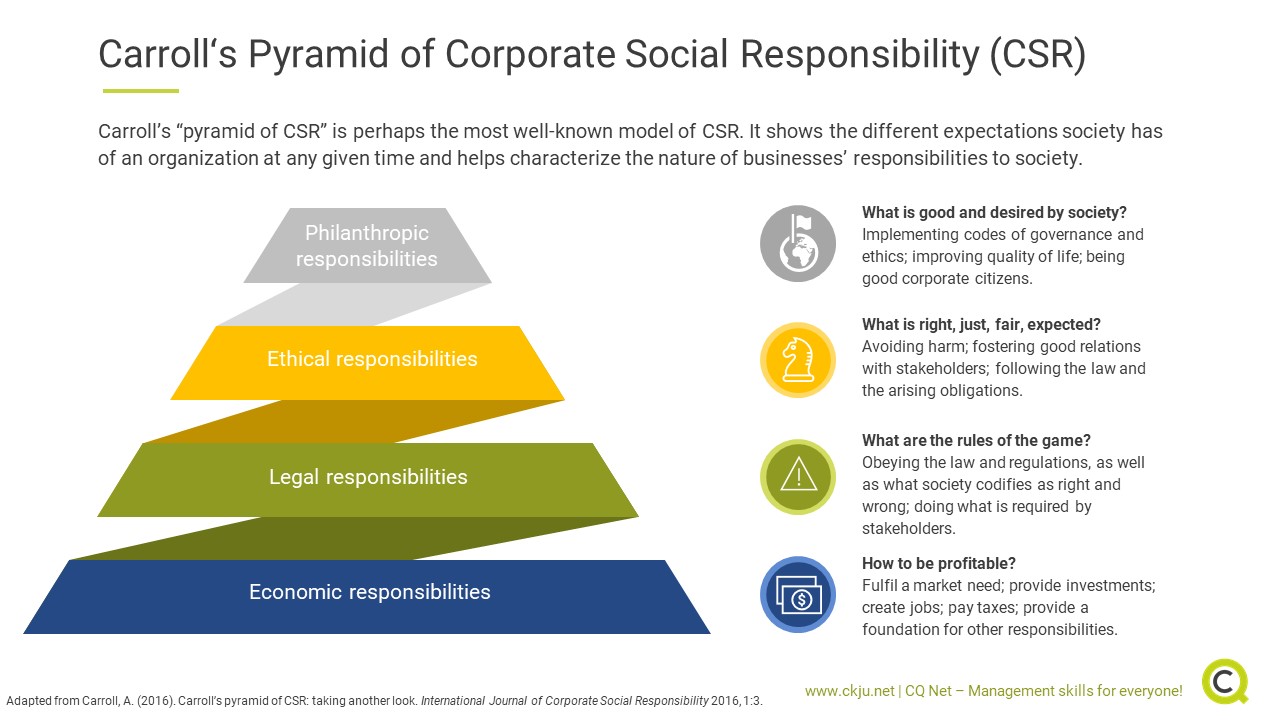
In their ideal form, balancing these responsibilities sees organizations acting profitably, obeying laws and obligations, and keeping in mind what is just and fair while being a good corporate citizen. Carroll posits that all businesses hold all four responsibilities, however choose to follow through with related obligations to varying extents. Adhering to this four-fold model and acknowledging that these responsibilities build on each other can help firms maximize profits, satisfy social values, and make contributions that improve societal welfare.
Incorporating CSR into strategy and practice helps yield internal and external benefits.
Indeed, a growing body of empirical literature on CSR shows that there are indeed benefits to acknowledging the top of Carroll’s pyramid and incorporating it into broader strategy. Research finds that firms see lower employee turnover, higher reputation, and improved customer satisfaction (Galbreath, 2010).
Nurn and Tang (2010) find that CSR leads to greater financial performance and helps firms attract better employees and operate at greater efficiency with lower operating costs. In addition, CSR can help employee motivation, trust, morale and commitment (see review by Siddique, 2015). Klará (2011) summarizes the benefits as:
In the commercial sector, CSR is considered a part of strategic planning for those companies that strive to be successful, that want to improve their reputation and especially those who want to be competitive. CSR is a competitive advantage for businesses, having as a source the intangible and human resources, and being executed by competences such as communication, management and corporate culture.
Which management practices help drive corporate social responsibility?
Tharp and Chadhury (2008) point out that a commitment to CSR can be integrated into any organization and supplement their goals, ending in a win-win situation. CSR thus becomes part of “organizational capital” and spans across operations, monitoring, targets, and incentives (Lev and Radhakrishnan, 2005). To align profit and philanthropy in practice, organizations can take small steps to embed social responsibility into overall mindset and organizational culture. This can help drive CSR in a consistent, determined, and all-encompassing manner and be a stepping stone for further steps.
Strengthening organizational capital and a culture of value.
Organizational capital plays an “intangible role in shaping corporate outcomes” (see Bloom and Van Reenen, 2007). In fact, having strong and good organizational capital can be a firm’s competitive advantage in that it is difficult to imitate, replace, or transfer (Martin-de-Castro et al., 2000).
In this vein, fostering a culture of value and commitment that underpins management, operations, incentives and monitoring activities alike is likely to boost productivity, commitment, and help create a sustainable mindset.
Often, a code of ethics can help guide relations within and outside the organization, reduce the risk ofirresponsible behaviour, and help avoid the appropriation of socially responsible commitments for personal gain (Green & Armstrong 2012).
Responsible management education helps foster profitable outcomes.
Ethical training can be conceived as a catalyst to establish socially and ethically managed organizations (Cornelius, Wallace & Tassabehji, 2007). There is ample evidence that management and leadership education matters, and that fostering such capacities is in turn likely to enhance sustainability outcomes (Jones & Kramer 2010). Business schools have long had the integration of “responsible management” into their curriculum to deviate from competition and profit-driven management.
Although this may still not be commonplace everywhere, it is widely established that having good management practices leads to improved social actions, and that management practices impact social outcomes (Attig & Cleary, 2014). Hence, leaders should take a pro-active approach towards getting informed about practices of leadership that help foster sustainable and authentic outcomes for employees, stakeholders, and leadership alike.
Reporting and transparency help identify risks and opportunities.
Practicing corporate social responsibility and a sustainable strategy also means communicating this well. Corporate social reports are a vital benchmark for accountability and help showcase economic data, as well as information about the environment and social field. With a growing number of companies worldwide using CSR reports, these can help boost reputation, authenticity and be a key component to a business’ stakeholder strategy. Indeed, Bouten et al. (2011) find that the most successful forms of CSR reporting generally include an interplay of three broad themes:
- vision and goals,
- management approach, and
- performance indicators.
These themes help organizations remain aware of advantages and disadvantages to strategy. Hence, they can help bring a systemic approach to management and also play a part in helping identify risks and opportunities for improvement (Moravcikova et al., 2015).
Creating shared value and establishing a shared vision with society can be part of any change-management strategy.
The methods above are a good starting point for embedding CSR into organizational culture and committing to socially responsible practices. This can be part of any change-management strategy and help organizations succeed on many levels.
Keeping in mind Carroll’s pyramid and that all organizations hold social responsibility to some extent, it is vital to remember that CSR should not be seen as an isolated practice or as a means to an end. Rather, it permeates organizational culture and is a thread running through operation, strategy and practice.
A fruitful way to view CSR in company practices is to understand it as creating shared value (Porter and Kramer, 2011). Firms should inherently not seek to act as charities, but take on practices (using their knowledge, resources and tools) to help create a shared vision with the society in which they operate.
Hence, CSR does not have to mean fundamentally re-aligning an organization’s goals. On the contrary, it means acknowledging the space in which business is being conducted and taking small steps towards responsibility in every action and practice.
There are several tools available that can help determine your company’s commitment to CSR: check out the assessment tool by CSR Europe, fill out the checklist for CSR and let us know how your organization did in the comments below!