
What is an organization? Ways to understand organizations and how they function
Contents
However, most of us take it for granted that organizations exist and don`t question what they are and how they work. As professionals we plan, organize, communicate, and manage on a daily basis assuming that we know how our activities impact the organization. This is a rather courageous approach which sometimes succeeds. In many cases however, we don`t achieve what we expected to achieve and don`t really understand why things didn`t work out as planned.
The very basis of navigating in an unknown environment is to make oneself comfortable with its characteristics. This inevitably leads to the questions what an organization is and how it works as the very foundation of any management intervention. Unfortunately, there is no simple answer to this question but a set of different ones. Depending on which one you choose, it provides you valuable insights into how organizations work.
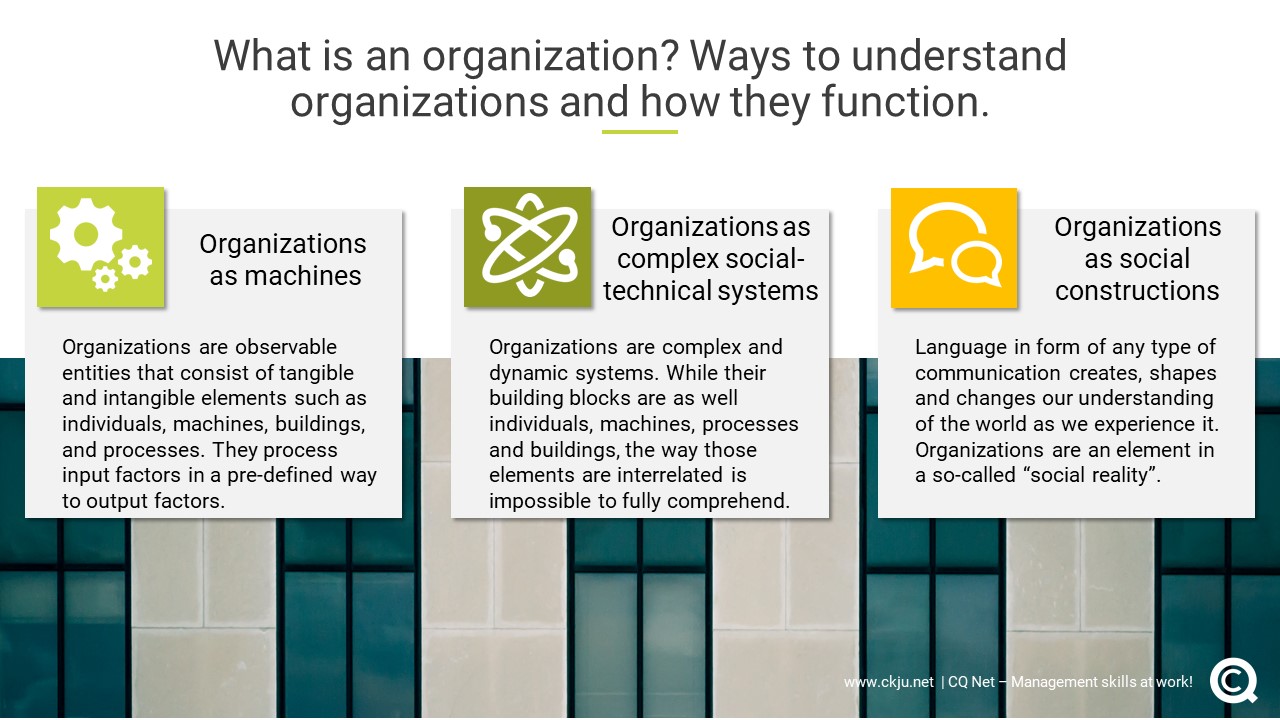
We will have a look at three different ways to understand organizations, what they are and how they work:
- Organizations as machines
- Organizations as complex social-technical systems
- Organizations as social constructions
Going through each of them we will address their characteristics and derive recommendations for professionals like you.
Organizations as machines
One of the most prominent ways to understand organizations is the so-called machine metaphor (Wiener, 1961). It is based on the understanding that organizations are observable entities that consist of tangible and intangible elements such as individuals, machines, buildings, and processes. Following this internal logic, organizations as machines process input factors in a pre-defined way to output factors.
As with any type of machine, organizations can be controlled and steered by pushing the right button and pulling the right lever. Thus, the organization’s reaction to any kind of management intervention is predictable and be planned upfront.
Examples of management interventions that rely on the machine metaphor include top-down driven financial planning processes, planned change initiatives, and traditional problem-solving activities.