The Language of Change Management: How Language Shapes Social Reality and Drives Change
Executive Summary
One of the most powerful tool to manage change is language. Depending on how you use it, language can enable, block or drive organizational change. While the role language plays in organizational change has not yet been fully recognized in the practical domain, the social sciences have started the so called linguistic turn years ago (Alvesson und Kärreman 2000). This Dossiers provides you an introduction into the role language plays in managing organizational change. In addition, the dossier summarizes evidence-based practices from research and theory on how you as a manager and professional can consciously use language to manage change.
Contents
- Executive Summary
- The rational approach to change has a poor track record
- Organizations consist of different social realities: Language shapes those realities
- Megadiscourses as resources of sensemaking, power and legitimation
- Microdiscourses as source of organizational (social) reality
- Discourses shape social reality but are also shaped by the way they are used
- Create new discourses & shape established discourses in a way that support your change rational
- Don’t let others step in to fill the vacuum of new discourses important for your change initiative
- Introducing, changing and shaping social realities takes time and patience
- Key take-aways
- References and further reading
The rational approach to change has a poor track record
Most managers act based on the assumption that an organization is a physical thing that can be changed from top-down by implementing a pre-defined plan. The plan is usually developed by senior management and reflects their understanding of where the organization should move in order to succeed. After this plan is cascaded from top to bottom into the organization, a change process is initiated and senior management expects the organization to develop into the desired direction. This rational approach to change utilizes language as tool to convey plans and manage deviations. An increasing track record of failed change initiatives has led both practitioners and scholars to question whether such a rather static and receipt-like approach to managing change can be successful (Smith und Graetz 2011).
Organizations consist of different social realities: Language shapes those realities
Recent insights from social sciences have brought to light a different understanding of language and how it shapes organizational change. This alternative approach is rooted in social constructivism and goes back to some early works in sociology (e.g. Berger und Luckmann (1967)). Social constructivism is built on the assumption that language constitutes or constructs social reality. This is in stark contrast to the paradigm underlying the rational change approach which assumes that there is one overarching and socially independent reality.
While this might sound strange at first glance, there are many empirical studies that support the claim that language plays a crucial role in shaping our perception ( Alvesson und Kärreman (2000), Butcher und Atkinson (2001)). As a consequence, the way you use language impacts the social reality in your organization and thus enables, blocks and drives organizational change. Of course, this understanding of language and change implies that it is not only you who has an impact on your organization’s change trajectory. Every single employee and even peoples and institutions outside of your organization can shape the dominant social reality of your organization (Buchanan und Dawson 2007). You are wondering how all this happens? We’ll have a look at some research behind it.
Megadiscourses as resources of sensemaking, power and legitimation
The driving force behind language and change is called discourse (Alvesson und Karreman 2016). The common understanding of discourse is some sort of dialogue. Social sciences go one step further and define discourse as a set of interrelated texts, pictures, videos or any other language conveying structure that gives meaning to an object or subject we refer to in conversations (Phillips und Hardy 2002).
For instance, “global warming” is a mega-discourse that conveys a specific meaning which relies on a variety of interrelated studies, texts, regulations, interviews and many other connected structures. However, “global warming” doesn’t convey a meaning by itself. It does have an impact only, if it is used in a specific context and conversation (Grant und Marshak 2011). Imagine you introduce a new policy in your organization to reduce greenhouse gases in order to contribute to the fight against global warming. By using the discourse “global warming” you draw on it as a resource of sensemaking, power and legitimation (Vaara und Tienari 2011) to give your efforts a specific meaning in the particular organizational context.
Microdiscourses as source of organizational (social) reality
When you analyze the discourses used in your organization you will recognize that there are many very specific narratives related to the industrial, social and cultural context your organization is operating in. Such micro-discourses could be related to products, services, projects or any other object or subject that has a meaning tied to it and thus is part of your organization’s reality.
Of course, micro-discourse can also develop to mega-discourses when they get enough change momentum and traction. Think of products and services that were invented years ago by small companies and have by now made its way into every organizations’ vocabulary.
Discourses shape social reality but are also shaped by the way they are used
Every time you draw on a discourse you utilize the meaning tied to it in the specific context. However, this is no one-way street. The way the discourse it utilized has an impact on the meaning tied to it. Think of a newly introduced product with severe quality flaws. In a worst case scenario the discourse connected to the product can significantly change to the negative. Your competitor could leverage the discourse as resource to damage your organization’s reputation.
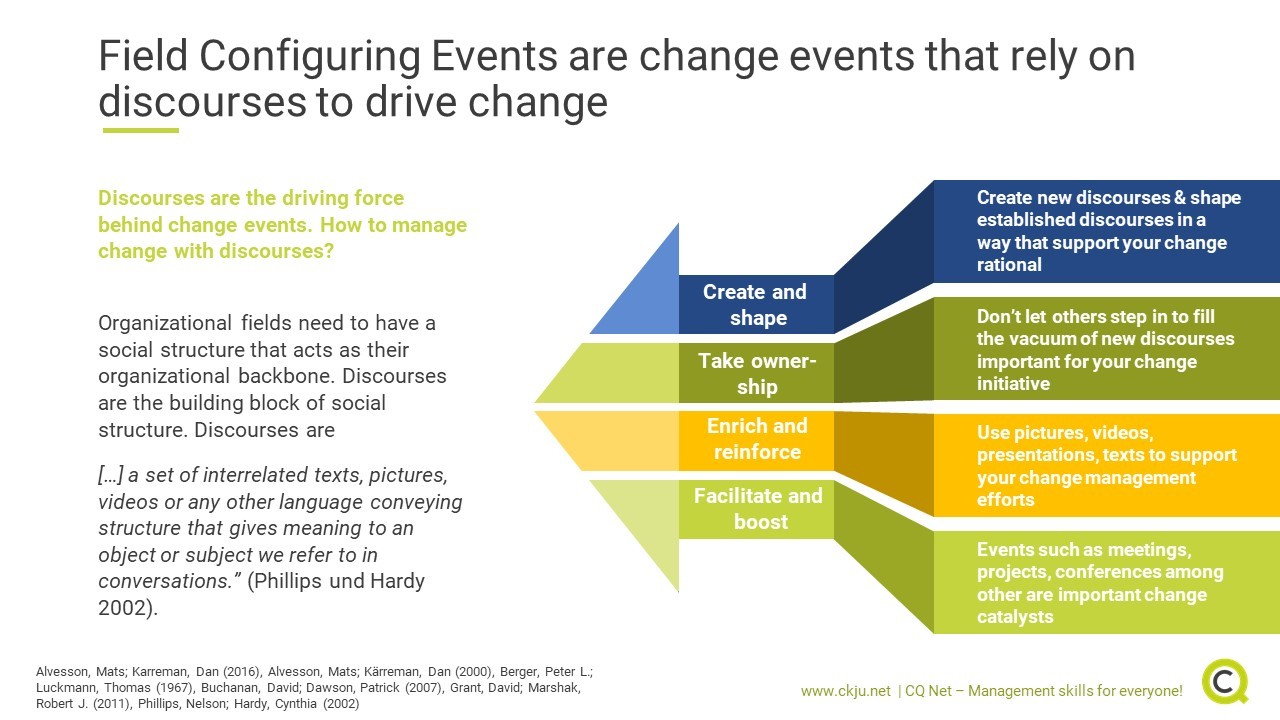
While it sounds appealing to use discourses as change management tool, it is not as easy do that as you might expect at first glance. The way discourses shape our social reality and the other way round is a dynamic, subtle and multifaceted process which cannot be tightly controlled in a rational manner (Hardy und Maguire 2010). However, there are certain principles you can follow that help you to successfully change your organizations social reality into the desired direction.
Create new discourses & shape established discourses in a way that support your change rational
When you want your organization to change in a specific direction search for established discourses that support your change rational. How does your change rational fit in your organization’s history? How does your change effort fit in your organization’s strategy? Of course, you can also introduce new discourses and connect them with your change rational in a positive manner. However, as mentioned earlier, you can think of discourses as a resource of sensemaking, power and legitimacy (Vaara und Tienari 2011). Thus, it is not easy to build a discourse that is broadly embedded into an organization’s social reality overnight.
Don’t let others step in to fill the vacuum of new discourses important for your change initiative
Change goes always hand in hand with uncertainty. As a consequence, you will be confronted with the challenge of making sense of a new situations, products, strategies or whatever is necessary to define the desired change outcome. When you don’t take the lead to fill the vacuum of new discourses important for your change initiative’s success, somebody else will do. This is even more important in times of social media and other means of easy and fast communication (Veil et al. 2012).
Introducing, changing and shaping social realities takes time and patience
Changing an organization’s social reality is a time and resource consuming task. Unless you have the privilege to be part of a startup which doesn’t have any established social reality (yet), you need to consistently repeat, relate and reframe the change discourse again and again. When you experience resistance think about how it is related to the overall picture:
- Which discourses are part of the narrative that counter your change initiative?
- How do they relate to each other?
- How can you embrace them by reframing your change discourse?
Finally, you will find yourself in a dynamic process of investigating which and how discourses are used in your organization and re-aligning the way you use them in order to support your change initiative.
Key take-aways
- Social constructivism assumes that language constitutes or constructs social reality
- The way you use language impacts the social reality in your organization and thus enables, blocks and drives organizational change
- Discourse are structures (texts, pictures, videos etc.) that give meaning to an object or subject we refer to in conversations
- Create new discourses & shape established discourses in a way that support your change rational
- Don’t let others step in to fill the vacuum of new discourses important for your change initiative
- Introducing, changing and shaping social realities takes time and patience
References and further reading
Alvesson, Mats; Karreman, Dan (2016): Varieties of Discourse. On the Study of Organizations through Discourse Analysis. In: Human Relations 53 (9), S. 1125–1149. DOI: 10.1177/0018726700539002.
Alvesson, Mats; Kärreman, Dan (2000): Taking the Linguistic Turn in Organizational Research. In: The Journal of Applied Behavioral Science 36 (2), S. 136–158. DOI: 10.1177/0021886300362002.
Berger, Peter L.; Luckmann, Thomas (1967): The Social Construction of Reality. A Treatise in the Sociology of Knowledge. New York: Random House.
Buchanan, David; Dawson, Patrick (2007): Discourse and Audience. Organizational Change as Multi-Story Process. In: J Management Studies 44 (5), S. 669–686. DOI: 10.1111/j.1467-6486.2006.00669.x.
Butcher, David; Atkinson, Sally (2001): Stealth, secrecy and subversion. The language of change. In: Journal of OrgChange Mgmt 14 (6), S. 554–569. DOI: 10.1108/eum0000000006142.
Grant, David; Marshak, Robert J. (2011): Toward a Discourse-Centered Understanding of Organizational Change. In: The Journal of Applied Behavioral Science 47 (2), S. 204–235. DOI: 10.1177/0021886310397612.
Hardy, Cynthia; Maguire, Steve (2010): Discourse, Field-Configuring Events, and Change in Organizations and Institutional Fields. Narratives of DDT and the Stockholm Convention. In: AMJ 53 (6), S. 1365–1392. DOI: 10.5465/AMJ.2010.57318384.
Phillips, Nelson; Hardy, Cynthia (2002): Discourse analysis. Investigating processes of social construction. Thousand Oaks, Calif.: Sage (Qualitative research methods, 50). Online verfügbar unter http://www.loc.gov/catdir/enhancements/fy0658/2002002730-d.html.
Smith, Aaron; Graetz, Fiona M. (2011): Philosophies of organizational change. Cheltenham: Elgar.
Vaara, Eero; Tienari, Janne (2011): On the Narrative Construction of Multinational Corporations. An Antenarrative Analysis of Legitimation and Resistance in a Cross-Border Merger. In: Organization Science 22 (2), S. 370–390. DOI: 10.1287/orsc.1100.0593.
Veil, Shari R.; Sellnow, Timothy L.; Petrun, Elizabeth L. (2012): Hoaxes and the Paradoxical Challenges of Restoring Legitimacy. In: Management Communication Quarterly 26 (2), S. 322–345. DOI: 10.1177/0893318911426685.