Leadership competencies and leadership competency models: What they are and why they matter

Executive summary
This CQ Dossier describes leadership competencies and why they are an important foundation for organizational effectiveness. The dossier draws on contemporary leadership models that describe the core competencies that are important across different organizations and settings. We describe some core models and also provide practical examples of leadership competencies profiles developed in different industries.
Contents
- Executive summary
- What are leadership competencies?
- Early leadership competency models
- Contemporary leadership competency models
- Examples of leadership competencies models
- Shortcomings of leadership competency models
- The future of leadership competencies model
- Conclusion
- Critical appraisal of leadership competency models: Solidity rating 4
- Key take-aways
- References and further reading
What are leadership competencies?
Leadership competencies represent a combined set of knowledge, skills, and abilities (KSA) that constitute effective leadership within an organization (Hollenbeck, McCall, & Silzer, 2006). There have been several attempts to generate a range of leadership competencies that are generalizable across industries and jobs.
Early leadership competency models
The idea of a leadership competency model originated from McClelland’s work in the 1960s on what constituted an effective manager. This first step towards leadership competencies was further augmented by the American Management Association’s push in the 1980s to distinguish effective from ineffective management in behavioral and performance terms.
Efforts to identify and measure leadership competencies are part of a broader trend towards a competency-based management approach. Many organizations have started to develop competency models they use for selection, assessment and development activities.
The two main models also focused on behavioral and performance terms of effective management and are described below.
Boyatzis's leadership competency model
One of the earliest models was developed by Boyatzis (1982) who identified 19 competencies that aligned with effective leadership. This competency model showed the following five clusters (Boyatzis, 1982):
- goal and action management,
- leadership,
- human resource management,
- focus on others, and
- directing subordinates.
Sparrow's leadership competency model
A later model developed by Sparrow (1997) identified management competence and behavioral competencies of effective managers. Both these models identified competencies at the individual level yet Sparrow (1997) also introduced the organizational competency or strategic competency with a focus on practices that lead to organizational innovation.
Sparrow (1997) describes organizational competency as a characteristic that evolved from the behaviors of the individuals within the organization, so it is an organizational level competency rather than an individual competency. This validates the notion that context also plays a role in determining which competencies are the most important (Sparrow, 1997).
Contemporary leadership competency models
Contemporary leadership competency models have moved away from the simplistic notion that aggregated KSAs denote leadership competency. Today’s competency models appreciate the complexity of organizational life and how both situational and individual differences factors can attenuate or increase the effectiveness of leadership competencies.
The models also strive to include factors at multiple levels and utilized science-based evidence to construct the models. This section describes some key models that offer a contemporary approach.
Leadership competencies based on self self-determination theory
A recent model of leadership competencies is also useful and derived from well-established scientific principles because it incorporates self-determination theory into the model (Fowler, Zigarmi, Roberts & Shuck, 2018). The model posits that leaders need to nurture their subordinates’ basic psychological needs including autonomy, relatedness, and competence (Deci & Ryan, 2002).
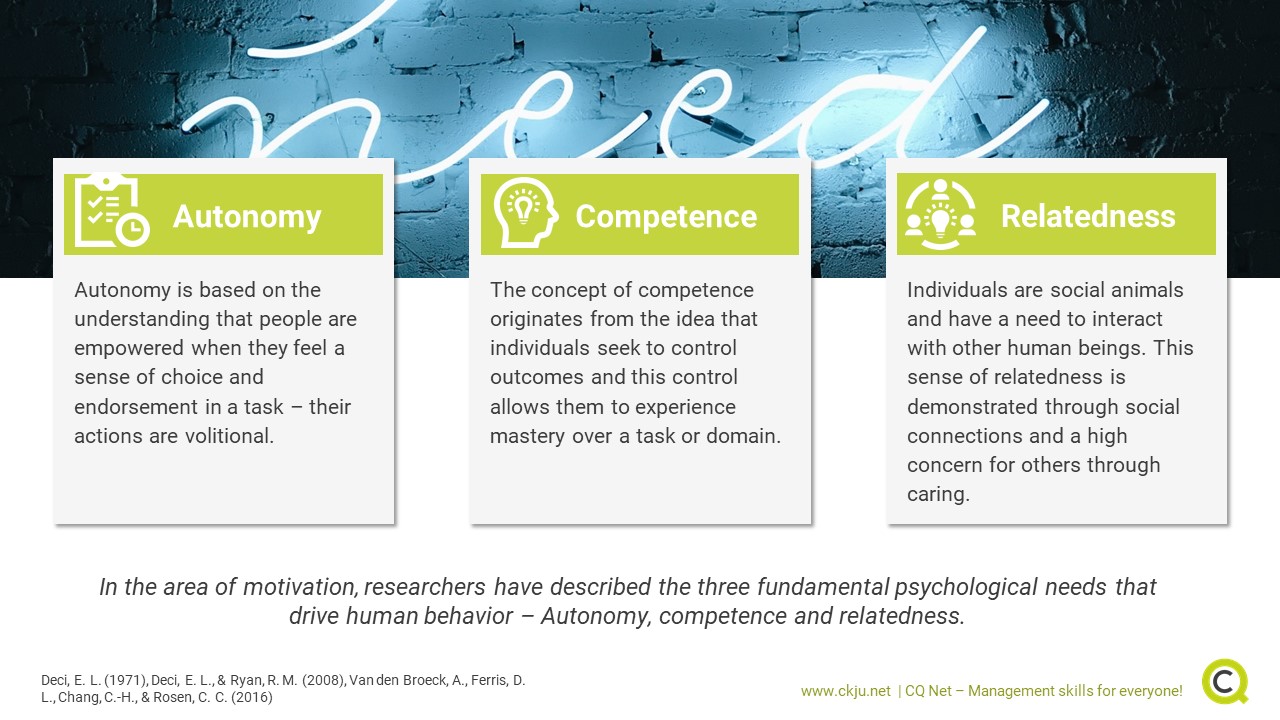
Leaders show competence in autonomy when they encourage their subordinates to realize that they have choices and their behavior is under their own control. Leaders who allow autonomy are less likely demand accountability or apply pressure (Deci & Ryan, 2002).
When leaders show relatedness, they show their subordinates that they care about their contribution to the team and sustain connectedness (Deci & Ryan, 2002).
Effective leaders also make their employees feel competent through encouraging them to demonstrate their skills and allowing them to grow and flourish (Deci & Ryan, 2002).
Leadership strataplex model
The Leadership strataplex model is a multi-level model and includes skill requirements that are layered (strata) and segmented (plex), leading to the name of strataplex (Mumford, Campion, & Morgeson, 2007). The model consists of the following leadership skill requirements:
- cognitive skills,
- interpersonal skills,
- business skills, and
- strategic skills.
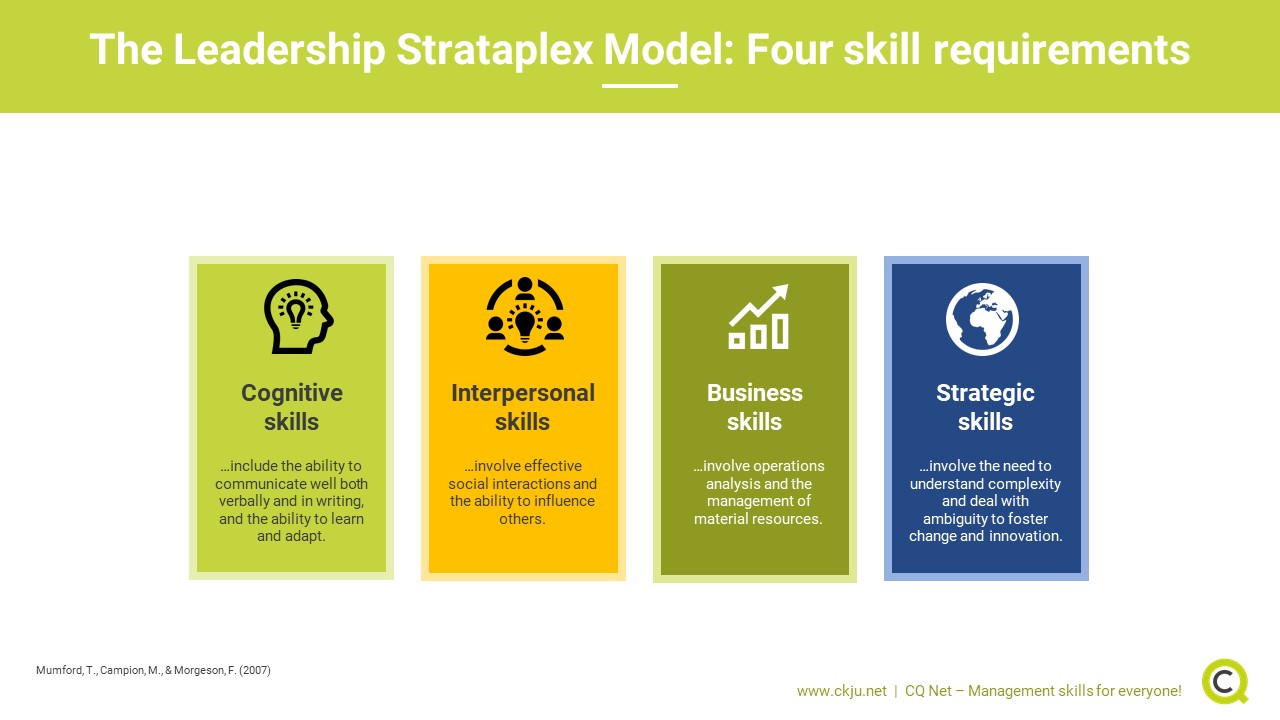
Cognitive skills include the ability to communicate well both verbally and in writing, and the ability to learn and adapt.
Interpersonal skills involve effective social interactions and the ability to influence others.
Business skills involved operations analysis and the management of material resources (Mumford et al., 2007).
Moreover, leadership positions at higher levels of the organization required strategic skills that were most important for organizational effectiveness (Mumford et al., 2007). Strategic skills requirements are required at the higher level because leaders need to understand complexity and deal with ambiguity to foster change and innovation.
They tested the model in a sample of 1,000 junior, midlevel, and senior managers (Mumford et al., 2007) and found support for the strata portion of the model with different categories of leader requirements being important at different organizational levels.
Examples of leadership competencies models
There are several examples of leadership competencies models. Most organizations have modified existing competency frameworks to fit their context. We will have a look at the Health Leadership Competency Model (HLCM) and the University of Wollongong competency model.
Health Leadership Competency Model (HLCM)
One such model is the Health Leadership Competency Model (HLCM) which is an evidence-based model across healthcare professions (Calhoun et al., 2010). The model was based on characteristics that distinguished effective or outstanding leadership from satisfactory performance and included three key areas:
- transformation,
- execution, and
- people.
Within each of these three main areas, there are 18 behavioral and eight technical competencies. The HLCM is “scaled” to delineate the performance required from entry-level to senior positions within the healthcare industry.
For example, for the behavioral competency accountability differentiates the following five levels (Calhoun et al., 2010):
- Level 1: requires individuals to communicate requirements and expectations;
- Level 2: the individual sets limits;
- Level 3: the individual demands high performance;
- Level 4: the individual confronts performance problems and for
- Level 5: the individual creates a culture of responsibility.
The HLCM was derived through a mixture of behavioral observation, competency research and modeling methods, mainly derived from Boyatzis’ earlier competency model. The HLCM is also useful for those seeking a career in the healthcare industry because it outlines those competencies that are needed across a wide range of jobs (Calhoun et al., 2010).
University of Wollongong competency model
Another leadership competency example can be found at the University of Wollongong, Australia that adopted an integrated approach to leadership competency development within the library system (Jantti & Greenhaigh, 2012). The university recruited a consultant to assist with the UOW Library’s leadership crisis and utilized the Lominger Leadership competencies model.
The college developed measurable characteristics related to workplace success to develop an effective leadership profile. In developing the profile, the university conducted interviews and also provided professional coaching and in-house assignments so that employees gained the leadership competencies (Jantti & Greenhaigh, 2012). The leadership competencies model included (Jantti & Greenhaigh, 2012):
- managing vision and mission,
- political savvy,
- strategic agility,
- business acumen,
- developing others, and
- negotiating.
The model was successful in providing 360-degree performance feedback to staff, and in increasing leader self-efficacy and performance after the review.
Shortcomings of leadership competency models
There have been several criticisms of leadership competency models.
First, the competency model paradigm still focuses on individual characteristics that constitute an effective leader and tends to ignore situational factors that increase leader effectiveness (Hollenbeck et al., 2006).
Second, there is scant evidence that leadership competency models actually work in practice and that senior leaders who have these competencies are more effective than other senior leaders (Hollenbeck et al., 2006).
Most of the evidence for competency models is based on selection and training at lower levels of the organization where a competency-based approach appears to work (Hollenbeck et al., 2006).
The future of leadership competencies model
Due to rapid changes in technology and the global economy, leadership competencies will need to be dynamic in order to capture the new paradigm of boundary-less careers (Toppo & Fernandez, 2010). In the last three decades, there has been a shift from traditional work, whereby individuals stay with an organization for an extended period of time to a landscape that promotes changing career paths (Toppo & Fernandez, 2010).
The ideal boundaryless organization emphasizes ideas, information, decisions, and action rather than focusing on the separation of employees and tasks (Toppo & Fernandez, 2010). Based on this concept of a boundaryless organization, professionals can build models that promote “free movement of ideas, information, decision, talent, rewards and actions” across internal and external boundaries (Toppo & Fernandez, 2010).
Conclusion
Overall, leadership competencies models are effective in capturing those main qualities that are required in leadership positions. Moreover, leadership competencies cut across industries and job roles so are important in helping organizations create HR strategies to select, train, and promote employees.
Critical appraisal of leadership competency models: Solidity rating 4
Based on the empirical evidence for the evidence of leadership competency models as important tools for organizations, this dossier is assigned a Level 4 rating, (Based on a 1- 5 measurement scale). A level 4 is the second highest rating score for a dossier based on the evidence demonstrating that Leadership Competency Models are an effective way for organizations to determine the KSAs required for a wide range of positions. However, more research is needed to determine the relationship between leadership competency models and organizational effectiveness.
Key take-aways
- Leadership competencies are sets of KSAs thatconstitute effective leadership
- Key Leadership competencies models focus on action management, consideration for others, and directing subordinates
- Leadership Competencies models identify managerial and behavioral competencies
- Leadership competencies are demonstrated at the individual and organizational level
- Contemporary models acknowledge the importance of empowering employees through self-determination.
- The Leadership Strataplex model is multilevel and includes cognitive, interpersonal, business, and strategic skills.
- Effective leadership models are evidence-based and include a variety of methods to validate the model.
References and further reading
Boyatzis, R.E. (1982) The Competent Manager: a model for effective performance. New York: Wiley.
Calhoun, J., Dollett, L., Sinioris, M., Wainio, J., Butler, P., Griffith, J., & Warden, Gail. (2010). Development of an Interprofessional Competency Model for Healthcare Leadership. Journal of Healthcare Management. American College of Healthcare Executives, 53, 375-89
Deci, E. L., & Ryan, R. M. (2002). Handbook of self-determination research. Rochester, NY: University of Rochester Press.
Fowler, S., Zigarmi, T., Roberts, P., & Shuck, B (2018). Toward a New Curriculum of Leadership Competencies: Advances in Motivation Science Call for Rethinking Leadership Development. Advances in Developing Human Resources 20, 2, 182-96.
Hollenbeck, G. P., McCall, M. W. & Silzer, R. F. (2006) Leadership competency models, The Leadership Quarterly, 17, 4, 398–413.
Jantti, M. & Greenhalgh, N. (2012) Leadership competencies: a reference point for development and evaluation', Library Management, vol. 33, no. 6, pp. 421-428.
Mumford, T., Campion, M., & Morgeson, F. (2007). The leadership skills strataplex: Leadership skill requirements across organizational levels. The Leadership Quarterly, 18, 154-166.
Sparrow, P. (1997) Organisational competencies: creating a strategic behavioural framework for selection and assessment. In N. Anderson and P. Herriot (Eds) International Handbook of Selection and Assessment. Chichester: John Wiley.
Toppo, S., & Fernandez, A. (2010). Global Leadership Competencies: A Review and Discussion. Journal of Contemporary Management Research, 4, 1, 1-10.