
Executive summary
Creativity and innovative problem-solving must be cultivated within an organization. While productive, useful idea-generation does require a degree of structure, and even deadlines, a truly innovative organization provides its employees with room to explore, pursue novel approaches, and even fail (Ciit, 2016). More rigid and risk-averse organizations, in contrast, are more likely to stifle creativity, and may leave team members with the impression that only flawless, highly actionable, low-impact ideas are welcome at the table. In this CQ Dossier we provide you some guidance on how to foster innovative thinking and promote innovation in your organization.
Contents
- Executive summary
- Crafting organizational culture that fosters true creativity
- Promote innovative thinking by fostering organizational warmth
- Failure tolerance and ambiguity tolerance is key to foster innovative thinking
- Stimulate innovative thinking with a long term orientation
- Key take-aways
- References and further readings
Crafting organizational culture that fosters true creativity
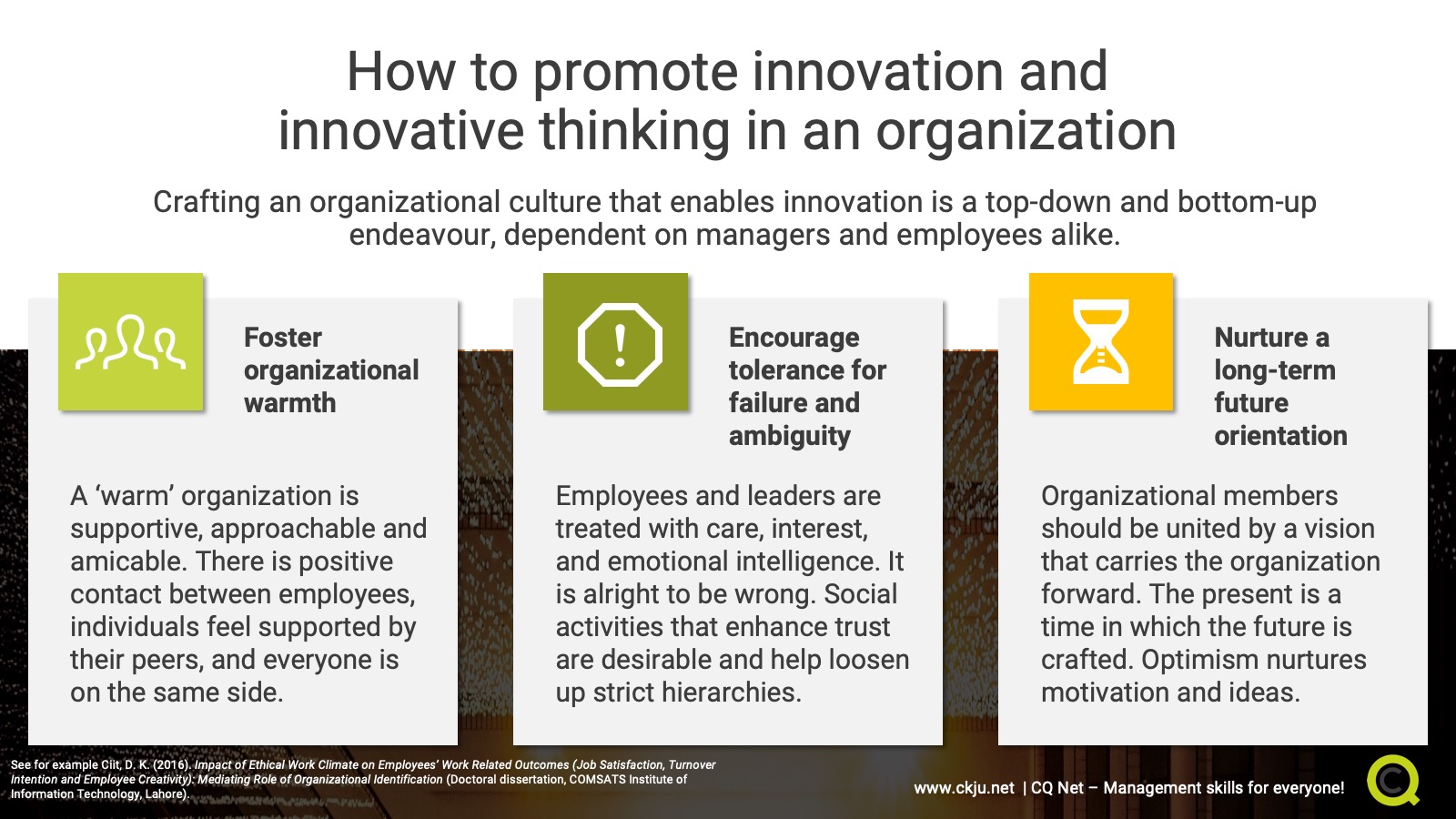
As member of an organization, regardless of manager or employee, you must take responsibility for influencing your organization’s culture, to create a workplace that is both comfortable and challenging, in which everyone is free to produce big ideas that may, sometimes, fail. Crafting an organizational culture that fosters true creativity can be a big challenge – and it will typically require steps from both the top-down and bottom-up level. Ultimately, however, industrial-organizational research has identified the main elements of organizational culture you should target, if you wish to foster innovative thinking and foster innovation:
- organizational warmth,
- tolerance for failure and ambiguity,
- and a long-term future orientation.
Promote innovative thinking by fostering organizational warmth
What is the “temperature” of your organization or workplace? Psychologists define an organization’s warmth or coldness in terms of how supportive, approachable, and amiable its employees feel about one another and the company as a whole (Hashim, Ishak, & Hilmi, 2017). A “cold” organization is one where individuals may be highly competent, but they are also incredibly serious, even withdrawn. Cold organizations can be productive, organized, and highly formal – but coldness does not engender creativity.
“Warm” organizations feature frequent, positive social contact between employees
To make your organization one where team members feel collaborative and creative, foster a warm temperature. “Warm” organizations feature frequent, positive social contact between employees. Individuals feel supported by those around them – they may even feel as though management and administration is “on their side” and “rooting for them to succeed” (Hashim, Ishak, & Hilmi, 2017). Warm organizations help employees form bonds, by creating social opportunities in the workplace, and by having a reasonable tolerance for conversation, play, and energy. In this climate, individuals feel free to discuss emotions, personal details, and unusual, challenging ideas (Bagheri et al, 2016).
Promote innovative thinking by cultivating an organization’s warmth
While it is important to maintain boundaries and make sure the work place doesn’t become excessively informal, warmth is generally a major promoter of innovation. Most organizations, however, rank as far too “cold” to cultivate real, forward-thinking creativity. You can improve warmth by treating your co-workers and peers with emotional intelligence, care, and interest (Maamari & Majdalani, 2017).
- Read up on, and practice, emotional mirroring and active listening skills, and model those skills for your employees.
- Allow yourself to be more emotionally expressive, if needed;
- Engage in an appropriate amount of self-disclosure (sharing of personal details and feelings), and permit team members to do the same.
- Promote organizational warmth by providing employees with opportunities to socialize and relax (Cuadra-Peralta, et al, 2017).
Optional team retreats and parties can help individuals bond, and can lead to the development of new ideas. Take these team-building opportunities out of the workplace, so that there is less pressure to behave in a restricted, professional way. For social activities such as an escape room, trivia night, or organizational sports team, appoint someone relatively low in the organization to a position of leadership, such as team captain – this helps reduce employees’ sense of the organization having an hierarchy, and can help increase communication and comfort for all (Lu, 2016).
Finally, make sure that opportunities to relax and socialize do not feel like an added work duty – ‘structured play’, when not implemented well, can place additional time demands on an employee and make them feel less comfortable.
Failure tolerance and ambiguity tolerance is key to foster innovative thinking
Generating innovative proposals is a process with a high signal-to-noise ratio. Even among unbridled, deeply creative teams, many ideas will prove impractical or destined for failure. In an organization that cultivates creativity, failure is tolerated and seen as part of the cost of doing novel, challenging work (Hutchinson-Krupat & Chao, 2014). When employees are afraid to fail, they will tend to freeze up, or refuse to share anything but highly conventional, low-risk ideas – both of these things are toxic for creativity.
Model patience and acceptance, reflect upon failure
To make your organization one that tolerates failure, everyone must model patience and acceptance. When an implemented change does not succeed, reflect upon what was learned, express gratitude for the aspects of the process that were beneficial, and do not place blame (Custodio, Ferreira, & Matos, 2017). Do not demonstrate anger, resentment, or fear in the face of disappointment. Mindful reflection upon failure can also be beneficial in these instances – plan meetings where team members are allowed to reflect upon the creative failure, and grant them time to express their own frustrations (while putting a stop to any finger-pointing or blame).
Frame ambiguous problems as chance for something new
In addition to accepting failure, a creative organization must have a degree of comfort with ambiguous problems that have no clear solution. True innovation, after all, tends to hinge upon finding problems that others have not yet recognized, or casting existing problems in a new light. Many people find uncertainty to be deeply threatening; they may deploy detachment or black-and-white thinking to cope with that discomfort. These processes are not amenable to finding provocative, impactful solutions.
Encourage your team to confront ambiguity and uncertainty head-on
You should encourage your team to confront ambiguity and uncertainty head-on. Make it clear that you do not expect individuals to deliver tidy solutions or quick results – instead, adopt a process orientation, where the quality of the work being done is more important than the immediate results themselves (Chen, Leung, & Evans, 2016).
Encourage tenacity
Encourage tenacity; use motivating statements that make it clear that it’s the search for a solution that is vital. Evaluate performance, when possible, in terms of how effective a team member is at adapting and collaborating with others, not how many problems they have tidily solved (Zhai et al, 2018).
Stimulate innovative thinking with a long term orientation
Most organizations have five- or ten-year plans. In practice, however, many organizations operate with attention solely focused on the present and the short-term future. More attention is devoted to immediate problems – fires that must be put out – rather than long-term development. The fiscal bottom-line may be watched carefully, and any disappointments may be seen as a deep threat to the organization’s continued existence.
This fearful, short-term focused approach is common, but it does little to stimulate or encourage innovative thinkers. If you wish to create a workplace environment where people can present risky, paradigm-shifting approaches, it is immensely beneficial to adopt and encourage a future-focused orientation (Ozkaya et al, 2015).
Cultivate a future orientation
Innovative, paradigm-challenging organizations truly look to the future. They can withstand a few quarters of loss or struggle, knowing that the ultimate pay-off will be worth it. Members of the organization, especially those in leadership, have a vision – they are not just hopping from crisis to crisis, they are carrying the organization forward. To an innovative team, the future is a long, massive expansive ripe with untold possibility. The present is merely a time when that future is being carefully, gradually crafted. Inspiring leaders help to promote this kind of outlook by openly engaging in hopeful, abstract, long-term thinking (Wiesenfeld et al, 2017).
Foster organizational optimism
To orient your organization toward the future, high and promote employees who are promotion-focused (Wallace et al, 2016); people who are motivated to grow their careers and take bold steps forward, rather than motivated by avoiding negative outcomes or reducing the impact of crises. Foster organizational optimism – not by silencing dissenting views or unhappiness, but by truly expecting the best of employees and the organization itself (Chang & Teng, 2017).
Offer continuing education benefits
On a practical level, you can (and should) offer employees numerous opportunities to develop new skills, learn new facts, and be stimulated. Offer continuing education benefits, if possible, and be truly encouraging of employees pursuing their true interests (Davies et al, 2014). Provide the organization with seminars, optional workshops, and other opportunities to learn about a wide array of topics. A monthly book club, with free books provided to members, can also help employees grow their knowledge and feel like vital investments in their organization’s future (Fernandez-Mesa & Alegre, 2015).
Involve employees into your thought process
In everyday management activities, let employees into your thought process and share more information with them than is strictly vital. These steps increase employees’ investment in the organization’s success, and leave them looking toward the big-picture future, which can nourish a forward-thinking, deeply innovative mindset.
Key take-aways
- Innovative organizations are warm, tolerant of failure & ambiguity, and future-oriented.
- Create warmth by being emotionally present with your employees, and by providing them with genuine opportunities to bond and relax.
- Create tolerance of failure & ambiguity by practicing mindful reflection about disappointment, and by evaluating performance in terms of process, not output.
- Create a future-orientation by giving employees opportunities to grow, learn, and be stimulated, and by taking a long, optimistic view of an organization.
Management skills newsletter
Join our monthly newsletter to receive management tips, tricks and insights directly into your inbox!
References and further readings
Bagheri, R., Yarjanli, M., Mowlanapour, R., & Mahdinasab, N. (2016). Examining the Relationship between organizational Climate and Entrepreneurship with regard to Staff’s Locus of Control in Industry Companies in Iran. International Journal of Humanities and Cultural Studies (IJHCS) ISSN 2356-5926, 677-693.
Chang, J. H., & Teng, C. C. (2017). Intrinsic or extrinsic motivations for hospitality employees’ creativity: The moderating role of organization-level regulatory focus. International Journal of Hospitality Management, 60, 133-141.
Chen, J., Leung, W. S., & Evans, K. P. (2016). Are employee-friendly workplaces conducive to innovation?. Journal of Corporate Finance, 40, 61-79.
Ciit, D. K. (2016). Impact of Ethical Work Climate on Employees’ Work Related Outcomes (Job Satisfaction, Turnover Intention and Employee Creativity): Mediating Role of Organizational Identification (Doctoral dissertation, COMSATS Institute of Information Technology, Lahore).
Cuadra-Peralta, A. A., Veloso-Besio, C., Iribaren, J., & Pinto, R. (2017). Intervention for supervisors, based on social skills and leadership, in order to improve organizational climate perception and organizational performance outcomes. Journal of Organizational Change Management, 30(2), 281-292.
Custodio, C., Ferreira, M. A., & Matos, P. (2017). Do general managerial skills spur innovation?. Management Science.
Davies, D., Jindal-Snape, D., Digby, R., Howe, A., Collier, C., & Hay, P. (2014). The roles and development needs of teachers to promote creativity: A systematic review of literature. Teaching and Teacher Education, 41, 34-41.
Fernández-Mesa, A., & Alegre, J. (2015). Entrepreneurial orientation and export intensity: Examining the interplay of organizational learning and innovation. International Business Review, 24(1), 148-156.
Hashim, H., Ishak, N. A., & Hilmi, Z. A. G. (2017). Job Embeddedness and Organizational Climate. Asian Journal of Quality of Life, 2(6), 31-42.
Hutchison‐Krupat, J., & Chao, R. O. (2014). Tolerance for failure and incentives for collaborative innovation. Production and Operations Management, 23(8), 1265-1285.
Lu, Z. (2016). How Does Organizational Power Affect Organization Perceptions? (Doctoral dissertation, Pennsylvania State University).
Maamari, B. E., & Majdalani, J. F. (2017). Emotional intelligence, leadership style and organizational climate. International Journal of Organizational Analysis, 25(2), 327-345.
Ozkaya, H. E., Droge, C., Hult, G. T. M., Calantone, R., & Ozkaya, E. (2015). Market orientation, knowledge competence, and innovation. International Journal of Research in Marketing, 32(3), 309-318.
Wallace, J. C., Butts, M. M., Johnson, P. D., Stevens, F. G., & Smith, M. B. (2016). A multilevel model of employee innovation: Understanding the effects of regulatory focus, thriving, and employee involvement climate. Journal of Management, 42(4), 982-1004.
Wiesenfeld, B. M., Reyt, J. N., Brockner, J., & Trope, Y. (2017). Construal level theory in organizational research. Annual Review of Organizational Psychology and Organizational Behavior, 4, 367-400.
Zhai, Y. M., Sun, W. Q., Tsai, S. B., Wang, Z., Zhao, Y., & Chen, Q. (2018). An Empirical Study on Entrepreneurial Orientation, Absorptive Capacity, and SMEs’ Innovation Performance: A Sustainable Perspective. Sustainability, 10(2), 314.