Agile for all: The principles of agility, agile leadership, and how to be an agile leader

Executive summary
This CQ Dossier focuses on agile leadership, the principles underpinning it, and ways to implement agile leadership in practice. Concretely, the focus is put on the concept of agility and on ten principles of agile leadership that can benefit the navigation of complex environments. The Dossier describes how agility leadership ties into organizational practice relating to leadership, teamwork, processes and strategic tools, and describes which methods can be used to reap benefits and keep on top of the challenges associated with agility - for employers and employees alike.
Contents
- Executive summary
- The foundation of agile leadership is agility
- Agility is a tool of choice for navigating the VUCA environment
- What is agile leadership?
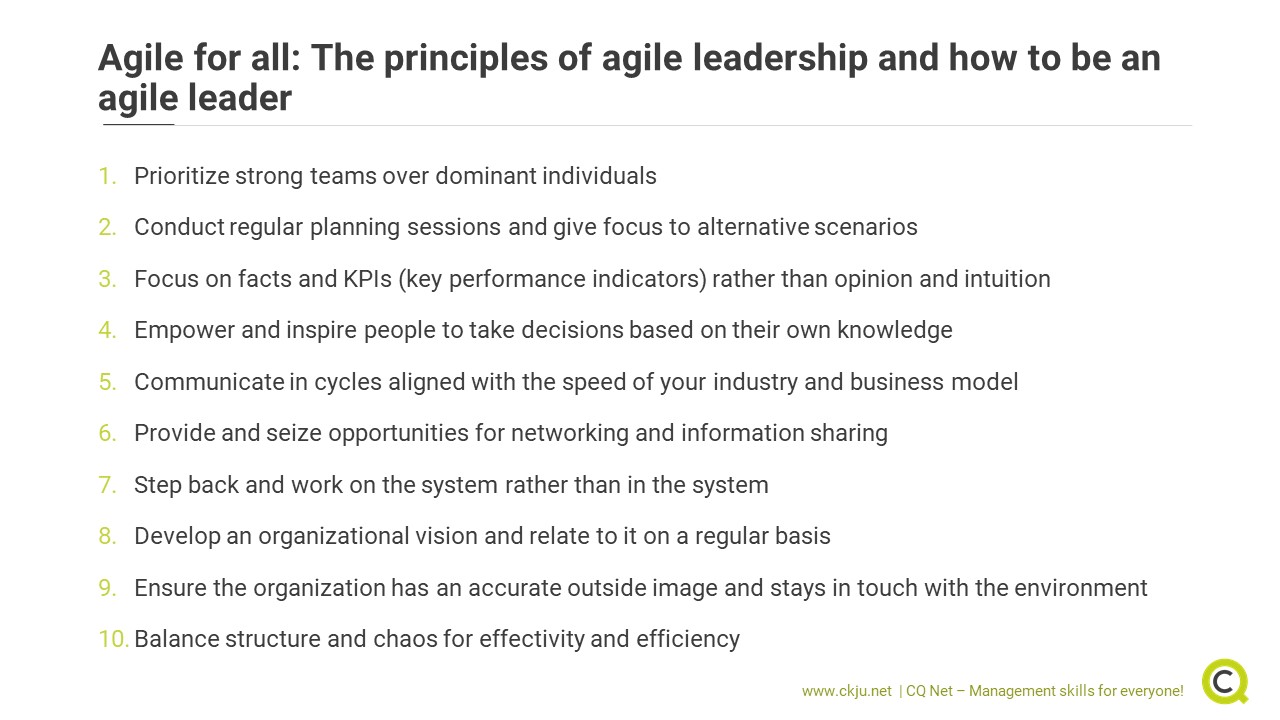
- Agile leadership consists of ten principles that help achieve organizational goals
- Prioritize strong teams over dominant individuals
- Conduct regular planning sessions and give focus to alternative scenarios
- Focus on facts and KPIs (key performance indicators) rather than opinion and intuition
- Empower and inspire people to take decisions based on their own knowledge
- Communicate in cycles aligned with the speed of your industry and business model
- Provide and seize opportunities for networking and information sharing
- Step back and work on the system rather than in the system
- Develop an organizational vision or strategy and relate to it on a regular basis
- Ensure the organization has an accurate outside image and stays in touch with the environment
- Balance structure and chaos for effectivity and efficiency
- Agile leadership principles are key to competitiveness
- What do an agile approach and agile leadership look like in practice?
- Critical appraisal of agile leadership: Holistic concept
- Key take-aways
- References and further reading
The foundation of agile leadership is agility
In its’ core, agility is a decision-making and decision-implementation framework. Although agility has become a buzzword in the past few years, the concept has been used for decades in various contexts. Originally stemming from evolutionary biology, it is a way to refer to a survival mechanism or technique for living organisms. In this sense, it is best described using one of two examples: the OODA-loop, developed by military strategist John Boyd in 1987.
OODA stands for
-
- Observe
- Orient
- Decide
- Act
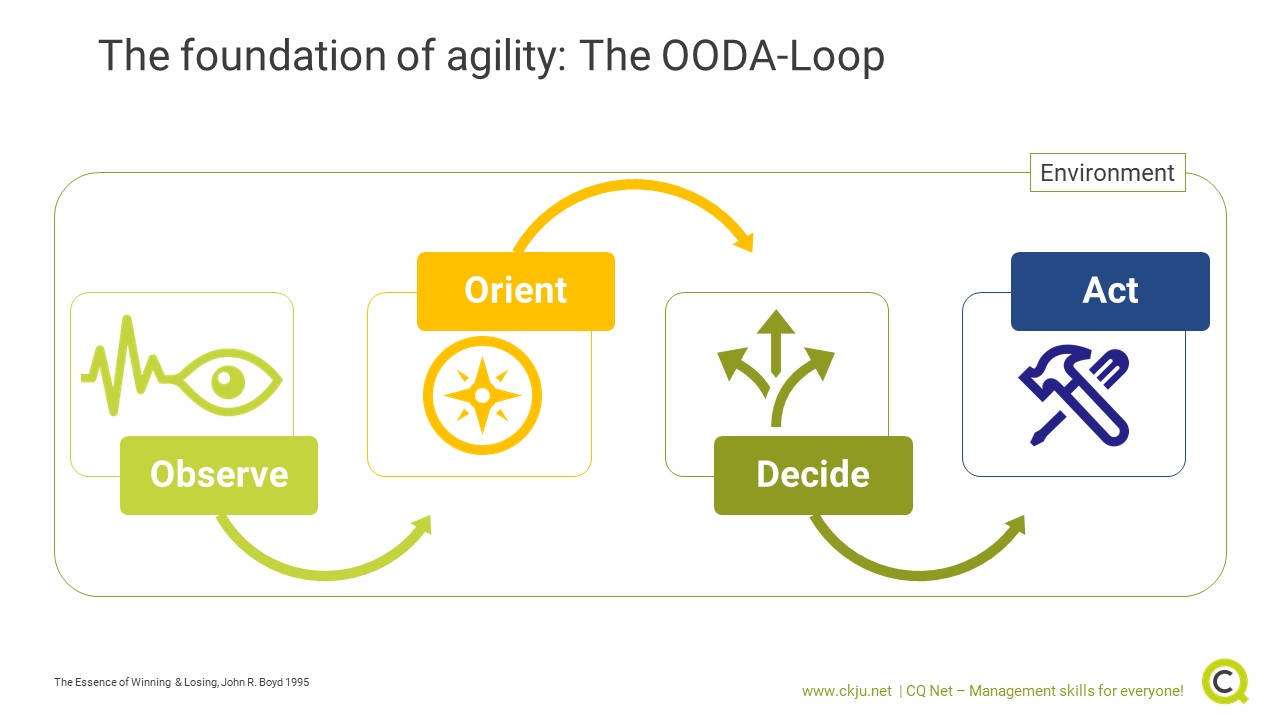
In this sense, agility is the ability or technique to be aware of one’s surroundings (Observe), to align with them (Orient), to make a decision on how to act (Decide), and to act (Act). This cycle is repeated until the desired effect has been achieved.
Agility is a tool of choice for navigating the VUCA environment
Agile principles have long been present in military strategies and are understood as getting into and intercepting the decision-making cycle of the enemy - this has the effect of leaving the enemy in chaos and turmoil. Beyond the military application, agility soon found its way into organizational contexts as well (see Osinga, 2007)
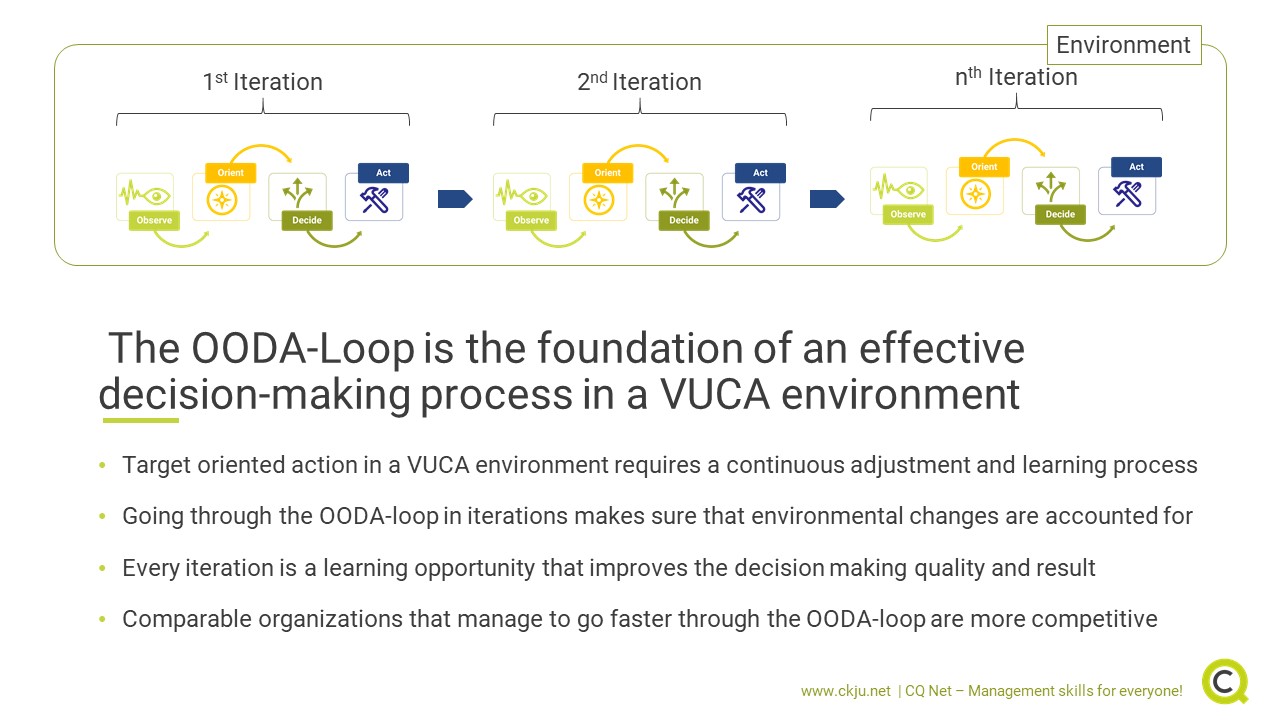
In organizational settings, agility has become a tool of choice to succeed in complex and uncertain environments. VUCA environments, that is environments that are volatile, uncertain, chaotic and ambiguous (Bennett & Lemoine, 2014), are characterized by being unpredictable and thereby necessitating adaptive, flexible approaches and interventions to muster them. Due to its dynamic nature, agility is particularly useful in organizations operating in VUCA settings:
-
- Target oriented action in a VUCA environment requires a continuous adjustment and learning process
- Going through the OODA-loop in iterations makes sure that environmental changes are accounted for
- Every iteration is a learning opportunity that improves the decision making quality and result
- Comparable organizations that manage to go faster through the OODA-loop are more competitive
What is agile leadership?
Keeping in mind the OODA-loop agile leadership is about building a high-performance team or organization that applies agile principles in its processes, structures and people development activities to increase competitiveness.
This form of leadership is not a traditional leadership approach on its own. Rather, it is a supplementary tool or extension to leadership approaches that are rooted in organizational psychology, including transformational leadership, trait-based leadership, and complexity leadership.
Agile leadership has an effect on two levels: the structural and the behavioral level:
- On the structural level, agile leadership affects processes, roles, responsibilities, key performance indicators (KPIs) and so on.
- On the behavioral level, it refers to specific actions taken by leaders in certain situations, that are underpinned by particular mindsets and abilities.
Taken together, structural and behavioral components mutually reinforce each other and culminate in a leadership tool that extends its influence on the entire organization.
In this sense, agile leadership is a holistic concept that acts as guidance for a team or organization to achieve outcomes that are tailored to the VUCA environment or situation. This is becoming ever-more necessary to deal with a changing business environment (Lipman-Blumen, 2000; Joiner, 2009).
Agile leadership consists of ten principles that help achieve organizational goals
Literature on agility is plentiful, however there is very little research covering how agility and agile capabilities can be developed (see Appelbaum et al., 2017). Taking into account the structural and behavioral components of agile leadership, there are several key aspects in organizational practice that can benefit from agile leadership tools and methods. These range from leadership style and managerial decisions to communication cycle and organizational culture and values.
[embed_view name="product_link" arg="37096, Learn how to increase organizational agility in our
Masterclass on the foundations of agility, agile leadership and how to implement it"]
Most of all, however, they relate to the person who leads in an agile way: an agile leader is flexible, not afraid to step out of their comfort zone, and is not afraid to deal with complexity or uncertainty. An agile leader is someone whose credibility it not dependent on knowledge or status, but who becomes credible through their mindset and skillset (see McPherson, 2016). In this sense, everyone can be an agile leader in their own right.
Prioritize strong teams over dominant individuals
As previously mentioned, agile leadership prioritizes the importance of teams to implement agile strategies and tools. Effective teams are groups that achieve high levels of both task performance and human resource maintenance (Parker, Holesgrove & Pathak, 2015: 115). There is ample evidence that shows teams are more beneficial for organizational performance than individual high-performers.
Teams have many benefits, ranging from heightened creativity and a safe environment for innovation to more diverse outcomes. Research shows teams, in particular self-organized teams, are more productive than non-teams (Moravec, 1999).
Conduct regular planning sessions and give focus to alternative scenarios
Regardless of how well teams work internally, it is crucial to hold regular meetings and to set goals for the outcomes of these meetings. Outcomes, however well-planned and thought-through, meetings should always hold room for alternative outcomes and consider a variety of scenarios: in a VUCA world, all parameters can never be known at all times and therefore, there can be multiple equally correct solutions to a problem.
In common agile practices organizations tend to use, including Scrum, Kanban or Design Thinking, regular planning sessions are necessary to maintain a trial-and-error attitude and to consistently re-align expectations and goals (Zerfuss et al., 2018)
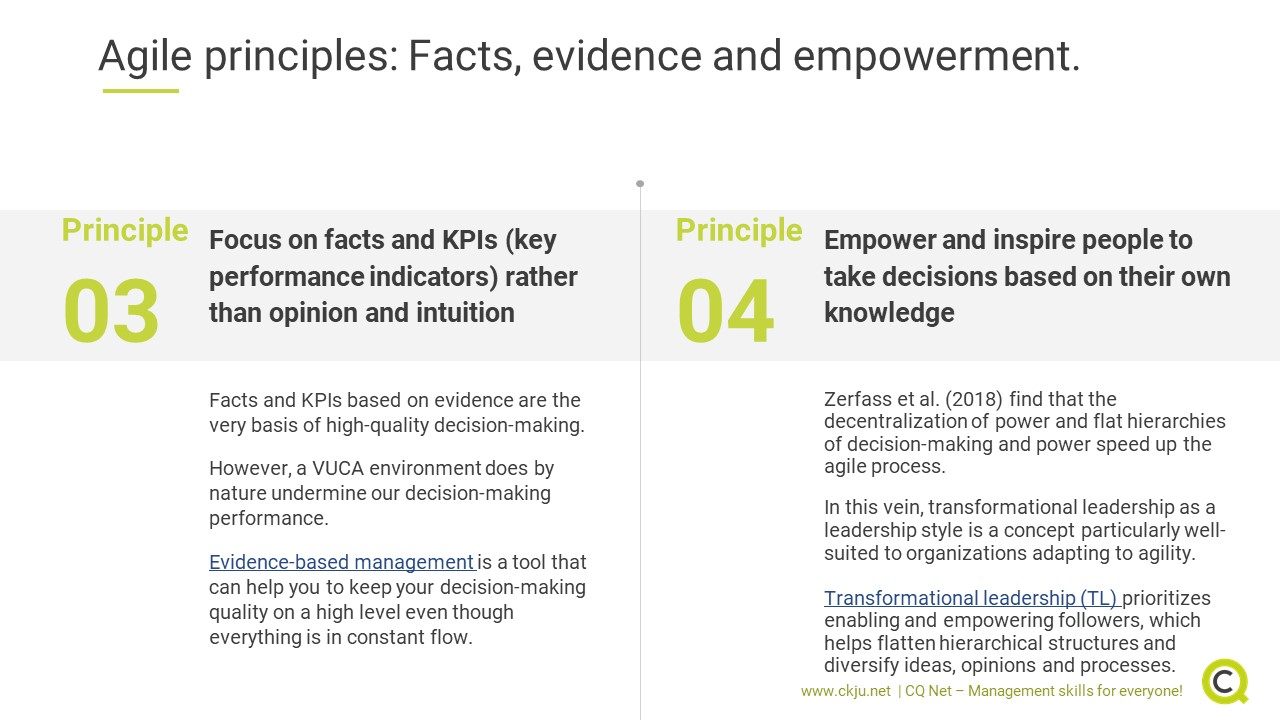
Focus on facts and KPIs (key performance indicators) rather than opinion and intuition
Zerfass et al. (2018) point out that using KPIs may be more difficult in a non-traditional and interconnected environment, precisely because such indicators are static and the VUCA environment is dynamic. However, KPIs can nonetheless be useful in developing new and innovative processes for change.
KPIs that are rooted in evidence, for example evidence on productivity, organizational output, employee satisfaction or similar, help put into perspective and set boundaries for organizational developments by defining objectives and results. On the one hand, this helps measure success, what works and what doesn’t work.
On the other hand, there may be many equally right approaches to reach these objectives and results, so KPIs can help establish new routes for innovation and flexibility.
Empower and inspire people to take decisions based on their own knowledge
Evidence rooted in organizational psychology-based leadership models show that leaders who enable followers to be autonomous, self-determined and free in their thoughts are successful in capturing their followers. These are characteristics that are known to improve employee satisfaction, which in turn is a prerequisite for fostering agile capabilities (Appelbaum et al., 2017).
Zerfass et al. (2018) find that the decentralization of power and flat hierarchies of decision-making and power speed up the agile process. In this vein, transformational leadership as a leadership style is a concept particularly well-suited to organizations adapting to agility in the VUCA environment: transformational leadership prioritises enabling and empowering followers, which helps flatten hierarchical structures and diversify ideas, opinions and processes.
Communicate in cycles aligned with the speed of your industry and business model
Every organization and every industry is different. Research conducted by Zerfass et al. (2018) found that a commitment to agility opens up new opportunities for communication processes that can benefit the organization as a whole. Agile communication is short-cycled, meaning that long communication cycles are avoided and replaced by smaller, regular cycles among teams that allow for re-alignment and re-adjusting.
Seeing as agility became particularly popular in the IT sector, it is crucial to consider the positive role technology can have in helping this communication: Indeed, Crocitto and Youssef (2003) point out that using technology in agile organizations facilitates interpersonal communication and helps streamline work-flows.
Provide and seize opportunities for networking and information sharing
Companies with a healthy organizational culture, which is also characterized by healthy communication and opportunities for exchange and growth, perform better than organizations without. The sharing of information is directly related to teams on the one hand, and short communication cycles on the other. Technology, as previously mentioned, can ease networking efforts through knowledge or project management platforms that encourage collaboration (Zerfass et al., 2018). At the same time, providing open physical work places and physical room for exchange and collaboration is beneficial to organizational outcomes. This is very much in line with the idea behind nudging management.
Step back and work on the system rather than in the system
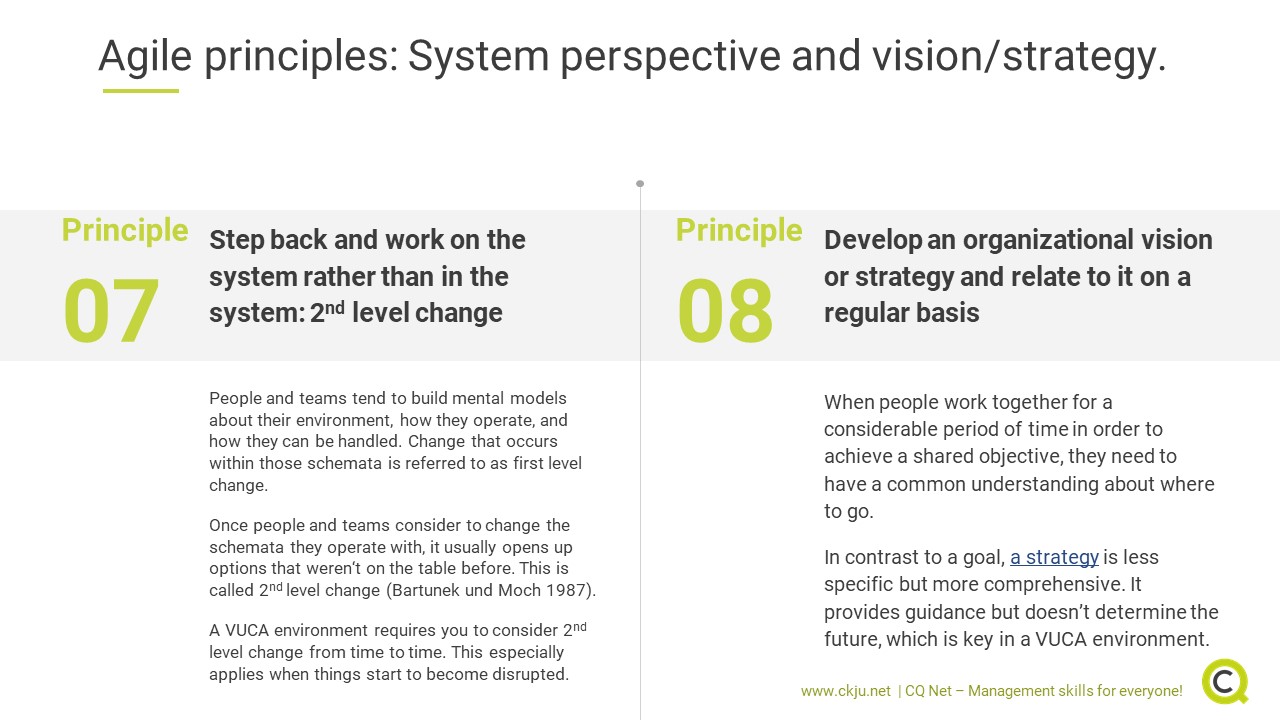
Sometimes, you cannot see the forest because there are too many trees. Similarly, in organizations an outside perspective can work wonders for innovation and performance. Preiss et al. (1996) found that for organizations to build agility, stakeholders must understand the business environment and the changes taking place there.
Therefore, a constant focus towards what is happening inside an organization and its processes is only helpful to a certain extent: Appelbaum et al. (2017) point out that agility implies that organizations can adapt to external changes and the VUCA world. In this sense, to ensure that internal group dynamics that skew critical thinking are avoided (like groupthink or an echo chamber), an external perspective from external stakeholders should always be considered to ensure diversity of thought.
Develop an organizational vision or strategy and relate to it on a regular basis
Any organization needs a strategy and a vision to determine its path and to help establish a shared objective and intention - for people inside and outside the organization to relate to it, this vision or strategy needs to be clearly set, carefully developed (and adapted!) and be a red thread that goes through every process, activity and communication.
A strong culture of values helps not only employees and internal stakeholders understand and commit, but is also helpful for external stakeholders to clearly position an organization and to enrich it with useful feedback and input. Vision is crucial to organizational agility, as amidst chaos, it is easy to lose perspective and direction.
Ensure the organization has an accurate outside image and stays in touch with the environment
When portraying the face of your organization to the outside world, consistency and committing to living the values the organization stands for are key. While a vision helps guide organizations and stakeholders within and outside it, the image dictates how the organization is perceived and what expectations are ascribed to it. Establishing and maintaining an image should always consider what is happening in the environment surrounding the organization. While remaining in touch with gatekeepers and outside happenings, organizations can align whilst remaining serious and trustworthy. This can have advantages: consider the example of sustainability, an issue of major global concern.
According to Muja et al. (2014), committing to a vision that includes sustainability elevates companies from “doing” sustainable things to “being” sustainable as a whole. In doing so, organizations are automatically committed to staying on top of change, in line with global developments and newly arising needs and demands of consumers and stakeholders (Gallo, 2010). Yet, no matter the extent of adaptation within this, the outside image stays upright and helps maintain realistic expectations.
Balance structure and chaos for effectivity and efficiency
Agility means creating change on the one hand, and being able to respond to it on the other. Agile leadership principles are a great example showcasing that structure and chaos are not mutually exclusive. Quite the contrary: chaos can give birth to strength and flexibility, and it is a strength of organizations and stakeholders to understand, embrace, and adapt to chaos.
Structure on the other hand can help set parameters of what is possible and expected, and provide a playing field for agile leadership. Complexity theory states that innovation truly takes place where structure and chaos meet - this is particularly true in the business world (see Tsoukas, 1998) . Therefore, in a VUCA world, organizations that are open to constant change and re-evaluation whilst remaining true to their vision and values will be effective and efficient.
Agile leadership principles are key to competitiveness
Agile leadership principles help navigate the VUCA world. They provide a set of holistic practices that embrace an ever-changing (business) environment. At the same time, they are broad tools and strategies that can be practiced by stakeholders inside and outside of leadership positions. Not only are these strategies necessary in the current day and age, they also highlight practices and evidence-based insights that have circulated in organizational research for many years. In this sense, they tie together somewhat “alternative”, non-hierarchical and non-traditional organizational approaches that require flexibility, adaptation and “out-of-the-box” thinking to retain organizational success in the 21st century. To quote Zhang and Sharifi (2007 in Wahyono, 2018), this can be conceived as a new, agile paradigm altogether:
“Organizational agility is a cornerstone of competitiveness and it can be advocated as the business paradigm of the twenty-first century and the dominant vehicle for competition”.
What do an agile approach and agile leadership look like in practice?
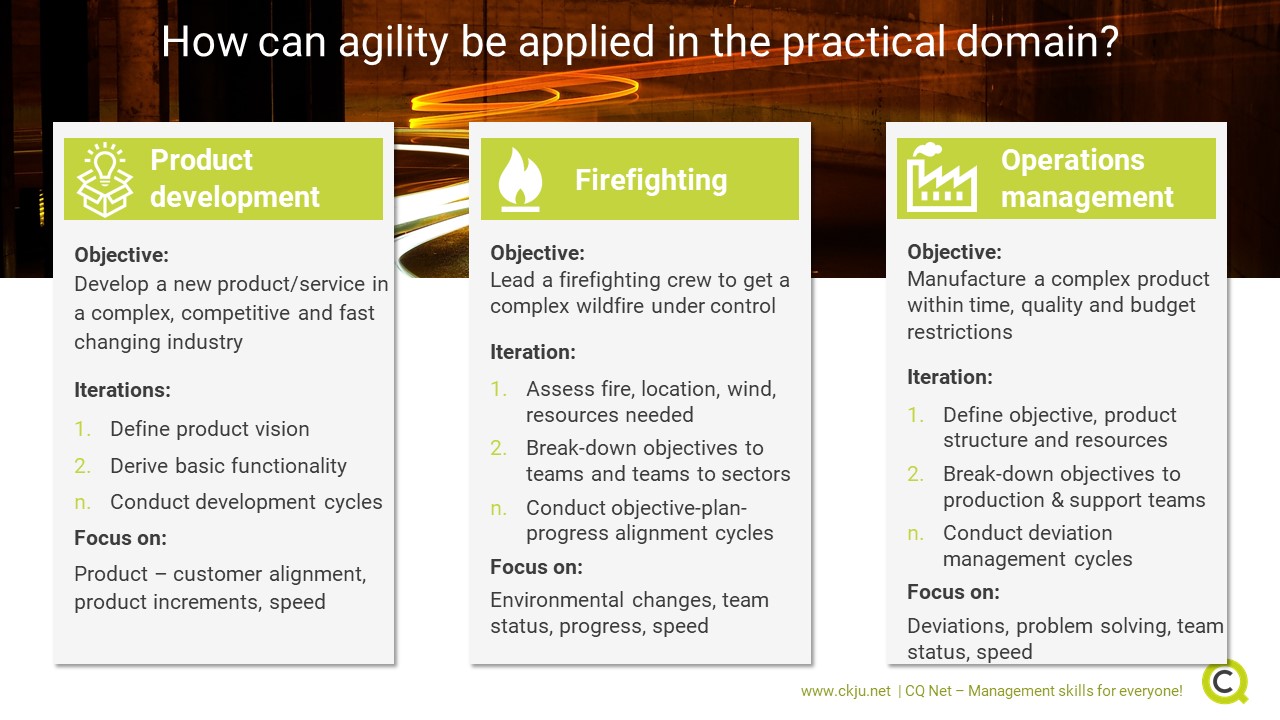
Having gone through the foundation of agility and the principles of agile leadership, the question arises how both concepts can be applied in practice. We have prepared three practical examples on what agility could look like in practice.
Agility in product development
One of the best-known areas of application of agility is product development. Agile frameworks such as SCRUM and Kanban have become the de-facto standard in software development and have started to get attention in other product development areas as well.
In line with the OODA-loop, agile product development is conducted in iterations also called Sprints in the SCRUM framework. After every iteration, a new or adjusted product increment is available and aligned with customer expectations. As a consequence, the risk of a detachment of the product and the environment (represented by the customer or product owner) is minimized and the speed to market is increased.
Agility in fire-fighting and the military
Complex natural distasters such as wildfires usually unfold in an way that is best described by the VUCA concept introduced earlier. This makes an agile approach the only viable choice to manage such a situation in an effective way. It all starts with an assessment of the fire, location, environmental factors (e.g. weather) and the resources needed to achieve the desired objective.
In a second iteration the objective is broken down to teams. Every team starts the OODA-loop again for the specific sector it is assigned to, derives a plan how to best achieve the objective, implements appropriate actions, and evaluates its achievements.
Changes of the environment and input from other teams and the overall leadership are continuously fed into the OODA-loop the team is going through again and again until the objective is reached. The same approach is applied in the military domain as well.
Agility in operations management
Operations is another area where agility can add value. This especially applies when the task is to manufacture a complex product within a challenging budget, time and quality restrictions. On a structural level, agility in operations requires a team-oriented manufacturing structure. A set of Key Performance Indicators (KPIs) provides the team with an almost real-time status of the manufacturing progress and deviations.
In line with the OODA-loop, every team is in charge to monitor its manufacturing progress in accordance with the team specific objectives on a regular basis. For instance, this can be achieved in daily deviation management cycles. Once a deviation is identified, the team starts a problem-solving process until the root cause is found and mitigated.
Critical appraisal of agile leadership: Holistic concept
Agile leadership is a rather broad concept that covers a wide range of evidence-based practices such as team mental models, goal setting, effective communication, transformational and complexity leadership. As a consequence, there is no single Solidity Level that can be assigned to agile leadership. However, most of the concepts and theories underlying agile leadership have a sound empirical basis which makes agile leadership a holistic concept that can be considered as having a positive impact on organizational performance when implemented in the right way.
Key take-aways
- The VUCA world and environment merit people with an agile mindset and skillset
- Using the holistic tools and strategies of agile leadership helps organizational outcomes
- Anyone can be an agile leader and commit to ten principles of agile leadership:
- Strong terms perform better and are more innovative than individuals
- Regular planning sessions help re-evaluate and re-align goals and outcomes
- KPIs provide the frameworks for measuring success and new ways to achieve goals
- Transformational leaders are particularly well-suited for agile development due to their enablement and empowerment of followers
- Short-cycle communication aided by technology helps stay in the loop
- Networking and information sharing should be fostered to maintain a culture of regular and fruitful exchange
- External perspectives help avoid an organizational echo chamber of ideas
- A strong organizational vision is the red thread that ties together all processe
- The outside image helps set expectations and boundaries
- Balancing structure and chaos is the true recipe for innovation in the 21st century
References and further reading
Appelbaum, Steven & Calla, Rafael & Desautels, Dany & Hasan, Lisa. (2017). The challenges of organizational agility: part 2. Industrial and Commercial Training, Vol. 49, pp 69-74.
Bennett, N. & Lemoine, J.G. (2014). What a difference a word makes: Understanding threats to performance in a VUCA world. Business Horizons, Vol. 57 ,No. 3, pp 311-317.
Bartunek, Jean M.; Moch, Michael K. (1987): First-Order, Second-Order, and Third-Order Change and Organization Development Interventions: A Cognitive Approach. In: The Journal of Applied Behavioral Science 23 (4), S. 483–500.
Crocitto, M., & Youssef, M.A. (2003). The human side of organizational agility. Industrial Management and Data Systems, 103, pp 388-397.
Gallo, P.J. (2010). See the Good, Speak the Good, Do the Good: Three Essays on Organizational Change for Sustainability. University of North Carolina, Chapel Hill, NC.
Hesselberg, J. (2018). Unlocking Agility: An Insider’s Guide to Agile Enterprise Transformation. Addison Wesley.
Joiner, B. (2009). Guide to Agile leadership. Industrial Management, Vol. 51 No. 2, pp 10-15.
Lipman-Blumen, J. (2000). Connective Leadership: Managing in a Changing World. Oxford University Press, London.
McPherson, B. (2016). Agile, adaptive leaders. Human Resource Management International Digest, Vol. 24 No. 2, pp 1-3.
Moravec, M. (1999). Self-managed teams. Executive Excellence, Vol. 16 No. 10.
Muja, N., Appelbaum, S.H., Walker, T., Ramadan, S. and Sodeyi, T. (2014). Sustainability and organizational transformation: putting the cart before the horse? (Part one). Industrial and Commercial Training, Vol. 46 No. 5, pp 249-56.
Osinga, F. (2007). Science, Strategy and War: The Strategic Theory of John Boyd. Routledge.
Parker, D. W., Holesgrove, M., & Pathak, R. (2015). Improving productivity with self-organised teams and agile leadership. International Journal of Productivity and Performance Management, Vol. 64 No. 1, 112-128.
Tsoukas, H. (1998). Introduction: Chaos, Complexity and Organization Theory. Organization, Vol.5 No. 3, pp 291–313.
Wahyono, W. (2018). A conceptual framework of strategy, action and performance dimensions of organizational agility development. Industrial and Commercial Training, Vol. 50 No. 6, pp.326-341.
Zerfass, A., Dühring, L., Berger, K., & Brockhaus, J. (2018). Fast and flexible. Corporate communications in agile organizations (Communication Insights, Issue 5). Leipzig, Germany: Academic Society for Management & Communication.