
Closing the Loop from deviation detection to resolution with effective business performance management
Contents
- Why do performance deviations often remain unresolved?
- What effective deviation management software should enable?
- Why do corrective actions fail to deliver lasting improvement?
- How deviation management software strengthens organisational control?
- Where AI support fits into business performance management?
- Building a closed-loop approach to continuous improvement
- Conclusion
- References and further reading
When business performance deviates from expectations, leadership teams rarely lack information. KPIs reveal the gap, reports highlight affected areas, and review meetings examine the numbers. Yet the same deviations can persist across reporting cycles despite repeated discussions and improvement commitments. The challenge is much different than simply identifying underperformance; it is translating that insight into accountable action and measurable improvement.
Effective business performance management therefore requires a closed-loop approach that connects performance monitoring with investigation, corrective action, and follow-up. This reflects the emphasis on linking performance measures to strategic objectives and management action (Kaplan & Norton, 1996; OECD, 2020).
A deep understanding of how a deviation management software supports this process can help executives move beyond reporting results and towards addressing the underlying conditions that shape organisational performance.
Why do performance deviations often remain unresolved?
A performance deviation occurs when actual results move away from an expected target, standard, or trajectory. Its significance depends not only on the size of the gap but also on its causes, potential consequences, and relationship with wider business objectives.
Consider an organisation whose delivery reliability falls below target for three consecutive reporting periods. The KPI is visible, the issue is discussed, and the operations team is asked to improve performance. However, delivery reliability remains low. The underlying constraint may involve supplier dependencies, production capacity, resource allocation, or decisions that have not been made in time.
The metric identifies the outcome, but it does not automatically explain the cause or determine the appropriate response. Root cause analysis is intended to move investigation beyond symptoms towards the factors contributing to a problem (ASQ, n.d.).
Performance measurement research reinforces the importance of connecting indicators with strategic objectives and the drivers behind business outcomes. In their work on the Balanced Scorecard, Kaplan and Norton (1996) argue that performance measures should be linked to strategy and to the relationships between outcomes and the activities that influence them.
Several organisational weaknesses can create a persistent gap between detecting a deviation and resolving it. Clear accountability and timely, decision-useful performance information are also emphasised in performance-monitoring guidance (OECD, 2020):
- Fragmented ownership: Multiple departments contribute to the outcome, but no individual is accountable for coordinating the response.
- Incomplete investigation: Teams respond to the visible symptom without examining the contributing factors.
- Unclear corrective actions: Improvement commitments lack a defined owner, deadline, or measurable intended result.
- Disconnected information: Performance indicators, project updates, and action lists sit in separate systems, making progress difficult to assess.
- Insufficient follow-up: Actions are marked complete without checking whether the intervention improved performance.
- For CEOs, CFOs, COOs, and transformation leaders, these weaknesses are more than operational inconveniences. Repeated deviations can affect financial results, strategic execution, customer commitments, and resource allocation.
The OECD's guidance on monitoring performance similarly emphasises the importance of aligning indicators with objectives, supporting accountability, and producing timely information for decision-makers (OECD, 2020). Although this framework addresses public governance, the underlying principle also applies to business: performance information should support decisions, not simply document results.
The implication is straightforward: performance visibility creates value only when it informs a management response. Without a structured process for acting on deviations, organisations risk becoming better at documenting problems than resolving them.
What effective deviation management software should enable?
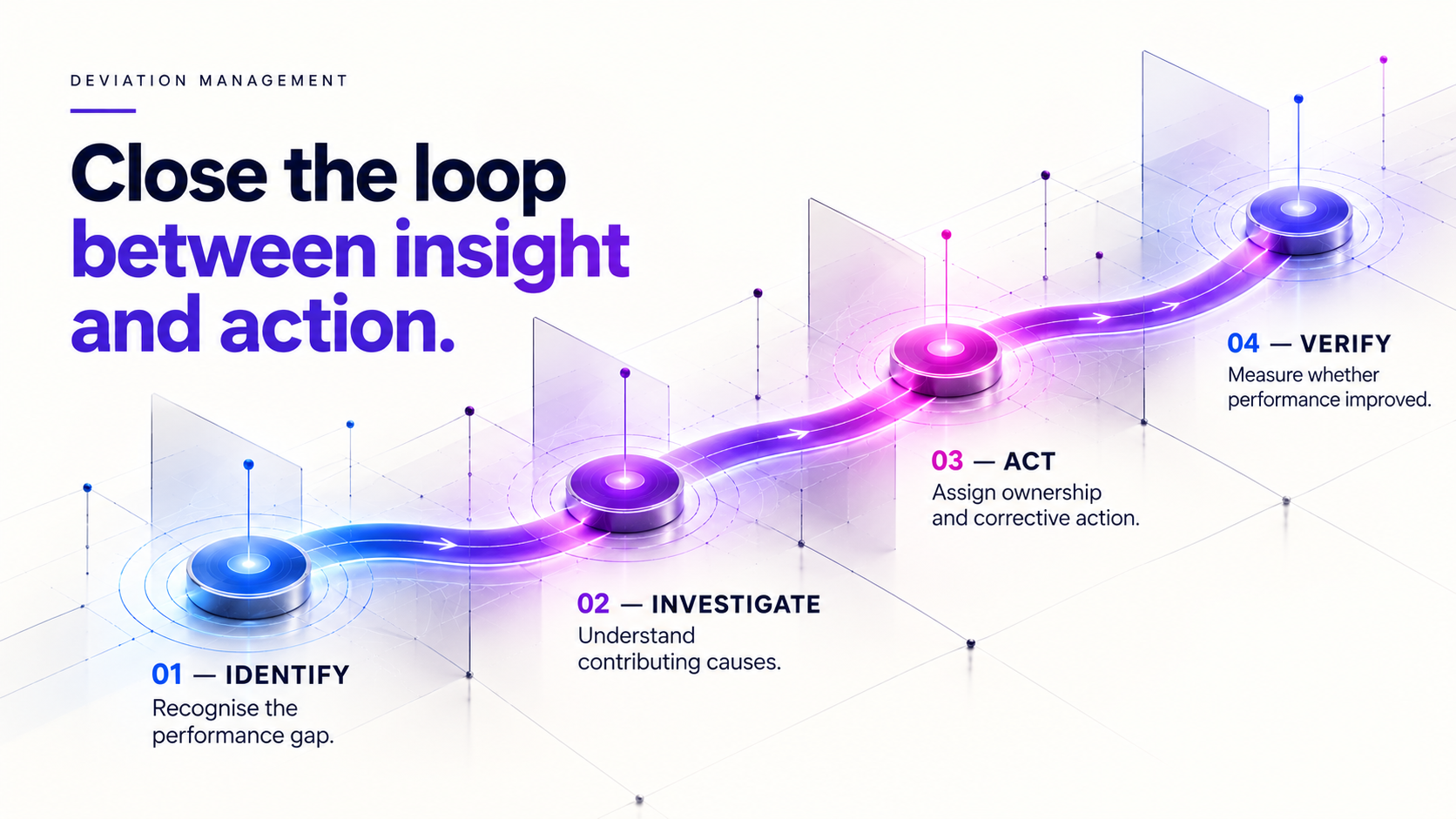
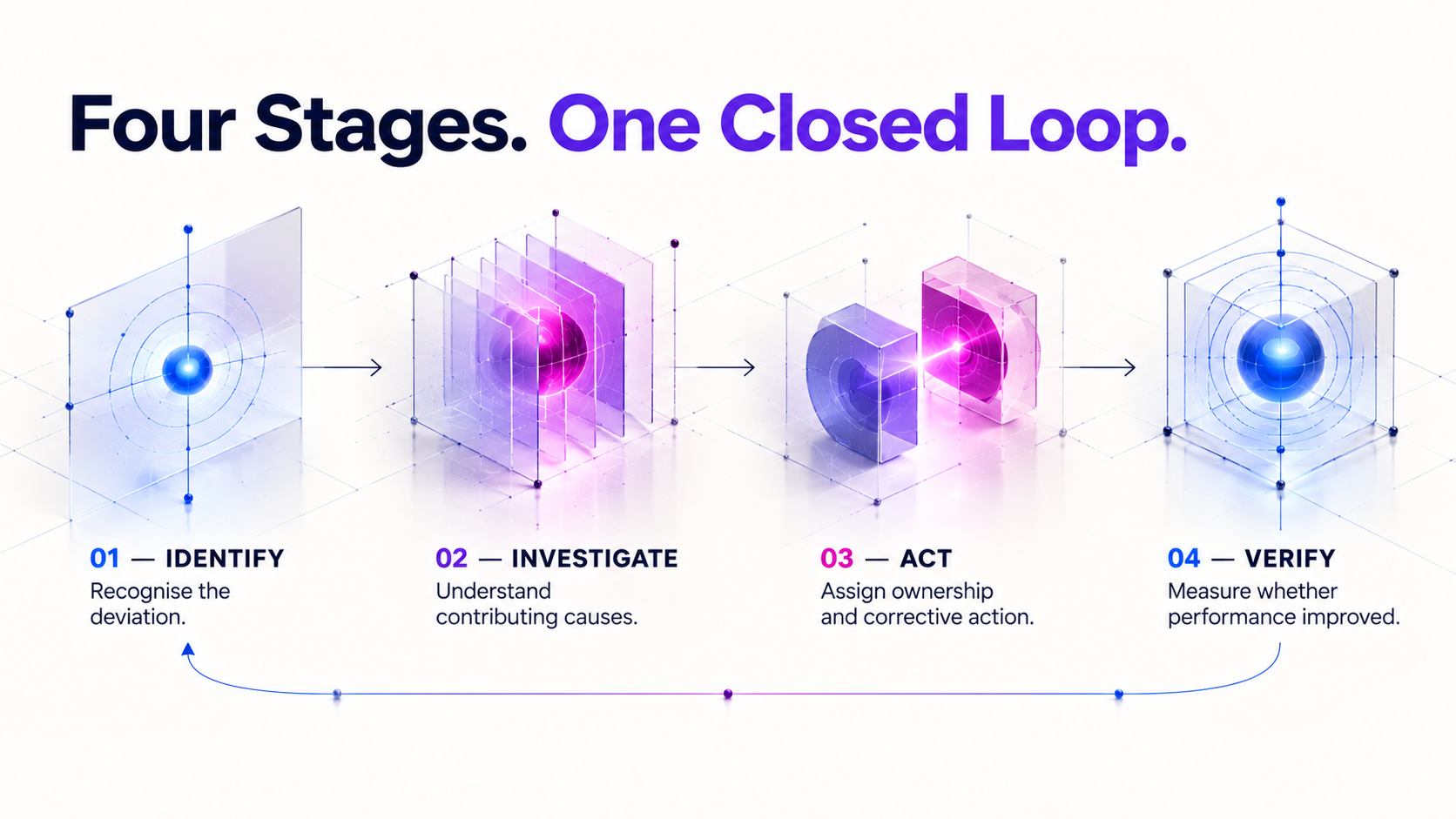
An effective deviation management software approach connects four stages of the management process: identifying a meaningful deviation, investigating its contributing causes, implementing corrective action, and verifying the outcome. Together, these stages provide a repeatable framework for moving from a performance signal to a management decision and a measurable result. Root cause analysis and corrective-action guidance both stress investigation and checking whether the response has been effective (ASQ, n.d.; International Organization for Standardization, 2015).
1. Identify and contextualise the deviation
The first step is to establish what has changed and why it matters. A KPI below target should be assessed in relation to its threshold, historical pattern, strategic importance, and potential effect on other business objectives.
Context helps leaders distinguish between issues that can be managed locally and those requiring cross-functional coordination or escalation. It also reduces the risk of directing resources towards whichever indicator appears most urgent in a report rather than the deviation with the greatest business implications.
2. Investigate contributing factors
Once a material deviation has been identified, the next step is to understand what may be driving it. Root cause analysis encourages teams to look beyond the immediate symptom and examine the processes, dependencies, constraints, and decisions contributing to the outcome (ASQ, n.d.).
The objective is not to assign blame or produce an elaborate explanation for every variance. It is to establish a sufficiently evidence-based understanding of the factors that need to change.
3. Assign corrective action and accountability
An investigation should lead to a defined response. Each corrective action needs a clear owner, an expected completion date, and an intended outcome. Where several teams are involved, responsibilities, dependencies, and decision requirements must be explicit.
This is where corrective action management becomes essential. It gives organisations a structured way to track commitments, identify delays, and escalate unresolved issues before they undermine broader objectives. In a quality-management context, ISO 9001 also requires organisations to evaluate the effectiveness of corrective action (International Organization for Standardization, 2015).
An action such as “improve resource planning” is difficult to manage because it does not specify what must change. A more actionable commitment might identify the planning process to be revised and the performance measure that will be reviewed afterwards.
Clear accountability does not mean assigning every problem to a single individual who has no control over the contributing factors. It means establishing who coordinates the response, who must contribute, and who has the authority to resolve dependencies.
4. Verify whether performance has improved
Completing an action is not the same as resolving a deviation. A process may have been updated, a resource allocated, or a decision implemented without producing the expected result.
The final stage is to review the relevant KPI or business outcome and determine whether the corrective action worked. If the deviation persists, the organisation may need to reassess its assumptions, investigate additional contributing factors, or select a different response (International Organization for Standardization, 2015; ASQ, n.d.).
This distinction is central to effective management. Tracking completion demonstrates that work has been carried out; tracking effectiveness demonstrates whether that work has achieved its purpose. Both matter, but they answer different questions.
The corrective-action approach in ISO 9001 includes reviewing the effectiveness of actions taken (International Organization for Standardization, 2015). The American Society for Quality likewise identifies effectiveness verification and sustainable improvement as important parts of root cause analysis (ASQ, n.d.).
Why do corrective actions fail to deliver lasting improvement?
Corrective actions can fail to deliver lasting improvement when organisations treat them as isolated tasks rather than interventions intended to change performance. A team may complete its assigned activities, report progress, and close the action while the original business problem remains unresolved. Guidance on corrective action highlights the importance of evaluating effectiveness, not merely recording that an action was taken (International Organization for Standardization, 2015).
|
|
|
|
|
|
|
|
|
|
|
|
|
|
|
|
|
|
How deviation management software strengthens organisational control?
For senior leaders, the value of deviation management software extends beyond managing individual problems. It can strengthen the connection between strategic objectives and operational execution. It makes it easier to understand where performance is diverging, what action is underway, and which issues require management intervention.
A connected view of performance helps leaders examine three questions. This is consistent with the principle that performance measures should be connected to strategy and the activities that influence outcomes (Kaplan & Norton, 1996).
Where does the deviation matter most?
A variance in one operational metric may have little strategic significance, while a smaller change in a critical business driver may threaten an important objective. Connecting performance indicators with organisational priorities helps leaders assess the implications of a deviation rather than relying solely on the size of the numerical gap.
Who needs to act?
Once a response is agreed, ownership and deadlines must remain visible. Where action depends on several teams, the organisation needs clarity about responsibilities, dependencies, and unresolved decisions. Escalation should help remove barriers to progress rather than simply transfer responsibility upwards.
What happened after the intervention?
Follow-up should establish whether the corrective action improved the relevant outcome, not simply whether the assigned task was completed. If performance remains below expectations, leaders need enough information to decide whether to extend the intervention, change course, or investigate further.
AgilityVisual brings strategy, KPIs, initiatives, and operational information together to support performance visibility and action. Its website describes capabilities including KPI visualisation, target-deviation monitoring, countermeasure implementation, task management, and escalation where required. These functions are intended to connect performance insight with execution rather than leaving leaders with disconnected reports (AgilityVisual, n.d.-a; AgilityVisual, n.d.-b).
For a CEO, this approach can provide a clearer view of whether strategic priorities are progressing and where unresolved issues threaten execution. For a CFO, it can help connect performance signals with areas that may require financial or resource-related decisions. For a COO or transformation leader, it can make operational dependencies and outstanding actions easier to follow.
Importantly, organisational control does not mean escalating every deviation to senior leadership. Excessive escalation can overwhelm decision-makers and weaken accountability at operational levels. A more effective approach distinguishes between issues that teams can resolve independently and those that require additional authority, resources, or cross-functional intervention.
The objective is to ensure that material deviations receive the appropriate level of attention and that unresolved issues do not disappear between reporting cycles.

Where AI support fits into business performance management?
AI can provide an additional layer of assistance within a performance management environment, particularly when users need help navigating information or understanding how to use the platform. However, its contribution should be assessed against specific, verified capabilities rather than broad assumptions about automation.
AgilityVisual includes Erika, its AI chat support assistant. Erika can be described as a support resource for users working within the platform. Its role should be understood in the context of the capabilities actually available, rather than assuming that it autonomously identifies root causes, selects corrective actions, or resolves deviations.
This distinction matters because deviation resolution involves judgement as well as information. A performance gap may have several plausible explanations, each with different operational or financial implications. Selecting an appropriate response requires relevant evidence, organisational context, and an understanding of the trade-offs involved.
The Center for Evidence-Based Management (CEBMa) explains that evidence-based management draws on multiple sources: scientific research, organisational data, professional expertise, and stakeholder perspectives. It also emphasises the importance of critically evaluating evidence rather than accepting information or established practice at face value (CEBMa, n.d.).
For deviation management, this means that a dashboard or AI-generated suggestion should be one input into the decision process, not an automatic substitute for investigation. Leaders must still assess whether the evidence is reliable, whether the explanation fits the organisational context, and whether the proposed response is proportionate.
For organisations adopting AI-enabled business performance management, the practical objective should be to improve the accessibility and usability of management information while preserving human judgement, clear ownership, and evidence-based decisions.

Building a closed-loop approach to continuous improvement
A sustainable management process does not end when a KPI returns to its target. It also examines what the organisation has learned and whether the underlying conditions are likely to produce the same problem again. This aligns with corrective-action guidance that calls for reviewing effectiveness and with root cause analysis practices focused on sustainable improvement (International Organization for Standardization, 2015; ASQ, n.d.).
Three questions can help leadership teams assess the maturity of their approach:
- Can we trace a material deviation to a defined management response? There should be a clear relationship between the performance issue, the investigation, and the action taken.
- Can we identify who owns the response and when it should be reviewed? Accountability should remain visible across teams, dependencies, and reporting periods.
- Can we demonstrate whether the action improved performance? Completion should be distinguished from effectiveness, with further investigation where results remain below expectations.
These questions turn continuous improvement from a general organisational ambition into a repeatable management discipline.
Over time, reviewing corrective-action outcomes can help organisations recognise recurring patterns, identify weaknesses in their processes, and make better-informed decisions about priorities and resources. Using organisational data alongside professional expertise and research is consistent with evidence-based management (CEBMa, n.d.). If the same deviation repeatedly returns, the organisation may need to examine whether its response addresses the underlying conditions or whether broader changes are required.
Learning also needs to extend beyond the team that experienced the problem. Where a deviation reveals a weakness in a shared process, the lessons may apply to other departments, projects, or business units. Making those insights visible can reduce the likelihood of similar problems emerging elsewhere.
Not every deviation can be prevented, and not every intervention will produce the intended result. The objective is to build a management process that responds consistently, learns from evidence, and adjusts when the results do not match expectations.
That is what makes the loop valuable: the organisation does not simply monitor performance and react to problems. It uses each material deviation as an opportunity to improve how decisions are made and how business objectives are achieved.

Conclusion
Effective business performance management depends on more than identifying gaps between targets and results. It requires a connected process that links performance visibility with investigation, accountable action, escalation, and outcome verification. For executive teams, closing this loop strengthens the relationship between strategic intent and operational execution. Deviation management software can support this discipline by making performance signals, responsibilities, and follow-up easier to connect. AgilityVisual helps organisations bring strategy, KPIs, and execution into a shared performance environment. To understand how this approach could support your organisation, explore AgilityVisual and see how connected performance management can help turn visibility into action.
References and further reading
The following sources support the article's discussion of performance measurement, root cause analysis, corrective action, and evidence-based decision-making. They include independent research and professional guidance as well as AgilityVisual's product information.
- Institute for Healthcare Improvement (2015). RCA²: Improving Root Cause Analyses and Actions to Prevent Harm. A framework for connecting investigations to sustainable corrective actions and system improvement.
https://www.ihi.org/library/tools/rca2-improving-root-cause-analyses-and-actions-to-prevent-harm - Kaplan, R. S., and Norton, D. P. (1996). Linking the Balanced Scorecard to Strategy. California Management Review. Explains how performance measures should connect to strategy and to the drivers of business outcomes.
https://cmr.berkeley.edu/1996/11/39-1-linking-the-balanced-scorecard-to-strategy/ - Kaplan, R. S., and Norton, D. P. (2005). The Balanced Scorecard: Measures That Drive Performance. Harvard Business Review. Discusses the role of performance measurement in communicating and implementing business strategy.
https://hbr.org/2005/07/the-balanced-scorecard-measures-that-drive-performance - International Organization for Standardization (ISO). ISO 9001 — Quality Management Systems: Requirements. Provides a quality-management reference for addressing nonconformities, investigating causes, implementing corrective actions, and reviewing their effectiveness.
https://www.iso.org/standard/9001.html - Chartered Quality Institute (CQI). Preventing Recurrence of Nonconformance. Discusses systematic investigation and the use of problem-solving methods to address the causes of nonconformities.
https://www.quality.org/knowledge/preventing-recurrence-nonconformance - American Society for Quality (ASQ). Root Cause Analysis. Professional guidance on identifying causes, evaluating problems, and linking analysis with effective corrective action.
https://asq.org/specialized-credentials/root-cause-analysis - Center for Evidence-Based Management (CEBMa). What Is Evidence-Based Management? Explains how organisational data, scientific research, professional expertise, and stakeholder perspectives can inform management decisions.
https://cebma.org/resources/frequently-asked-questions/what-is-evidence-based-management - Organisation for Economic Co-operation and Development (OECD). Policy Framework on Sound Public Governance — Purposeful Monitoring. Provides guidance on aligning performance indicators with objectives, accountability, and decision-making. The framework concerns public governance, but its principles about relevant, actionable indicators offer broader management insights.
https://www.oecd.org/en/publications/policy-framework-on-sound-public-governance_c03e01b3-en/full-report/component-10.html - AgilityVisual. Business Performance Management Platform. Official product information on connecting strategy, KPIs, target deviations, countermeasures, tasks, and escalation.
https://www.agilityvisual.ai/en - AgilityVisual. Why Organisations Choose AgilityVisual. Further information on the platform's approach to connected performance management, strategic alignment, and continuous improvement.
https://www.agilityvisual.ai/en/why-agilityvisual-next-generation-business-performance-management