
Executive coaching: What is it and what are the benefits associated with it?
Contents
- What is executive coaching?
- Executive coaching has become a popular L&D intervention
- Executive coaching focuses on work issues
- Psychotherapy focuses on clients with mental health issues
- Executive coaches should have a background in psychology and/or organizational behavior
- Managers have to be ready for coaching
- Does executive coaching work?
- How can organizations choose a good coach?
- Executive coaching is not a panacea but is a useful L&D tool
- Coaching is not just beneficial for executives and managers
- References and further reading
The best executive coaches can earn up to $3500 an hour with median costs to the organization estimated at $500 per hour (Coutu & Kauffman, 2009). Given this major investment in coaching, it is important to evaluate the effectiveness of executive coaching. This blog describes what executive coaches do and the pros and cons of hiring a coach.
What is executive coaching?
Executive coaching involves a series of one-on-one interactions between a manager or executive and an external coach. The goal of coaching is to equip people with the knowledge and opportunities they need to develop themselves and become more effective. Behavior change is the goal of most executive coaching. One of the top researchers in the field of consulting provides the following definition:
"Executive coaching is defined as a helping relationship formed between a client who has managerial authority and responsibility in an organization and a consultant who uses a wide variety of behavioral techniques and methods to help the client achieve a mutually identified set of goals to improve his or her professional performance and personal satisfaction and, consequently, to improve the effectiveness of the client’s organization within a formally defined coaching agreement" (Kilburg, 2007, p. 28).
Executive coaching has become a popular L&D intervention
In the past, the view of coaching was seen as an intervention that organizations could utilize to deal with troubled managers and avoid leadership derailment. Now, this negative image of coaching has faded and multiple stakeholders, including organizations, psychologists and accredited bodies, have jumped on the bandwagon to benefit from the surge in coaching as a Learning & Development (L&D) intervention for high profile managers.
However, despite this increase in coaching, the profession is still chaotic mainly because there is diversity in experience and education among the professionals who offer coaching services (Bono et al., 2007).
Moreover, individuals are entering coaching from very diverse backgrounds such as clinical psychology, management and counselling so tailor counseling sessions based on their educational background (Bono et al, 2007). This has also led to differences in opinion on what should be assessed and how to conduct an individual assessment (Bono et al, 2007).
Executive coaching focuses on work issues
One of the issues with the diversity among coaching qualifications is in making a distinction between psychotherapy and coaching (Kilburg, 2004). One way in which The International Coaching Federation distinguishes between coaching and therapy is through whether the intervention focuses on the person or is focused on a work issue.
Psychotherapy focuses on clients with mental health issues
For example, psychotherapy focuses on clients with mental health issues whereas coaching focuses on managers who need business coaching to become more effective in their roles. The literature suggests it is important to make this distinction so that the lines are not blurred. It is unethical for a business coach to provide therapy when they do not have the necessary qualifications.
Executive coaches should have a background in psychology and/or organizational behavior
For executive coaching to be successful, organizations must screen coaches and examine their backgrounds in order to confirm that the coach has the necessary skills and experience for the coaching assignment. Several experts have advocated for all executive coaches to have a background in psychology.
Dean and Meyer (2002) have argued that psychological training “will assure that the coach has the basic knowledge and clinical skills needed to accomplish the objectives and goals.” (p.12). However, it is worth noting that executive coaching is probably not a place for psychologists who are not interested in business (Foxhall, 2002).
A qualification in the area of organizational behavior provides another valuable source of knoweldge for executive coaches. This especially applies to complex work issues that require an understanding of processes on team and organizational level.
Managers have to be ready for coaching
It is also important to ensure that the executive is ready for coaching. Employees can undergo psychological evaluation before coaching to screen out those are not prepared to benefit from the process (Berglas, 2002). If the executive is motivated to become a better performer then this motivation is important in the coaching process because it ensures that the executive is prepared to accept the feedback from the evaluation.
Does executive coaching work?
Most of the empirical research on coaching shows it to be effective. The studies have been rigorous with most designs incorporating a control vs. training group to determine the unique effect of executive coaching on job performance (De Haan & Duckworth, 2013).
Executive coaching improves performance and psychological well-being
Other correlational research has been rigorous in showing that executive coaching is effective based on multi-source ratings of self, management and coach on a range of performance indices including productivity, leadership effectiveness and leader behaviors (Perkins, 2009).
Two meta-analytic studies have also shown the effectiveness of executive coaching. Executive coaching and a positive, yet moderate, impact on individual job performance and psychological well-being (Theeboom et al., 204). The second meta-analysis also found that executive coaching had a greater impact on performance compared with other popular workplace development tools (Jones et al., 2014).
Executive coaching leads to better feedback from supervisors, peers and subordinates
In one of the few longitudinal studies, Smither and colleagues (2003) looked at the effectiveness of executive coaching through tracking over a thousand senior managers over a two-year period. The findings showed that those who received executive coaching received more positive feedback from their supervisors, peers and subordinates with areas of improvement including goal setting, soliciting ideas for improvement and ratings from direct reports and supervisors.
How can organizations choose a good coach?
It is important that organizations determine the needs of the individual to be coached based on the Development Pipeline (Peterson, 2006 & 1999; Grant et al., 2010). which consists of the following five stages:
- insight,
- motivation,
- capabilities,
- real-world practice, and
- accountability
The development pipeline assesses whether the executive needs additional insight, motivation or capabilities or whether needs to be given the opportunity to apply existing skills in a real-world setting and to be held accountable. The pipeline can also help the organization determine what sort of coach is suitable for the executive based on the needs analysis. It also helps to focus on the transfer of learning back to the workplace.
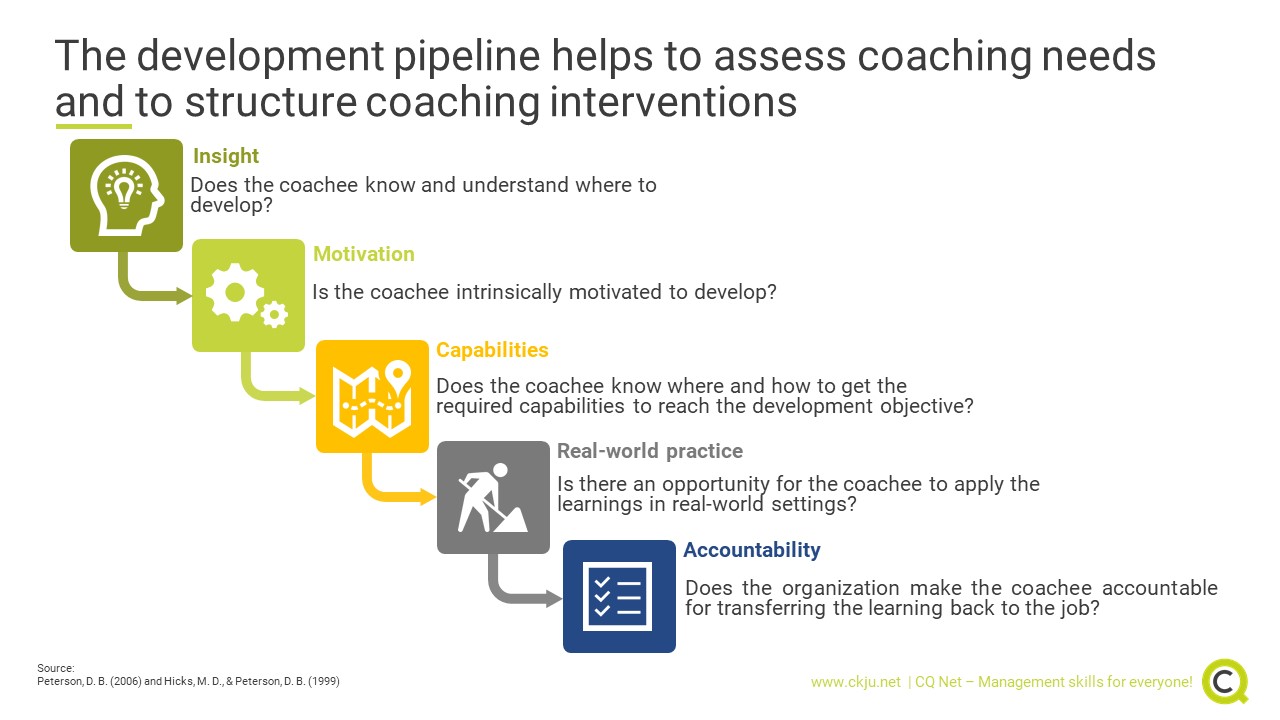
For example, if the executive needs insight, the most suitable coach is someone can provide feedback and goals to facilitate creativity. If the organization is unsure of what the executive needs they can hire a coach to help in problem identification such as a needs analysis.
Executive coaching is not a panacea but is a useful L&D tool
Based on the evidence, executive coaching is a valuable tool for management development. However, it is important that organizations carefully select a coach who meets the requirements for executive development. Executive coaching is not a panacea for all organizational problems but is a useful tool in training and development management-level staff.
Coaching is not just beneficial for executives and managers
It is not just executives and managers that can benefit from coaching. In the 21st century knowledge economy professionals have become the backbone of organizations. This makes it important to provide coaching interventions to a broader target group beyond traditional line managers and executives.
For instance, an experienced project manager with the necessary qualification for coaching can establish a coaching relationship with a junior project manager. This relationship has to have a clear objective such as successfully completing a complex project. The coach helps the junior project manager to evaluate how the project is going and defines measures how to keep it on track.