
Leadership Challenge #2: Communication Is Not the Same as Understanding.
Contents
- Communication Cascades: When Information Gets Lost Along the Way
- The Telephone Game: How Messages Get Distorted as They Travel
- Information Overload: Why More Communication Doesn't Mean Better Communication
- The Business Cost of Ineffective Communication
- The 3Rs of Effective Communication: Repeat, Relate, Reframe
- Structure Creates Clarity: One-Pagers, Shopfloor Management and Intranets
- Technology as an Enabler: Building a Digital Leadership Infrastructure with AgilityVisual
- Conclusion: The Goal Is Understanding, Not Just Communication
- References and Further Reading
Communication is arguably the most important tool in a leader's toolkit. It underpins almost every aspect of leadership, from day-to-day interactions with employees on the production floor to communicating a new corporate strategy across an entire organisation (Vries et al., 2010). Yet communicating a message is only half the job. Ensuring that it is understood consistently across different functions, management levels, locations and cultures is an entirely different challenge.
For leaders in large, internationally operating organisations, maintaining a consistent flow of information is particularly difficult. Traditional communication methods often struggle to keep pace with organisational complexity. Messages get lost, employees work with different versions of the same information, tasks are duplicated, and motivation suffers (Marlow et al., 2018). So why is effective communication so difficult to achieve at scale, and what can leaders do to make sure their messages actually get through?
Communication Cascades: When Information Gets Lost Along the Way
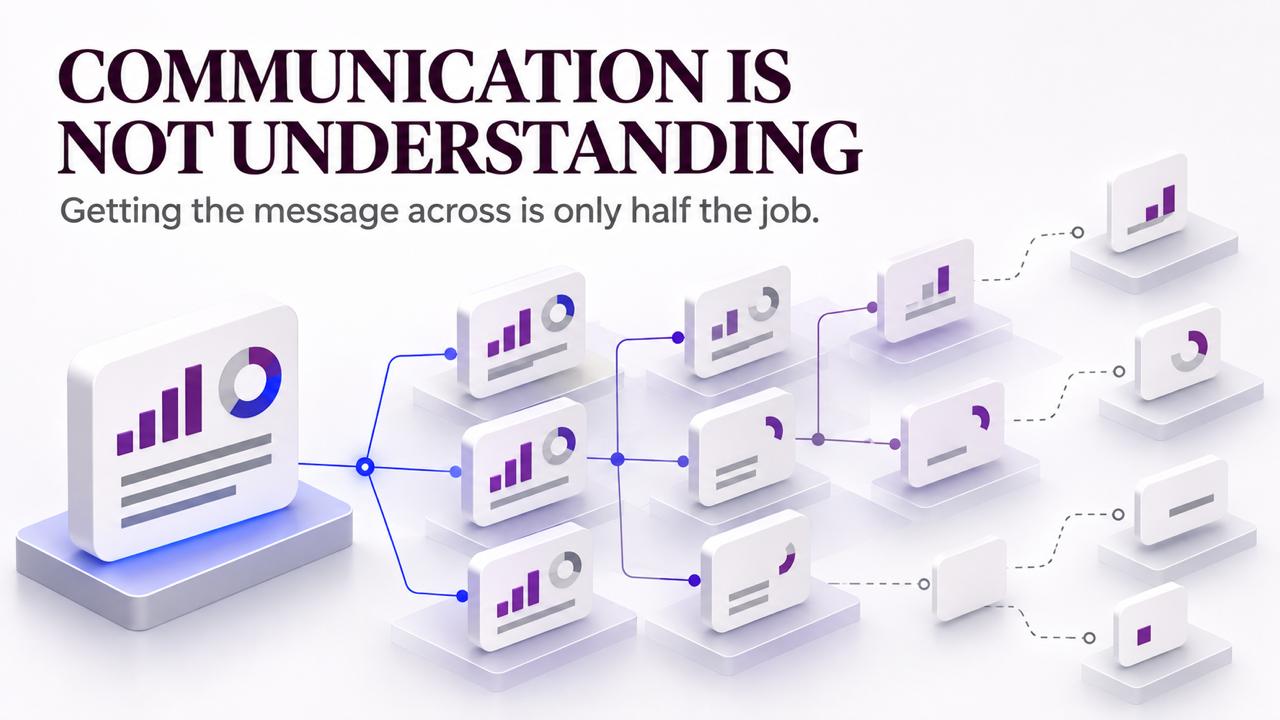
In organisations with multiple management layers, important information is typically passed down through a series of management levels, teams and departments. This process, commonly known as cascading communication, is a standard leadership practice. The idea is straightforward: senior management communicates key information to department heads, who then pass it on to team leaders and, ultimately, to employees. In practice, however, this process is rarely as seamless as it sounds.
Depending on the size and structure of an organisation, critical information can easily fall through the cracks (Staats et al., 2012). Emails go unread. Managers interpret messages differently. Important details get left out. And employees may be unavailable due to business travel, annual leave or other commitments. What starts as an attempt to create a consistent flow of information can quickly turn into fragmented communication. Different teams end up working with different levels of information, making alignment increasingly difficult and undermining overall organisational performance.
The Telephone Game: How Messages Get Distorted as They Travel
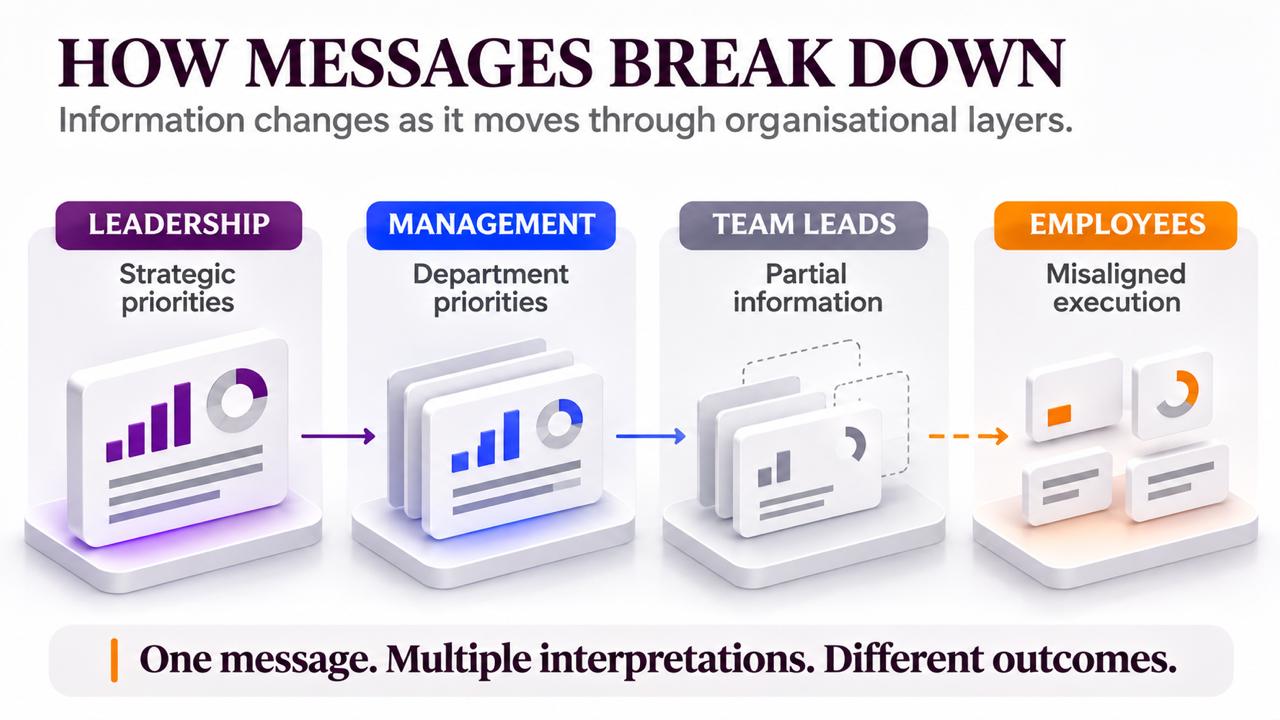
There is another problem with passing information through multiple layers of an organisation: the message itself can change along the way. This is similar to the familiar telephone game, in which a message is passed from one person to another until the final version bears little resemblance to the original. Research has demonstrated that information can change significantly as it moves between individuals (Bebbington et al., 2017). In organisations, the consequences can be far more serious than a misunderstood sentence.
A key strategic priority might be interpreted differently by individual departments. An important instruction might lose its original context. By the time a message reaches the people responsible for acting on it, its meaning may have changed entirely. Despite the evidence, leaders often underestimate this risk, assuming that once something has been communicated, it has also been understood (Sull et al., 2015). The problem is rooted in how people naturally process information. Everyone interprets messages through the lens of their own knowledge, experience and priorities. As information passes from one person to another, some details are omitted, ambiguities are filled in, and the original message is unconsciously adapted to individual perspectives. The result is a growing gap between what leadership intended to communicate and what employees actually understand.
Information Overload: Why More Communication Doesn't Mean Better Communication
Another challenge leaders need to account for is the limited capacity of people to absorb and process information (Cowan, 2001). Employees are constantly exposed to information from multiple sources: emails, meetings, internal announcements, project updates, management reports and everyday conversations. With so much competing for their attention, people naturally filter and prioritise what they consider important.
Which information receives attention depends on several factors, including an individual's emotional state, stress levels and immediate working environment. For leaders, this creates an important challenge: every new communication competes for a limited amount of attention and cognitive capacity. There is also a tendency to pay less attention to information that is communicated only once. Messages encountered repeatedly, particularly through different formats and channels, are more likely to be noticed and retained. Effective communication, therefore, is not about increasing the volume of information. It is about understanding how people absorb information and ensuring that important messages receive the attention they deserve.
The Business Cost of Ineffective Communication
Communication failures are rarely isolated incidents. They have a direct impact on how an organisation operates and performs. As the examples above illustrate, several factors can prevent leadership messages from reaching their intended audience or being understood correctly. Many of these factors are outside a leader's immediate control, yet their consequences can be significant. At an operational level, unclear communication can result in duplicated work, conflicting priorities and unnecessary delays. Employees may spend time working towards different objectives simply because expectations were not communicated consistently.
At a strategic level, the consequences can be even more serious. Misunderstood instructions, inconsistent decision-making and a lack of alignment across departments can escalate into major organisational problems. The question for leaders is not simply how to communicate more effectively, but how to establish an environment in which information is consistently received, understood and acted upon.
The 3Rs of Effective Communication: Repeat, Relate, Reframe
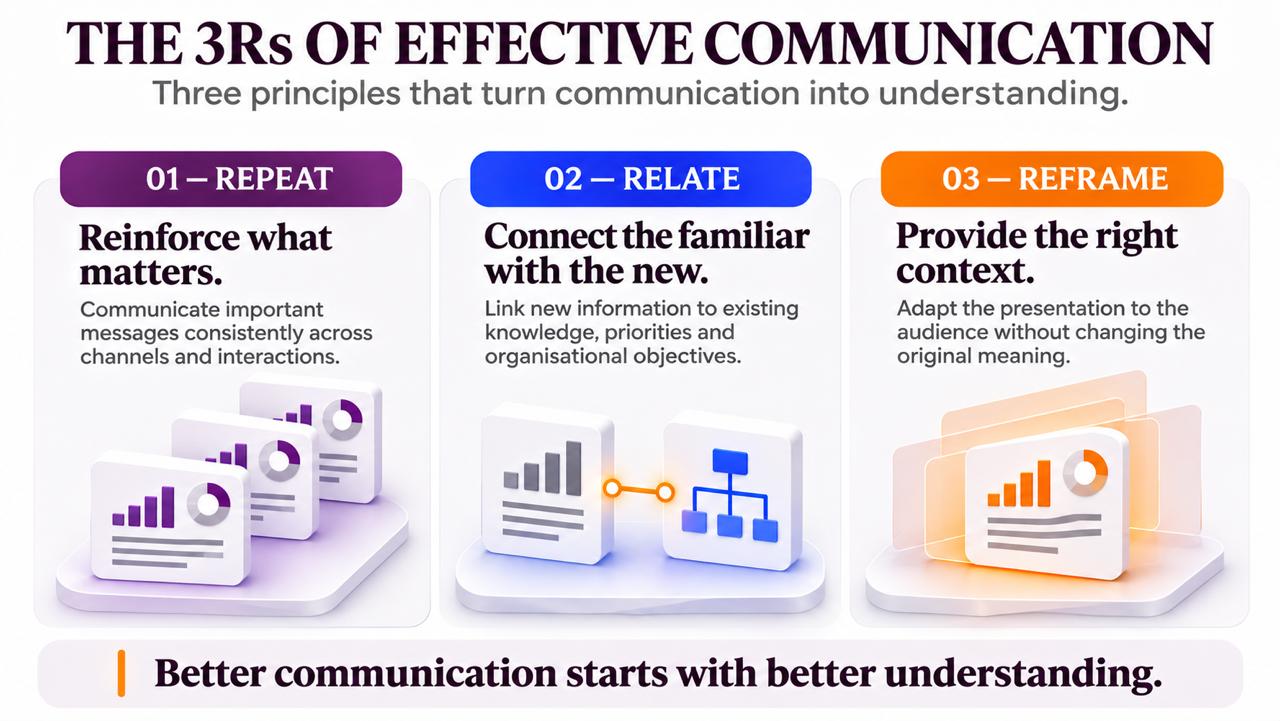
One practical framework leaders can use to improve communication is the 3Rs: Repeat, Relate and Reframe. These three principles recognise that communication is not a one-way transfer of information. It is a process that needs to account for individual perspectives, social dynamics and the context in which messages are received.
Repeat: Reinforce What Matters
Important messages should not be communicated just once and then assumed to have been understood. Repetition helps ensure that key information reaches everyone, including those who may have missed the original communication or need additional time to process it. This does not mean sending the same email repeatedly. It means reinforcing important messages through different channels, conversations and regular team interactions.
Relate: Connect New Information to What People Already Know
People are more likely to understand and retain new information when they can connect it to something familiar. Leaders should therefore link new messages to existing knowledge, previously communicated priorities and established organisational objectives. For example, when introducing a new strategic initiative, explaining how it builds on existing priorities can make its purpose and relevance much clearer.
Reframe: Provide the Right Context
The way information is presented matters just as much as the information itself. Leaders need to consider their audience and explain not only what is being communicated, but also why it matters and what it means in practice. A strategic announcement to senior management, for instance, may require a different level of detail and context than the same message communicated to an operational team.
The objective is to make information relevant and understandable to each audience without changing its underlying meaning. Together, the 3Rs help leaders move beyond simply distributing information towards creating genuine understanding across the organisation.
Structure Creates Clarity: One-Pagers, Shopfloor Management and Intranets
Effective communication depends not only on how leaders communicate, but also on the structures and systems that support communication across an organisation.
Leadership communication generally operates on two levels. The first is individual, focusing on direct interactions between leaders and employees. The second is organisational, focusing on creating an environment in which information can flow consistently and people can work towards shared objectives. Structured communication plays an important role at both levels. It provides clarity, establishes consistency and reduces the effort required to find and interpret information.
At the individual level, straightforward tools such as task lists in Microsoft Excel, Microsoft To Do or AgilityVisual can help employees and managers keep track of responsibilities and priorities. At the organisational level, tools and processes such as company intranets and shopfloor management systems provide established channels for sharing information across teams and management levels. Standardised formats, including one-pagers and internal blog posts, can further strengthen this process. By presenting information in a consistent structure, organisations can make it easier for employees to identify key messages and ensure that important details are not lost as information is passed on.
However, having a structure in place is not enough. Communication processes should be reviewed regularly to identify gaps, eliminate unnecessary complexity and make improvements where needed.
Technology as an Enabler: Building a Digital Leadership Infrastructure with AgilityVisual
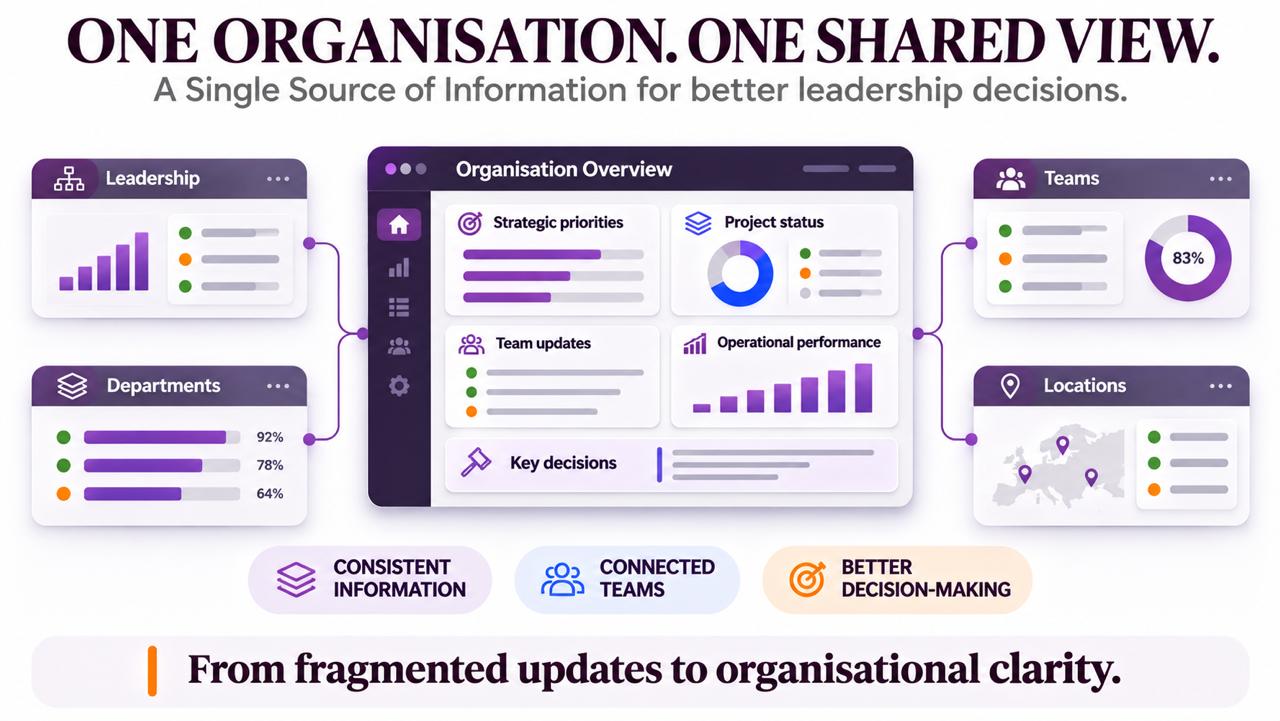
Technology can play an important role in addressing the communication challenges faced by complex organisations. Business Performance Management platforms such as AgilityVisual provide leaders with a digital infrastructure for structuring, visualising, sharing and escalating information across the organisation. At the heart of the platform are digital boards that can be configured to represent different organisational structures, including projects, teams, departments, regions and individual locations.
These boards act as a Single Source of Information, ensuring that everyone involved has access to the same, consistent information. Rather than relying on disconnected reports, individual emails or multiple communication channels, employees and managers can work from a shared information base. The interconnected nature of these boards also makes it possible to share updates, including news items, across different organisational levels without losing important context. These updates can then be discussed and followed up during regular team meetings. Each element on a board follows a standardised structure, ensuring that essential information is captured consistently. Importantly, information remains accessible over time rather than disappearing into email threads or meeting notes.
This allows teams to revisit important topics, reinforce key messages and maintain continuity in their discussions. By providing a shared and structured view of organisational information, AgilityVisual helps leaders reduce information fragmentation and establish greater consistency across teams, functions and locations.
Conclusion: The Goal Is Understanding, Not Just Communication
Effective communication remains one of the defining challenges of leadership and one of the most powerful drivers of organisational performance.
Communication cascades, the telephone game effect and the limited capacity of people to process information all contribute to messages being lost, misunderstood or distorted as they move through an organisation. The consequences extend well beyond occasional misunderstandings. They can lead to declining productivity, duplicated work, disengaged employees and, in more serious cases, significant organisational failures.
Leaders must therefore move beyond the assumption that communicating something is enough. What matters is whether the message has actually been understood.
Achieving this requires a combination of three elements: leadership behaviour, structured processes and the right technology. The 3Rs (Repeat, Relate, Reframe) provide a practical framework for making messages more effective and memorable. Structured communication formats, such as one-pagers, shopfloor management processes and intranets, create consistency and make information easier to follow.
Digital platforms such as AgilityVisual complement these approaches by providing a Single Source of Information, ensuring that everyone across the organisation can work from the same information. When these three elements work together, organisations can move from fragmented communication to a consistent, reliable flow of information. And that is ultimately what effective leadership communication is about: not simply making sure that information is shared, but making sure that people understand it, act on it and remain aligned with the organisation's objectives.
References and Further Reading
Bibliography
Bebbington, Keely; MacLeod, Colin; Ellison, T. Mark; Fay, Nicolas (2017): The sky is falling: Evidence of a negativity bias in the social transmission of information. In: Evolution and Human Behavior 38 (1), pp. 92–101. DOI: 10.1016/j.evolhumbehav.2016.07.004.
Cowan, Nelson (2001): The magical number 4 in short-term memory: A reconsideration of mental storage capacity. In: Behavioral and Brain Sciences 24 (1), pp. 87–114. DOI: 10.1017/S0140525X01003922.
Marlow, Shannon L.; Lacerenza, Christina N.; Paoletti, Jensine; Burke, C. Shawn; Salas, Eduardo (2018): Does team communication represent a one-size-fits-all approach?: A meta-analysis of team communication and performance. In: Organizational Behavior and Human Decision Processes 144, pp. 145–170. DOI: 10.1016/j.obhdp.2017.08.001.
Staats, Bradley R.; Milkman, Katherine L.; Fox, Craig R. (2012): The team scaling fallacy: Underestimating the declining efficiency of larger teams. In: Organizational Behavior and Human Decision Processes 118 (2), pp. 132–142. DOI: 10.1016/j.obhdp.2012.03.002.
Sull, Donald; Homkes, Rebecca; Sull, Charles (2015): Why strategy execution unravels – and what to do about it. In: Harvard Business Review 93 (3), pp. 58–67.
Vries, Reinout E. de; Bakker-Pieper, Angelique; Oostenveld, Wyneke (2010): Leadership = communication? The relations of leaders' communication styles with leadership styles, knowledge sharing and leadership outcomes. In: Journal of Business and Psychology 25 (3), pp. 367–380. DOI: 10.1007/s10869-009-9140-2.