
The rise of Crew Resource Management (CRM): Why CRM should be re-adapted as a framework for non-technical skills development in management teams
Contents
- Aviation went through a major change in technology starting in the 1950s
- Complex aircraft systems led to a rise of accidents related to human errors
- Crew Resource Management started in management development
- Organizations outside aviation have adapted Crew Resource Management
- Crew Resource Management increases both safety and team performance
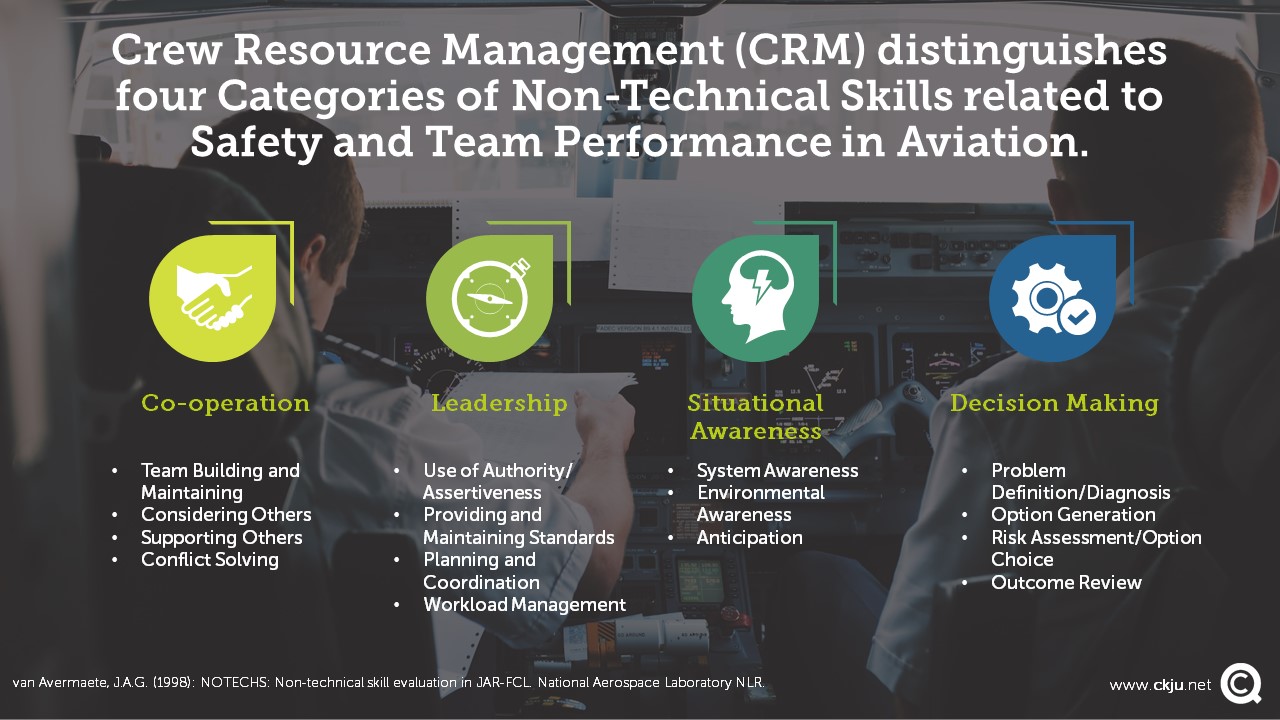
- Crew Resource Management focuses on non-technical skills (soft skills)
- Why should private sector management teams adapt Crew Resource Management for their purpose?
- Crew Resource Management is one of the most-researched team development interventions
- Management (still) relies too much on the “Great Man Theory“
- Most companies operate in a complex and dynamic environment
- CRM incorporates evidence-based practices that have proven their effectiveness in various other contexts
- Application of CRM in companies outside of the aviation industry has a measurable positive impact on performance
- References and further reading
Aviation went through a major change in technology starting in the 1950s
The advent of the jet age in 1950 in civil aviation brought deep and lasting changes to the aviation industry. Looking back to a time where flying was more of a risky adventure than a reliable means of transportation, the advances in technology led to a decline of accidents related to technical issues. However, this much welcomed development has had side effects the aviation industry wasn’t prepared for at that time.
Complex aircraft systems led to a rise of accidents related to human errors
Since its early years, flying an aircraft has been connected to brave and courageous men with a white scarf skillfully maneuvering their aircraft in the blue sky. This idealized “single pilot tradition” (Kanki et al. 2010) still dominates the way many people think about pilots today. However, aviation reality shows a different picture.
Flying with highly sophisticated multi-engine aircraft with 900 kilometers per hour in 30.000 feet above the ground through congested air spaces with changing weather conditions doesn’t require a hero, but a well working and aligned aircraft crew. Something airlines couldn’t rely on in the 50s.
As a consequence the share of accidents related to human factor issues such as communication, decision making and leadership considerably increased to an estimated 60 – 80% peaking in 1977 with over 580 fatalities in the Tenerife airport disaster (Alavosius et al. 2017).
Crew Resource Management started in management development
To address the increasing relevance of human factors in accident prevention, NASA sponsored a workshop initially called Cockpit Resource Management in 1979. Interestingly, the first trainings were developed based on management development interventions from the private sector (Helmreich and Wilhelm 1991).
Since then the scope of the training was increased to the entire aircraft crew and after a set of adjustments Crew Resource Management has become a de-facto standard in the aviation industry.
Crew Resource Management is - to the best of our knowledge - the only industry wide standard on how to address and utilize human factors in teams. One could even say that the aviation industry copied with pride from the business sector and developed it to the next (performance?) level.
Organizations outside aviation have adapted Crew Resource Management
But this is not all. Recently, Crew Resource Management has started to gain traction outside the aviation industry as well. Mostly organizations in high risk environments such as oil and gas, nuclear power, air traffic control and the healthcare sector have started to adapt Crew Resource Management in their domain (Havinga et al. 2017).
Taking all this into consideration, we were wondering what management teams in the private sector can learn from Crew Resource Management taking into account that they face some of the challenges the aviation industry has already gone through.
However, before we have a look at what is behind Crew Resource Management in more detail, we’ll briefly review the evidence whether Crew Resource Management really makes a difference in terms of safety and performance.
Crew Resource Management increases both safety and team performance
The question whether Crew Resource Management has a measureable impact on safety and team performance has been around from the very beginning of its introduction (Helmreich and Wilhelm 1991).
As with many other organizational interventions in complex socio-technical systems, there is no 100% concluding evidence that Crew Resource Management lives up to its promise.
However, there is considerable evidence that supports the claim that Crew Resource Management has a positive impact on safety and team performance (Rudari; Fisher et al. 2000; Nullmeyer and Spiker 2009; Flin et al. 2002).
First results outside the aviation industry point in a similar direction, though the data basis is still weak since CRM has not been around long enough in industries other than aviation (Wagener and Ison 2014; Kanki et al. 2010; KIM and BYUN 2011).
Taking into consideration that companies spend a vast amount of money for training and development measures without any evidence whether they really make a difference, Crew Resource Management is a positive exception.