
Why digital transformation stalls in the German Mittelstand: The management capability gap
Contents
- The state of digital transformation in the German Mittelstand
- Why does technology adoption not guarantee transformation?
- The strategic alignment gap
- Resource allocation and decision-making barriers
- The management capabilities transformation requires
- Building a framework for sustained transformation
- Digital transformation as a business performance challenge
- Critical appraisal and key takeaways
- References and further reading
Digital transformation is often treated as a technology challenge. For many German Mittelstand businesses, however, the more difficult challenge is managerial. Investing in enterprise systems, automation, data infrastructure or artificial intelligence does not automatically improve business performance. Organisations also need the management capabilities to coordinate people, priorities, resources and organisational change. This article examines why digital transformation stalls in the German Mittelstand. It explores the gaps in strategic alignment, leadership accountability, resource allocation and decision-making that can prevent technology investments from translating into measurable outcomes.
Recent research highlights the scale of the challenge. KfW found that only 30% of German SMEs completed at least one digitalisation project during the 2022–2024 period (Zimmermann, 2026). Bitkom reported that 51% of surveyed German businesses experienced difficulties managing digitalisation (Bitkom, 2026). Together, these findings point to a challenge that extends beyond technology adoption: the ability to manage transformation as an organisation-wide business priority.
The state of digital transformation in the German Mittelstand
Germany's Mittelstand is central to the country's industrial and economic strength. Yet digital transformation remains uneven across smaller and larger businesses. KfW's SME Digitalisation Report 2025 found that 30% of SMEs completed at least one digitalisation project between 2022 and 2024, a decline of five percentage points from the previous survey. Digitalisation expenditure also fell by approximately €8 billion, to just under €24 billion (Zimmermann, 2026).
The gap between business sizes is particularly significant. Large SMEs were 2.3 times more likely than small businesses to complete digitalisation projects and spent approximately 19 times more on digitalisation. These figures should be interpreted in context. KfW identifies the difficult economic environment and the end of pandemic-related effects as likely contributors to the decline. They do not establish that weak management alone caused the slowdown. Nevertheless, the differences in investment and project activity raise an important question: do smaller organisations have the structures and resources needed to manage digital transformation consistently?
Why does technology adoption not guarantee transformation?
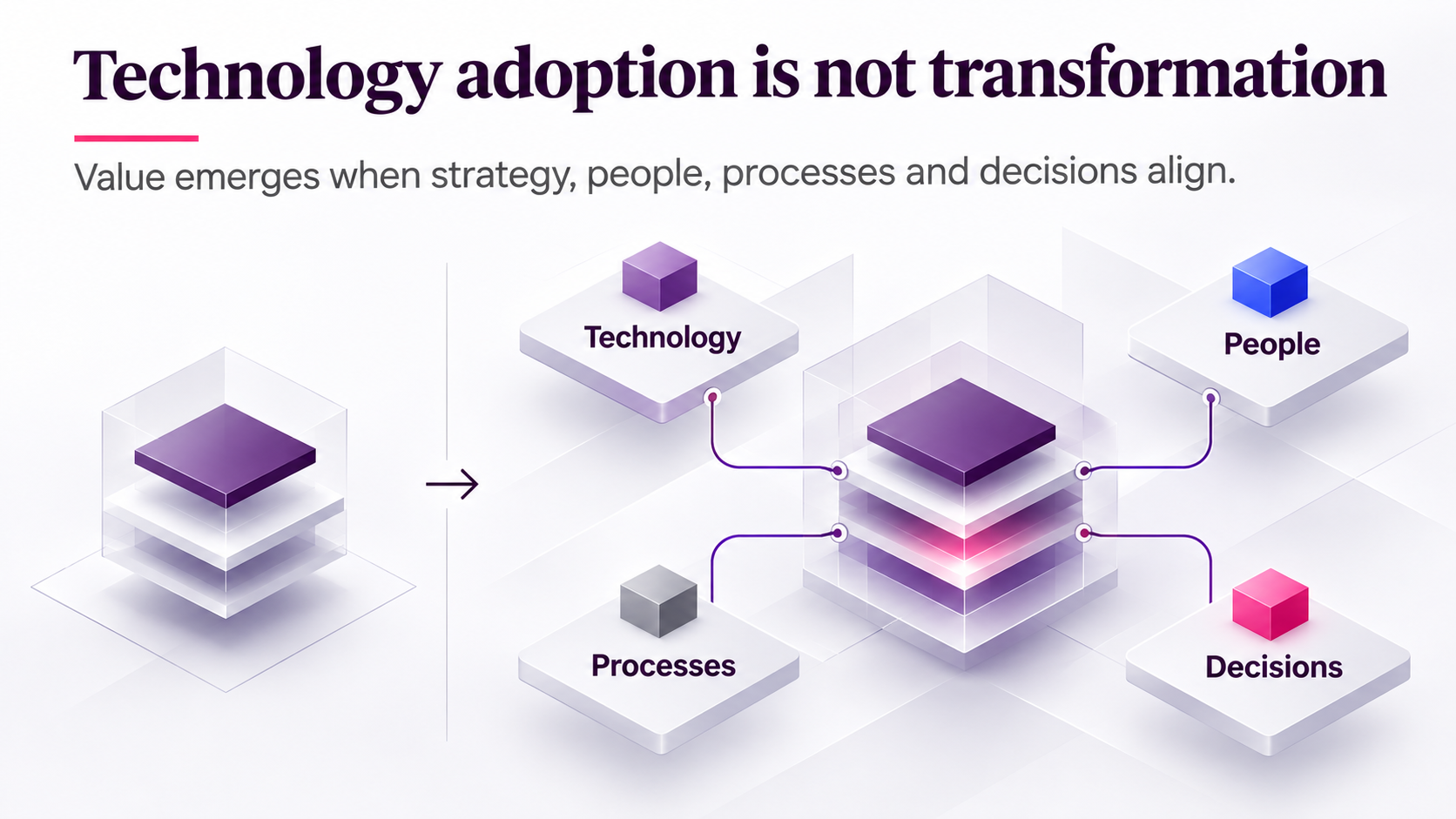
Digital transformation involves more than introducing new software or replacing manual processes. It changes how an organisation creates value, makes decisions, coordinates work and responds to its environment. Vial (2019), in a review of 282 academic works, describes digital transformation as a process in which digital technologies trigger strategic responses that alter organisational value creation. These changes also create structural and organisational challenges.
This distinction matters. A company may implement a new enterprise resource planning system, introduce automation or invest in AI without changing the management processes surrounding those technologies. If teams continue working in silos, priorities remain disconnected and leadership lacks visibility into implementation, the investment may produce limited organisational value. Research by KfW and ZEW Mannheim also indicates that the productivity benefits of digitalisation are not uniform. A 10% increase in digital capital stock was associated with an average productivity increase of 0.159%. Among firms with higher initial levels of digitalisation, the corresponding association was 0.808% (KfW Research and ZEW, 2026).
The findings suggest that businesses with stronger digital foundations may be better positioned to benefit from further investment. Technology matters, but organisational readiness influences the value a business can extract from it.
The strategic alignment gap
One of the most persistent obstacles to transformation is the absence of a shared organisational direction. Bitkom's research found that among companies with 20–99 employees, 22% had no digital strategy, while 57% had strategies limited to individual business areas. Only 21% reported an overarching central strategy (Bitkom, 2026).
When digital initiatives are developed independently across departments, organisations risk creating disconnected systems, competing priorities and duplicated efforts. IT may focus on infrastructure, operations on efficiency, and management on growth, without a common framework connecting these activities to business objectives. Strategic alignment requires leadership to establish:
- Clear business outcomes for each major transformation initiative.
- Ownership and accountability across departments.
- Shared priorities that guide investment and resource decisions.
- Measurable indicators connecting implementation to business performance.
Without this alignment, digitalisation can become a collection of projects rather than a coordinated programme of business transformation.
Resource allocation and decision-making barriers
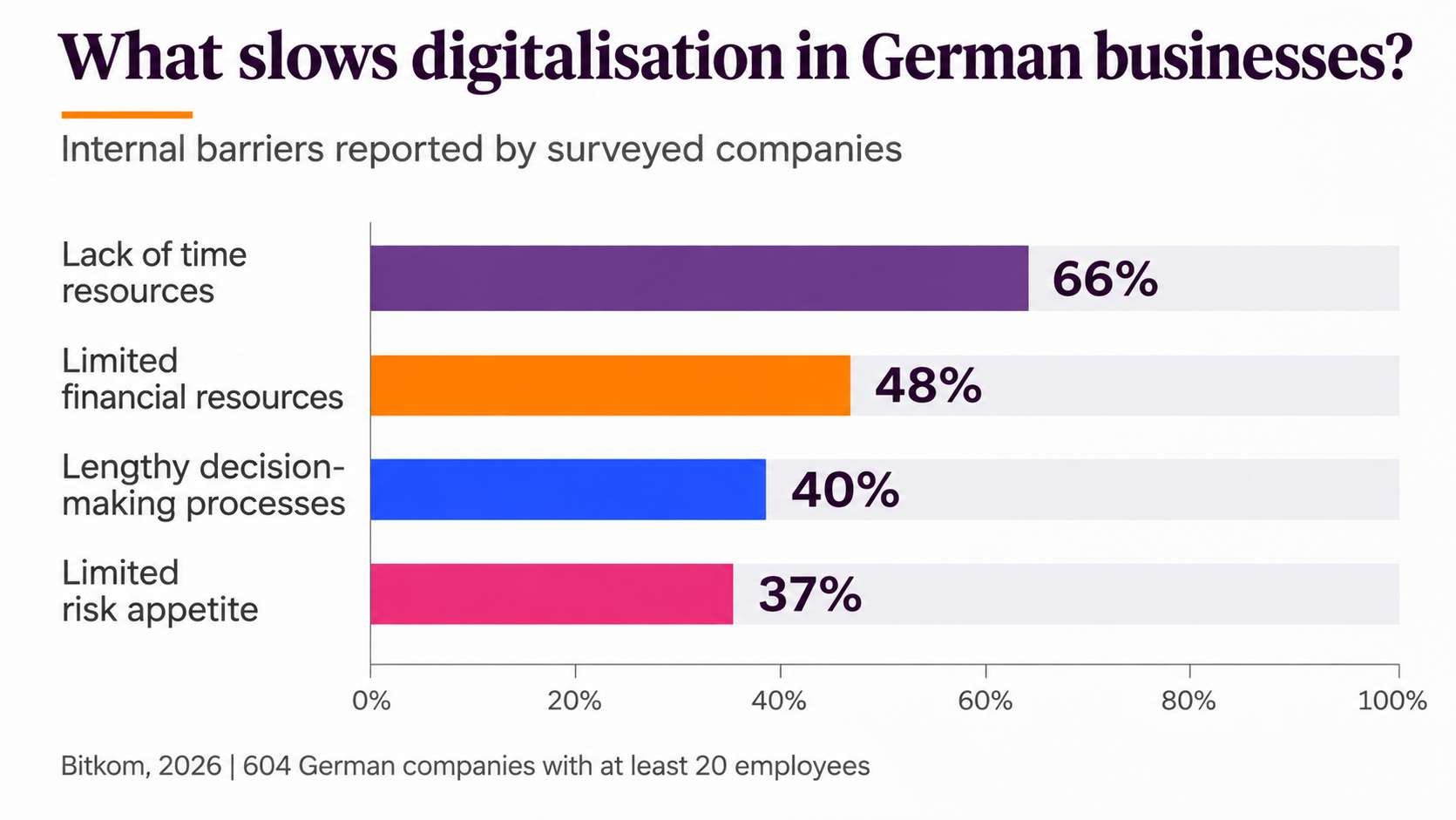
Even when a digital strategy exists, organisations must be able to execute it. This requires time, financial resources, skilled people and timely decisions. Bitkom's 2026 survey of 604 German companies with at least 20 employees found that 51% experienced difficulties managing digitalisation. Among the internal barriers reported, 66% identified insufficient time, 48% limited financial resources, and 40% lengthy decision-making processes. A further 37% cited limited risk appetite (Bitkom, 2026).
These findings apply to the wider surveyed business population, not exclusively to the Mittelstand. However, they highlight constraints that can be particularly difficult for smaller organisations with limited management capacity. Transformation initiatives also compete with day-to-day operational demands. When leaders cannot see how resources are distributed across projects, departments and strategic priorities, it becomes harder to identify bottlenecks or redirect capacity. The result is often fragmented execution: initiatives are approved but delayed, responsibilities overlap, and progress becomes difficult to evaluate. The issue is not necessarily a lack of ambition. It is the absence of a reliable management process for translating priorities into coordinated action.
The management capabilities transformation requires
Sustained transformation depends on an organisation's ability to recognise change, act on opportunities and adapt its resources. Teece (2007) describes these capabilities through three interconnected activities: sensing opportunities and threats, seizing opportunities, and reconfiguring organisational resources. Applied to digital transformation, this means identifying where technology can create value, committing resources to the right initiatives, and adapting structures and processes as conditions change. Research focused on German SMEs supports the importance of these organisational capabilities. Held, Heubeck and Meckl (2025) studied 98 SMEs in Southern Germany and found that dynamic capabilities contribute to the development of digital leadership and digital culture.
The study offers useful regional evidence, although its relatively small sample and specific geographical focus limit how broadly its findings can be generalised. Warner and Wäger (2019) similarly describe digital transformation as an ongoing process of strategic renewal, involving changes to business models, collaboration and organisational culture. For Mittelstand leadership teams, the practical implications are clear:
- Strategic visibility: Understand how initiatives contribute to organisational objectives.
- Leadership accountability: Establish clear ownership for transformation outcomes.
- Resource coordination: Allocate people, budgets and time according to strategic priorities.
- Performance oversight: Monitor progress and identify delivery risks early.
- Organisational adaptability: Reassess priorities as business conditions and requirements change.
These are management capabilities, not technology features. They determine whether digital initiatives can be coordinated and sustained.
Building a framework for sustained transformation
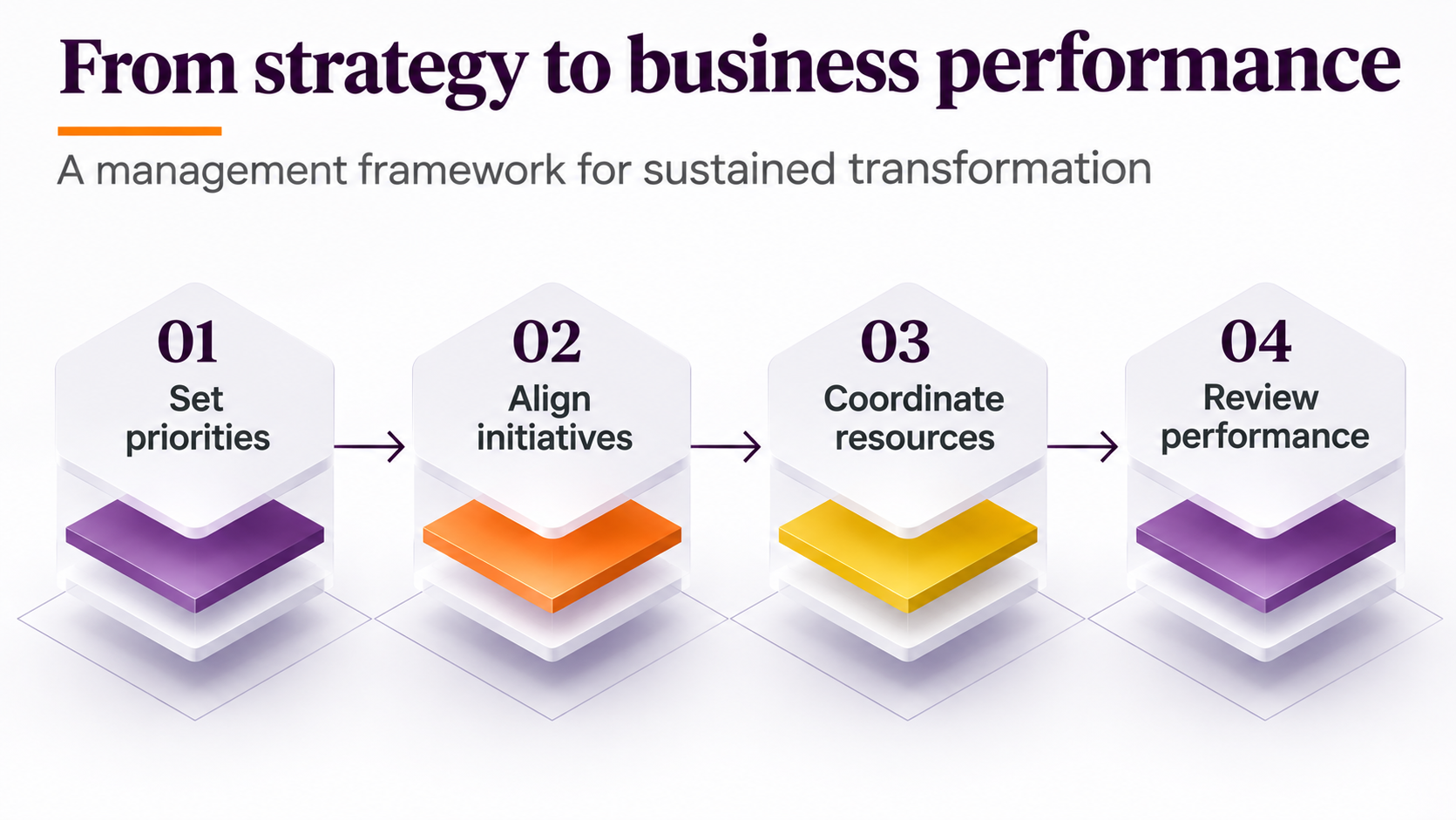
Digital transformation becomes more manageable when organisations connect strategy, execution and performance oversight through a consistent management framework. A practical approach involves four steps:
1. Establish strategic priorities.
Define the business outcomes transformation should support, such as operational efficiency, improved customer experience, resilience or productivity.
2. Connect initiatives to those priorities.
Evaluate projects according to their strategic contribution rather than treating every technology investment as equally important.
3. Coordinate resources and accountability.
Make responsibilities, dependencies, capacity requirements and decision-making ownership visible across the organisation.
4. Review performance continuously.
Track milestones, risks, resource utilisation and outcomes. Use this information to adjust priorities and address problems before they affect wider delivery.
This approach creates a connection between digital strategy and everyday management. It also helps leadership teams move beyond reporting whether projects are progressing towards understanding whether they are producing the intended business value.
Digital transformation as a business performance challenge
The central challenge for the German Mittelstand is not simply adopting more technology. It is developing the organisational capacity to turn digital investment into sustained business improvement. That requires visibility across strategic initiatives, clearer accountability, coordinated resources and decisions informed by reliable performance information.
Business performance management provides a way to connect these elements. Rather than viewing transformation as a series of isolated technology projects, leadership teams can assess how initiatives contribute to broader organisational objectives. AgilityVisual supports this management perspective by helping organisations improve visibility across portfolios and leadership priorities. For Mittelstand businesses managing multiple initiatives and competing demands, a structured view of priorities, progress and performance can support more informed management decisions.
Digital transformation is ultimately a leadership responsibility. Its success depends not only on what technology an organisation adopts, but on how effectively it manages the change that follows.
Critical appraisal and key takeaways
The evidence presents a consistent picture, but its limitations matter. KfW's findings cover SMEs and reflect the economic conditions of 2022–2024; they should not be interpreted as proof that management weaknesses caused lower digitalisation activity. Bitkom's management-barrier findings cover German companies with at least 20 employees, not the Mittelstand alone. The study by Held et al. offers relevant evidence from Southern German SMEs, but its sample of 98 businesses limits generalisability.
Taken together, the research supports a careful conclusion: technology investment and digital adoption are not sufficient on their own. Strategic alignment, leadership, resource coordination and organisational adaptability influence how effectively businesses translate digital initiatives into performance.
References and further reading
Bitkom. (2026). Digitalisation of the economy: Companies are struggling with digitalisation. Bitkom.
Bitkom. (2026). Small companies often lack a digitalisation strategy. Bitkom.
KfW Research and ZEW Mannheim. (2026). Digital firms are more productive.
Zimmermann, V. (2026). KfW SME Digitalisation Report 2025. KfW Research.