Effective workplace communication: Why it matters for leaders and how to improve it

Why should you care about workplace communication?
Communication is the lifeblood of any organization. Effective workplace communication has thus an immediate impact on organizational performance. For leaders to improve workplace communication, changing the culture is one place to start. Increasing psychological safety is one of the more important elements to focus on in a culture change initiative. In addition to culture change, coaching your peers, colleagues, and employees to communicate will also help encourage communication. When coaching, timing is very important. Furthermore, the five I’s of communication (intimacy, interactivity, inclusion, and intentionality) contribute to having meaningful dialogue at all levels. Finally, leaders should be aware of how technology such as business performance management software can help them to improve workplace communication.
Contents
- Why should you care about workplace communication?
- What is effective workplace communication?
- How to improve workplace communication?
- Encourage a culture of psychological safety
- Change internal beliefs through coaching interventions
- Implement lessons from small company organizational communication
- The four "Is" of effective organizational communication
- Technology and workplace communication
- Workplace communication can be improved
- Key recommendations for Leaders
- References and further reading
What is effective workplace communication?
Historically, communication within organizations came solely from senior executives who mostly communicated downward, receiving filtered upward information from close associates. Today, that model is becoming obsolete or even dangerous to rely upon. Leaders are learning that the older “command-and-control” model really cannot work in modern organizations due to the speed of change and the types of issues that arise.
Rather, leaders must harness the voices of people within the company as a source of new information, ideas, and problem solving. For instance, a Key Performance Indicator (KPI) that measures productivity can be seen from a totally different perspective on senior management level compared to a shopfloor level. While the senior management team looks at the KPI from a financial perspective, shopfloor team members look at it from an operational perspective. This may include specific measures to overcome roadblocks or to improve processes and standards to increase productivity.
When those perspectives are connected to each other, the shopfloor team will be supported by the senior management team to implement specific improvement measures which lead to productivity improvements. This might sound straightforward, however, it requires communication on eye level between people from different hierarchical levels with a different organizational reality.
Furthermore, effective workplace communications ensure that social networks within an organization are build, maintained, and utilized. When effective, those social networks are in important driver of organizational resilience, complexity management, innovation and many more outcomes related to organizational performance.
We still have many vestiges from the decades that organizations ran with a top-down communications culture, and many organizations will slip into this way of communicating almost accidentally. But, there are a variety of ways to improve this situation so that information can flow up, down, and horizontally within organizations.
How to improve workplace communication?
Improving communication can be challenging, but fortunately we have learned from decades of research that improving cultural variables like psychological safety can have a strong positive effect on communication.
Furthermore, research has shown us that we can coach more junior employees (at the appropriate times) to learn to communicate more effectively.
Finally, the Groysberg-Slind (2012) view of improving organizational communication combines factors from successful small companies and leaders to create a holistic model of successful communication in all directions.
Encourage a culture of psychological safety
In our Dossier on how organizational culture impacts communication, the research documenting the significant link between psychological safety and communication was discussed (e.g, Edmondson, 2004; Edmondson, 1999).
The problems with psychologically unsafe behavior (e.g., abusive supervision) also were clear from the literature (Tepper, 2000). In a psychologically safe environment, it is ok (and even expected) to speak-up with ideas and concerns. It is important that leaders foster a culture of psychological safety, and such a culture starts with their own behavior.
In order to encourage a culture of psychological safety, there are some basic steps that leaders can take. Edmondson (2004, 2014) suggests ways that leaders can improve psychological safety and communication. Three main ways include:
- Reframing work as a learning situation
- Acknowledging your own fallibility
- Model curiosity
Reframe work as a learning situation
Make it explicit that there is uncertainty here, so everyone’s voices are needed to get through the challenges. This creates the rationale for communication.
Acknowledge your own fallibility
Say simple things like, “I may miss something, I need to hear from you too”. That creates more safety for communication.
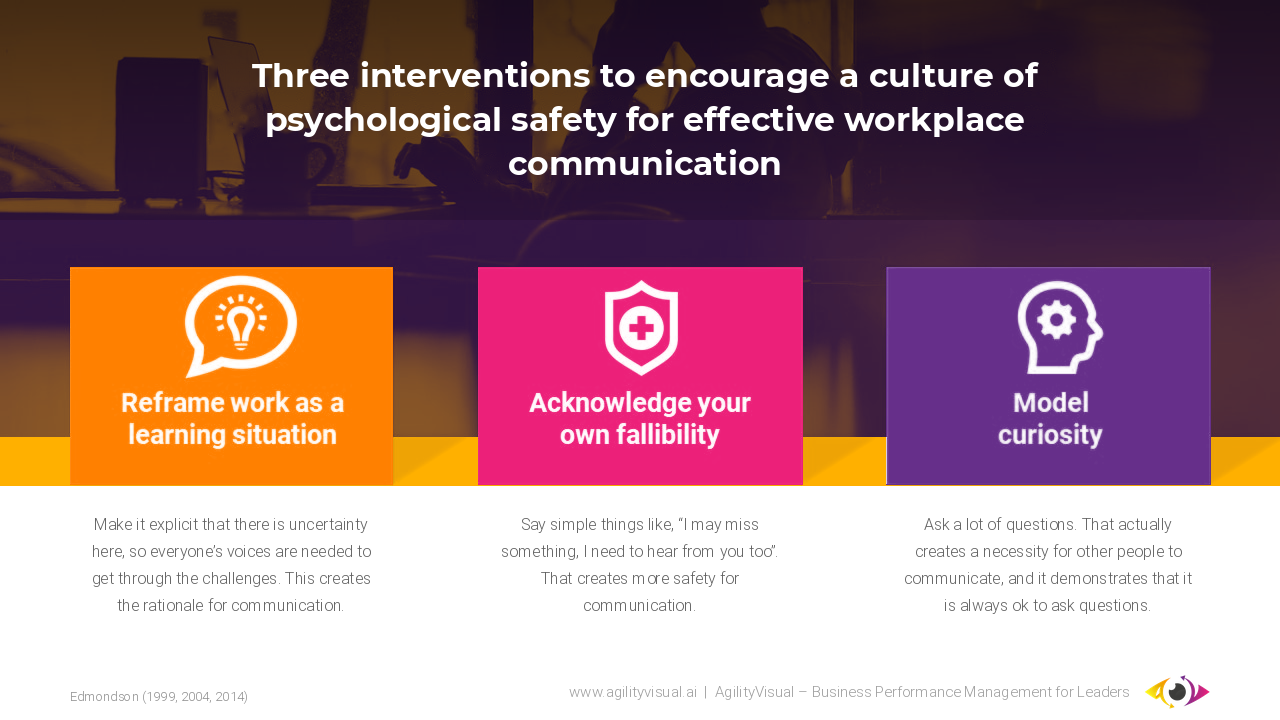
Model curiosity
Ask a lot of questions. That actually creates a necessity for other people to communicate, and it demonstrates that it is always ok to ask questions.
Some leaders are uncomfortable with some of the above steps because they feel like too much psychological safety might create complacency or even laziness. Psychological safety does allow people to feel a little freer to speak up and work together, but it is not going to reduce people’s motivation or accountability simply because they may feel safer to bring up a complaint or criticism.
Change internal beliefs through coaching interventions
Internal belief systems have a significant effect on what a person decides to communicate and when. Additionally, research has found that it is difficult to rewrite these beliefs just by changing the organizational culture alone (Detert & Edmondson, 2011).
Chose the right timing of coaching interventions
One way that these beliefs can be changed is through coaching (Edmonson, 2002; Edmondson, 2004). It is important to note that all coaching is created equal, and one important factor that researchers have studied is the timing of coaching interventions.
Timing coaching or communication to occur at the right moment has a significant effect on how well the intervention will work. In particular, if you are trying to change someone’s internal beliefs, timing is even more important (Wageman, Fisher, & Hackman 2009).
For example, if a leader is paying close attention to employees and gets the sense that someone is withholding criticism or an idea, they can intervene in that moment to say,
“it’s ok to criticize my idea – I really want to hear your thoughts on this… I haven’t fully fleshed all of this out yet.”
This will help to override the persistent and commonly-held belief that it can be dangerous to criticize the boss.
Relate the coaching intervention to a specific situation
It’s more effective to say this when a new product is being discussed or a new problem has come up than it is to have it said during some kind of general employee orientation about “how we have an open culture” which is common in larger companies.
In order for the message to sink in and for people to essentially relearn what it means to communicate it is important to relate the coaching intervention to a specific situation.
Implement lessons from small company organizational communication
The researchers Boris Groysberg and Michael Slind (2012) studied organizational communication by initially looking at the elements of small company success and how people communicated within those companies. They found four main factors within small companies that they later translated into actionable steps for leaders, discussed in the next section. The attributes of small companies were as follows:
- Scale: Leaders and employees are close to each other and there is no real hierarchy.
- Structure: Physical closeness and a collaborative culture allow people to share ideas and information can move in many directions.
- Participation: In a small company, there are fewer divisions of labor than in a large company. So, a wide range of employees can do many things. This gives employees better insight into all processes and they have more interaction with colleagues who would be in a different department (often separated from interaction) if the organization were larger.
- Focus: Employees are much more closely aligned with what their leaders want in smaller companies.
The four "Is" of effective organizational communication
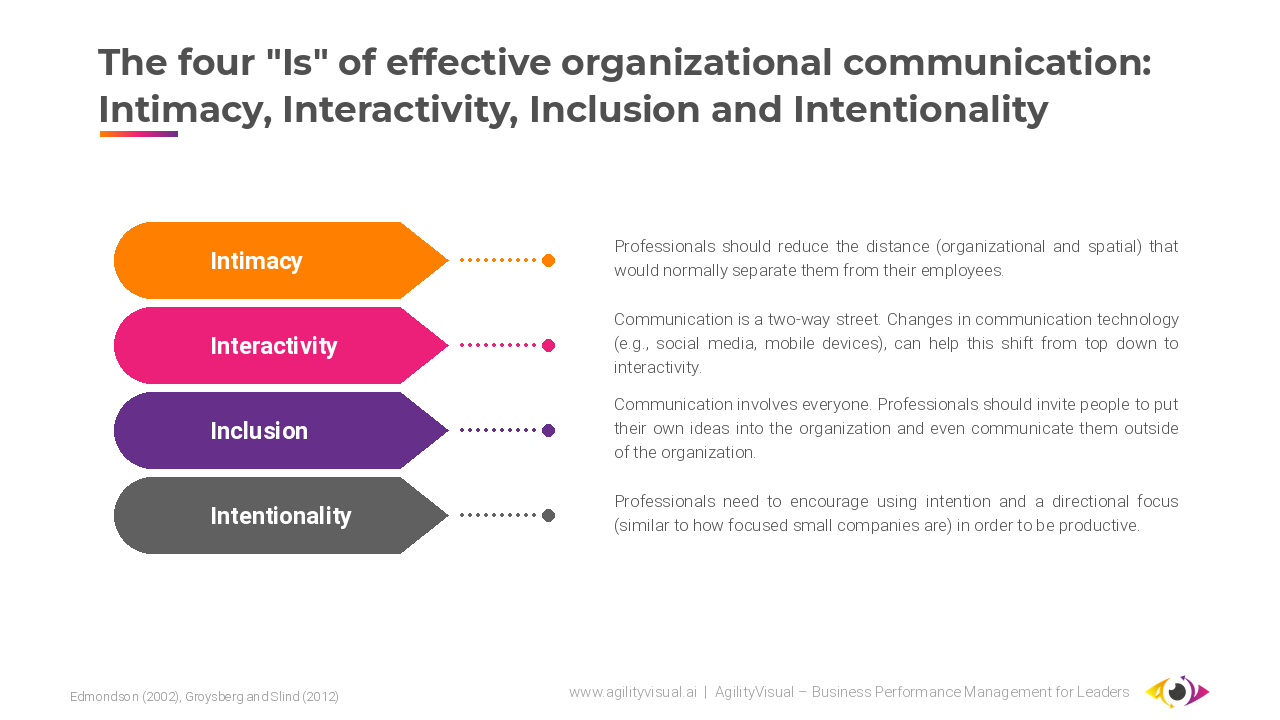
Groysberg and Slind (2012) took their findings successful companies and developed the “Four Is of organizational communication”:
- Intimacy,
- Interactivity,
- Inclusion and
- Intentionality.
These principles give leaders additional ways to intervene in order to improve communication and derive more value from it.
Intimacy
Conversation between two people requires and enables its participants to be close to each other. Intimacy allows people to have deeper and meaningful dialogue. Therefore, for effective organizational communication, leaders should reduce the distance (organizational and spatial) that would normally separate them from their employees.
They can do this by listening to people at all levels of the organization and by learning to talk with those people in ways that are personal, honest, and authentic.
They can also restructure organizations to become flatter. Intimacy also allows leaders to manage change within their company more effectively, as it helps them to solidify buy-in among employees for new initiatives.
In short, intimacy allows people to build trust through communication. Trust is also a key component of psychological safety, discussed above (Edmondson, 2002).
Interactivity
Communication is a two-way street. As mentioned, the older top-down method of corporate communication is becoming obsolete, and leaders now need to talk with employees and not just down to them.
Changes in communication technology (e.g., social media, mobile devices), can help to support this shift. As leaders emphasize interactivity, it becomes more normal for coworkers to communicate in every direction, rather than just receiving commands from above.
There are many benefits from two-way interactions. These include lower transaction costs, an easing of the pressure caused by information overload, and an increase in employees’ ability to respond readily to customer needs because they already have an interactive relationship with staff that they need to respond to customers if faced with a complicated problem.
Inclusion
At its best, communication involves everyone. Leaders should invite people to put their own ideas into the organization and even communicate them outside of the organization.
For example, people in customer-facing and midlevel posts can essentially be semiofficial company communicators through their own social media, as trained brand ambassadors.
By empowering employees to communicate in that way, leaders do give up some control that they formerly exerted over organizational messaging. This may seem dangerous as leaders used to a highly controlled corporate communications department, but leaders get a lot in return.
Through inclusion, leaders are able to boost employee engagement to spur innovation, creativity and to improve the branding and reputation of the organization. Brand ambassadors can also be conduits for customer feedback.
Intentionality
Even in the most casual conversation, the people talking will each have some sense of where they want the conversation to go. Leaders need to encourage using intention and a directional focus (similar to how focused small companies are) in order to be productive.
Leaders must put an emphasis on developing and following an agenda that aligns with the strategic objectives of the company. Over time, the many voices that contribute to communication within an organization ideally will converge, if intentionality and focus is prioritized.
Technology and workplace communication
While culture change and coaching address the human side of communication, technology increasingly shapes whether these interventions can scale across an organization. Digital collaboration tools and shared performance platforms can shorten the distance between leaders and employees, turn one-way reporting into ongoing dialogue, and make it easier to include voices from every level of the organization.
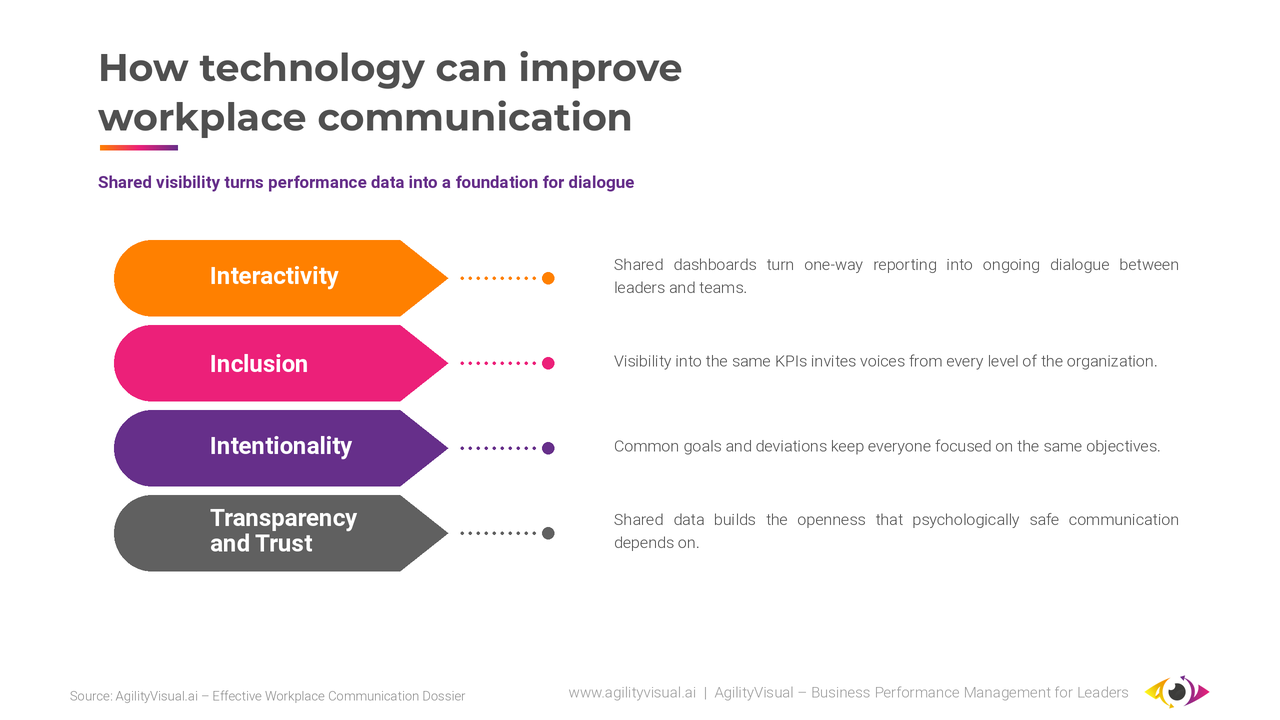
Business Performance Management Software like AgilityVisual puts this principle into practice: by giving everyone in the organization visibility into the same KPIs, goals, and deviations, it turns performance data into a shared reference point for conversation rather than a top-down report reserved for leadership. When teams and leaders can see the same numbers, ask the same questions, and track progress together in real time, it reinforces the interactivity, inclusion, and intentionality that the Four Is framework calls for, and builds the kind of transparency that psychologically safe communication depends on.
Workplace communication can be improved
By employing the strategies presented in this Dossier, the likelihood of creating a more fertile ground for effective organizational communication is greatly increased.
Key recommendations for Leaders
- The traditional top-down only communication approach is outdated
- Increasing psychological safety in your organization can improve communication
- Coaching employees at the right times will help them to learn communication skills appropriate to your organization
- The Four “Is” of communication (intimacy, interactivity, inclusion, and intentionality) are an important part of having organizational communication that flows well upward, downward, and horizontally
- Business Performance Management Software like AgilityVisual supports leaders to improve workplace communication
References and further reading
Detert, J. R. & Edmondson, A.C. (2011). Implicit voice theories: An emerging understanding of self-censorship at work. Academy of Management Journal, 54, 461-488.
Edmondson, A. C. (1999). Psychological safety and learning behavior in work teams. Administrative Science Quarterly, 44, 350-383.
Edmondson, A. C. (2002). The local and variegated nature of learning in organizations: A group-level perspective. Organization Science, 13, 128-146.
Edmondson, A. C. (2003). Speaking up in the operating room: How team leaders promote learning in interdisciplinary action teams. Journal of Management Studies, 40, 1419-1452.
Edmondson, A. (2004). Psychological safety, trust and learning: A group-level lens. In R. Kramer & K. Cook (Eds.), Trust and distrust in organizations (pp. 239-272). New York: Russell Sage.
Edmondson, A. C. (2014). Building a psychologically safe workplace: Amy Edmondson at TEDxHGSE,Retrieved from https://youtu.be/LhoLuui9gX8.
Groysberg, Boris, and Michael Slind. Talk, Inc. How Trusted Leaders Use Conversation to Power Their Organizations. Harvard Business Review Press, 2012.
Tepper, B. J. (2000). Consequences of abusive supervision. Academy of Management Journal, 43, 178–190.
Wageman, R., Fisher, C.M., & Hackman, J.R. (2009). Timing is everything: The importance of finding the right moment in leading teams. Organizational Dynamics, 38, 192-203.