Implicit bias: How to identify and to minimize bias in the hiring process

Why you should care about implicit biases
Humans are influenced by implicit biases in their day-to-day behavior. Particularly when it comes to the hiring process in organizations, implicit bias can play a strong role in deciding who to interview, who to hire and who to fire. This strongly influences organizational outcomes. There are particular types of bias that can be identified in the hiring process. Understanding, acknowledging and working against these implicit biases can improve the hiring process and help create an effective recruitment and selection program that benefits the organization on the long run.
Contents
- Why you should care about implicit biases
- Implicit bias influences the hiring process in organizations
- There are three most common implicit biases in hiring
- Race and gender bias during the hiring process is extremely common
- Human Resource practices help reduce bias in the hiring process
- Bias and prejudices negatively impact decision-making on all levels
- Key recommendations for professionals
- References and further reading
Psychological research has shown that implicit bias can impact the decisions made during the hiring process. There are several common and important psychological processes that impact decision making and hiring. Awareness of bias can help inform decision-makers on how to make successful hiring decisions. There is a wealth of scientific research demonstrating that individuals hold implicit biases that impact judgment.
Implicit bias influences the hiring process in organizations
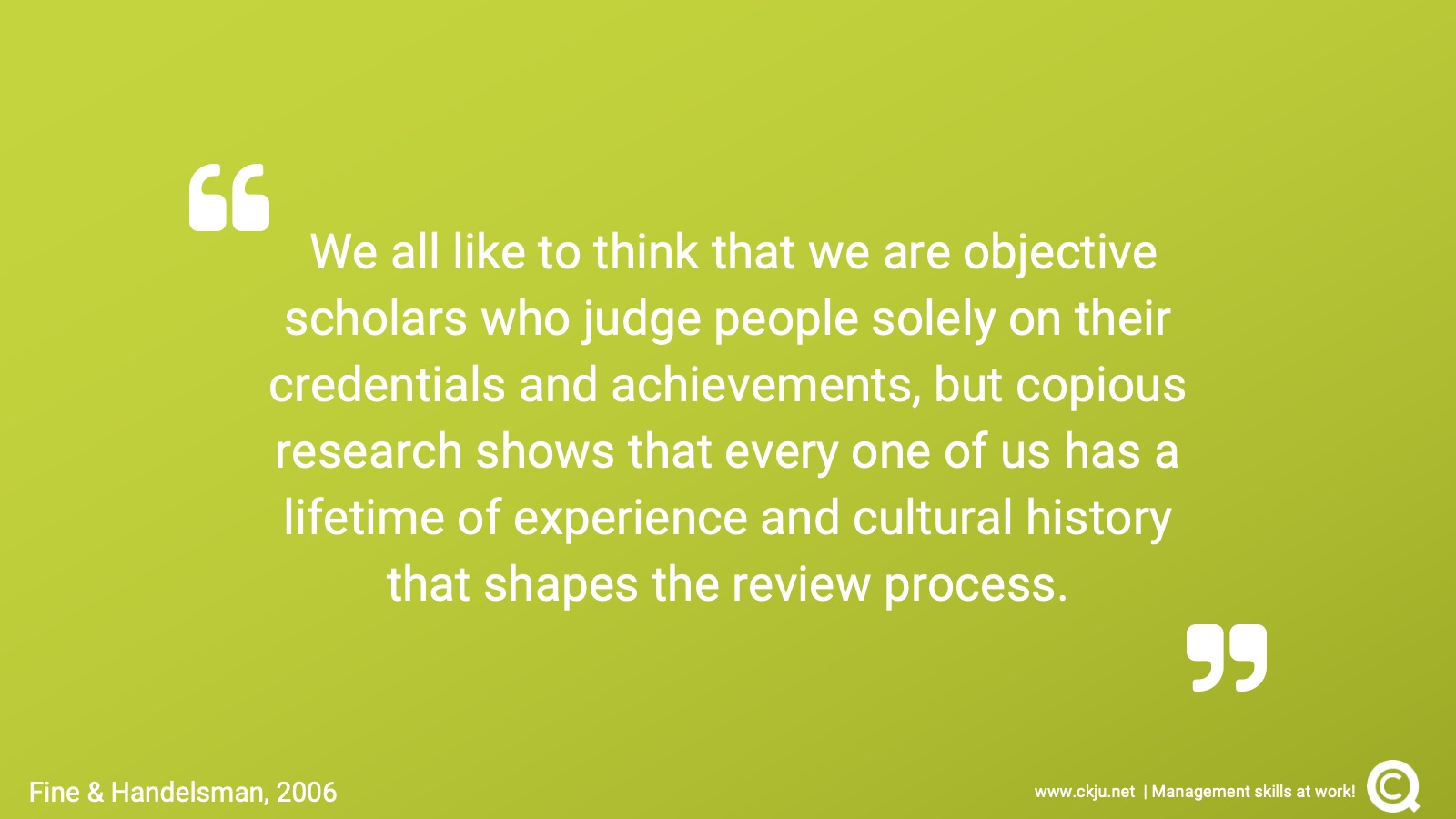
Research suggests that all individuals engage in unconsciously biased assessment and decision-making processes:
Rather than blaming decision-makers, it is important to understand and minimize the negative impact of unintended bias in searching for talented workers. This CQ Dossier describes those biases that can impact decision-making and makes recommendations on how best to overcome them.
There are three most common implicit biases in hiring
Research shows that in organizations, there are three most common implicit biases that occur in the hiring process. These influence not only who ends up working in the organization, but also how well the organization does and how organizational culture develops in the long run.
Categorization helps process complex information
Individuals are bombarded with a large amount of information and this is especially true in the workplace and during hiring. When dealing with a large amount of information about a candidate, decision-makers tend to use categorization. Categorization is a cognitive process that occurs largely outside of conscious awareness and helps people to cope in a complex and demanding environment.
Stereotyping links individuals with assumptions and judgments
Stereotyping is the unconscious habits of thought that link personal attributes to group membership and is an inevitable result of categorization. The expectations based on stereotypes can give rise to attributions that are biased and not based in fact (Reskin, 2000). Results from research studies have demonstrated that people often hold assumptions that influence their judgments and these include assumptions about physical or social qualities associated with race, gender and other demographic factors. All these biases have implications for the effectiveness of the hiring process.
The Halo/Horn effect makes one attribute overshadow another
The Halo effect is the tendency for an impression created in one area to influence opinion in another area. During an interview, an interviewer can allow one strong attribute about a candidate to influence all other effects. For example, if a candidate is physically attractive, then this can lead to the interviewer assuming they are intelligent and confident (Watkins & Johnston, 2000). The horn effect is the opposite effect whereby a weak impression in one area creates a weak impression in another. This is also similar to confirmation Bias, which is a tendency for humans to seek out information that supports a pre-conceived belief about the applicant that has been formed prior ot the interview (Phillips & Dipboye, 1989).
Race and gender bias during the hiring process is extremely common
The above-mentioned three types of bias manifest in very direct ways. The most obvious ones are race and gender bias. Such aesthetic attributes speak to implicit biases and thereby overshadow other traits more relevant to the job.
Race and implicitly associated traits directly influence hiring decisions
In a study that focused on the effect of bias on the hiring process, race played a factor in choosing the ideal candidate (Dovidio & Gaertner, 2000). Participants were asked to choose counselors from among a group of applicants who were neither exceptionally qualified nor unqualified for the position. All the applicants were equally qualified. The participants were more likely to choose the White candidates than Black candidates, indicating their willingness to give members of the majority group the benefit of the doubt (Dovidio & Gaertner, 2000). This study illustrates how decision-makers can apply generalizations that are not relevant to the evaluation of job candidates (Beiby & Baron, 1986).
There are several assumptions or biases that can influence the evaluation of applicants. Research provides several examples. For example, in a study regarding race bias, participants rated the quality of verbal skills as indicated by vocabulary definitions (Biernat & Manis, 1994). The evaluators rated the skills lower if they were told a Black applicant provided the definitions than if a White person provided them (Biernat & Manis, 1994). In a clever study, Bertrand and Mullainathan (2004) showed that job applicants with names that sounded White were more likely to be interviewed than applicants whose names sounded Black.
Pre-existing gender perceptions skew hiring and selection procedures
Evaluators also show bias based on gender. Research has shown that incongruities between perceptions of female gender roles and leadership roles cause evaluators to assume that women will be less competent leaders. Moreover, when women provide evidence of their competence and violate traditional gender norms, evaluators perceive them to be less likable and are less likely to recommend them for hiring (Eagly & Karau, 2002; Heilman et al., 2004).
Even in jobs that require high levels of expertise, there is evidence that bias exists. In a study focused on academic recruiting for medical faculty, there was evidence of bias in letters of recommendation (Trix & Psneka, 2003). The researchers examined over 300 recommendation letters for medical faculty hired by a large school in the United States. They found that letters for female applicants were substantially different than those for male applicants. Letters written or women were shorter, provided minimal assurance’ rather than solid recommendations, raised more doubts, and portrayed women as students. Men were portrayed as researchers and professional and the letters more frequently mentioned women’s personal lives (Trix & Psneka, 2003).
Human Resource practices help reduce bias in the hiring process
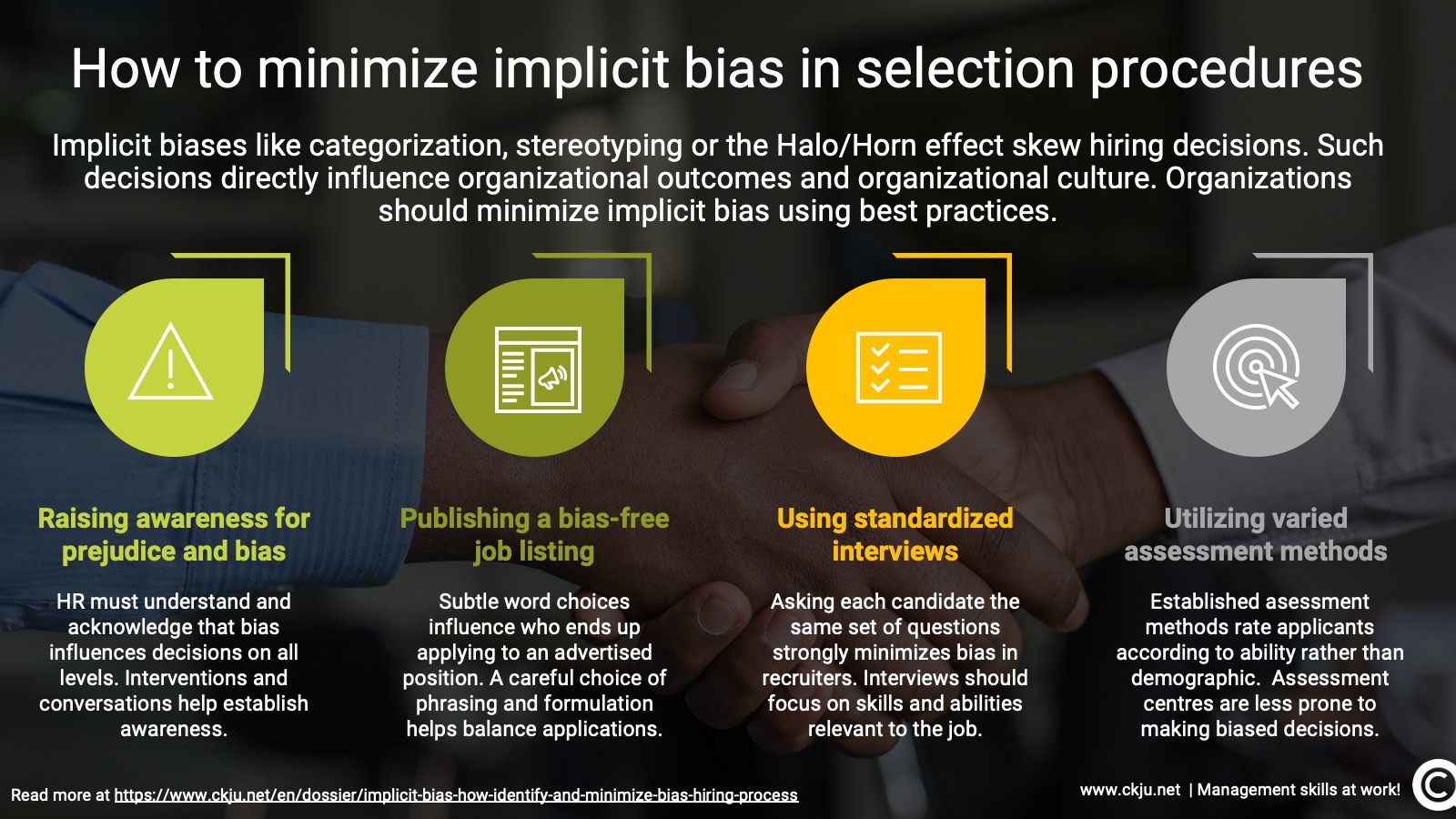
There are several ways to reduce bias in the workplace through implementing several human resource practices that challenge implicit assumptions and bias. Organizations and individuals in positions of influence must consider ways to simplify and standardize the process of hiring in order to minimize bias and to yield the best possible organizational outcomes.
Raising awareness for prejudice and bias
First, it is important that HR professional understand the nature of prejudices and how they operate. One strategy is to provide employees involved in the hiring process with education and training on the topic. Awareness training is useful because it allows individuals to acknowledge their own unconscious bias and recognize that everyone has them. Through awareness training, employees can recognize and challenge their own implicit biases and prejudices. This can be an organization-wide intervention whereby all employees engage in conversations on how the organization can take steps to minimize bias.
Minimizing bias begins with the job listing
During the recruiting posting, it is important to ensure that the job listing does not contain bias. Job listings play an important role in recruiting and even subtle word choices can impact recruitment. When recruiters use masculine language (e.g., competitive), this can deter women from applying to positions (Gaucher, Friesen, & Kay, 2011); in contrast, the use of words like collaborative and cooperative tend to draw more women than men (Gaucher et al., 2011).
Standardized interviews reduce bias and help focus on personality traits
The use of standardized interviews can also reduce bias because each candidate is asked the same set of defined questions and this standardizes the interview process by encouraging recruiters to focus on those factors that are directly relevant to job performance.
Using varied assessment methods allows for ratings based on ability rather than demographics
One way in which to reduce bias is through the utilization of a battery of assessment tests. Research has shown that assessment centers are a valid predictor of job performance and that they are also less prone to bias with use of multiple assessors and multiple assessment opportunities. Research suggest that most of the variance in ratings are due to differences among candidates rather than assessor bias (Thornton & Rupp, 2006). The reason for their effectiveness is that assessors are trained to focus on the dimensions of ability rather than on the candidate and the chosen method. This allows for congruence of ratings based on applicant ability rather than the demographics of the applicant. The use of multiple assessment tests and training is another way in which bias can be reduced.
Bias and prejudices negatively impact decision-making on all levels
In conclusion, scientific research demonstrates how bias and prejudices can negatively impact decision-making, particularly in the hiring process. Research demonstrates that individuals use unconscious bias when deciding whom to choose for a position. This bias occurs regardless of experience and education of the hiring personnel. However, research also suggests that these biases can be reduced through education, training, and effective human resource practices, such as the use of standardized interviews.
Key recommendations for professionals
- All individuals engage in unconsciously biased assessment
- It is important to minimize the negative impact of unintended bias in searching for talented workers
- Expectations based on stereotypes can give rise to attributions and judgements that are biased
- Biased hiring and selection procedures can negatively impact organizational outcomes
- Through awareness training, employees can recognize and challenge their own implicit biases and prejudices
References and further reading
Bertrand, M., & Sendhil, M. (2004). Are Emily and Greg more employable than Lakisha and Jamal? American Economic Review, 94, 991-1013.
Bielby, W.T., & Baron, J.N. (1986). Men and women at work: Sex segregation and statistical discrimination. The American Journal of Sociology, 91, 759-799.
Biernat, M., & Manis, M. (1994). Shifting standards and stereotype-based judgments. Journal of Personality and Social Psychology, 66, 5-20.
Dovidio, J.F., & Gaertner, S.L. (2000). Aversive racism and selection decisions: 1989 and 1999, Psychological Science, 11, 315-319.
Eagly, A.H., & Karau, S.J. (2002). Role congruity theory of prejudice toward female leaders, Psychological Review, 109, 573-598.
Fine, E., & Handelsman, J. (2005). Reviewing applicants: Research on bias and assumptions.
Gaucher, D., Friesen, J., & Kay, A. C. (2011, March 7). Evidence That Gendered Wording in Job Advertisements Exists and Sustains Gender Inequality. Journal of Personality and Social Psychology.
Heilman, M.E. Wallen, A.S., Fuchs, D. & Tamkins, M.M. (2004). Penalties for success: reactions to women who succeed at male gender-typed tasks. Journal of Applied Psychology, 89, 416-427.
Phillips, A. P., & Dipboye, R. L. (1989). Correlational tests of predictions from a process model of the interview. Journal of Applied Psychology, 74(1), 41-52.
Thornton, G. C., III, & Rupp, D. R. (2006). Assessment centers in human resource management: Strategies for prediction, diagnosis, and development. Mahwah, NJ: Lawrence Erlbaum.
Trix, F.& Psenka, C. (2003). Exploring the color of glass: Letters of recommendation for female and male medical faculty, Discourse & Society, 14, 191-220.
Watkins, L. M. & Johnston, L. (2000). Screening job applicants: The impact of physical attractiveness and application quality. International Journal of Selection and Assessment, 8, 76-84.