The importance of team cohesion for team effectiveness

Executive summary
This CQ Dossier examines the importance of team cohesion on team performance and organizational effectiveness. The notion of team cohesion has been an important topic for the past 70 decades with a plethora of knowledge concerning its role in team and organizational effectiveness. We provide you information on a several important features of team cohesion including a) a definition of team cohesion b) how team cohesion differs from group cohesion; c) how to measure team cohesion and c) the outcomes of team cohesion. In addition, we provide you recommendations on how organizations can benefit from team cohesion.
Contents
- Executive summary
- What is team cohesion?
- How does team cohesion differ from group cohesion?
- How to measure team cohesion
- What are the outcomes of team cohesion in terms of performance?
- Team cohesion predicts team performance over time
- Team cohesion is important and is positively linked to performance
- Critical appraisal of team cohesion: Solidity Level 4
- Key take-aways
- References and further readings
What is team cohesion?
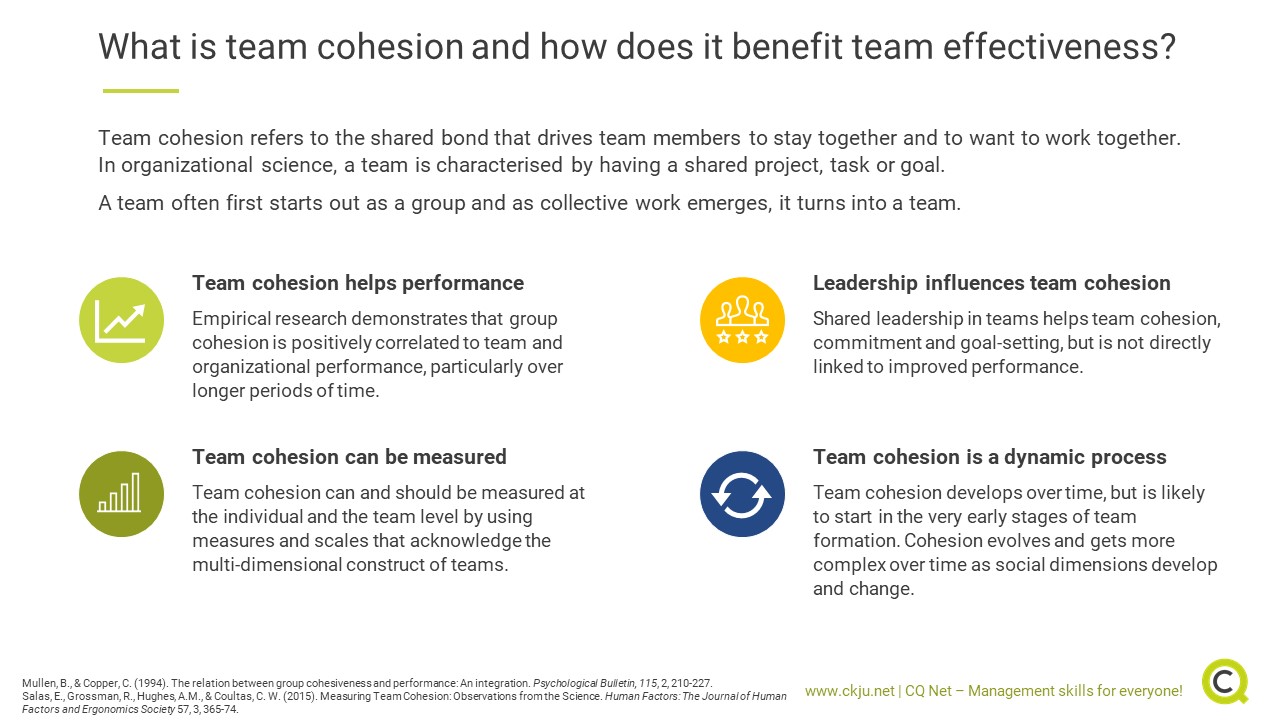
An early definition of team cohesion is “the total field of forces which act on members to remain in the group.” Festinger, Schacter & Back, 1950, p164). In a review of the team cohesion literature, Salas and colleagues (2015) describe how teams can be beneficial for organizational effectiveness but they need to be cohesive in order to be effective. Salas et al. (2015) describe team cohesion as “the shared bond/attraction that drives team members to stay together and to want to work together.” (p. 365).
How does team cohesion differ from group cohesion?
The terms team or group are often used interchangeably but there is a subtle difference in the term.
A group is characterized by social cohesion and interaction of its members
Social psychologists such as Hare (1962) define a group as “two or more humans who interact with each other, have expectations as members of the group, and share a common identity.” A group is more than a mass of people, such as those waiting in line at a supermarket. There is social cohesion among group members and a level of social interaction (Hare, 1962).
A team is characterized by having to complete a task or project
A team differs from a group in that team members are required to complete a task or project, and so the term team is important in the area of organizational science. Team members share responsibility for projects and, as a team are accountable for team performance. Within the workplace, teams work towards common organizational goals.
A group can be seen as first stage in becoming a team
Another way to approach the difference between group cohesion and team cohesion is to view a group as the first stage in becoming a team. In a Harvard Business review article, the authors view group cohesion as showing cooperation and coordination among group members. However, team cohesion occurs when the members engage in collective work and demonstrate mutual commitment to challenging goals in order to reach an overarching purpose. The authors state that “collective work produces more innovative and productive outcomes that exceed the simple sum of individual efforts.”
How to measure team cohesion
The measurement of team cohesion has been illusive for organizational science researchers. In a review of the literature on measurement of team cohesion, Salas and colleagues (2015) offer several recommendations.
- First, team cohesion is conceptualized as a multi-dimensional construct including dimensions that emphasize social and task dimensions across a range of attitudes and behaviors. It is best to construct measures and scales that emphasize team cohesion as a multidimensional construct.
- Second, team cohesion should be measured at both the individual level and at the team level (Salas et al., 2015).
- Third, team cohesion develops over time, yet few researchers have acknowledged the dynamic nature of team cohesion (Salas et al., 2015). Research suggests that teams develop cohesion during the early stages of team formation, so Salas and colleagues suggest that researchers develop measures that capture the concept of “swift cohesion” in order to increase the reliability and validity of measures.
What are the outcomes of team cohesion in terms of performance?
There is empirical evidence to show that group cohesion is a positive predictor of team and organizational performance. Several meta-analytic reviews have revealed a positive relationship between group cohesion and performance (e.g., Mullen & Copper, 1994). However, this relationship between group cohesion and performance has been small, leading to speculation in group theory on the role of group cohesion.
[block:views=teams_progressive-content_teams]
Organizational scientists have focused on team cohesion within the workplace and have posited that one of the reasons for these weak effects is that the dynamic nature of team cohesion has not been considered in the research studies.
Team cohesion predicts team performance over time
To examine this gap in the literature, Mathieu and colleagues conducted a meta-analytic review on 17 team cohesion-performance studies and found support for the positive relationship between the two factors. They also conducted a longitudinal study among 205 team members of 57 student teams. The teams were completing a business simulation over a 10-week period. They found that there was a positive relationship between team cohesion and performance over time. The results are as follows:
- Team cohesion was a stronger predictor of performance over time than when performance was examined as a predictor of team cohesion and the team cohesion-performance relationship grew stronger over time.
- In addition, shared leadership was related positively to team cohesion but not to performance.
This is one of the more robust studies on the linkage between team cohesion and performance mainly because the temporal nature of teams is included in the theoretical model.
Team cohesion is important and is positively linked to performance
There has been a plethora of research on the importance of team cohesion within the organizational science literature. The research shows that team cohesion is important and is positively linked to performance, when the temporal nature of teams is included in theoretical models. Researchers should focus on generating reliable and valid measures of team cohesion that capture the characteristics of this important construct. This will yield richer findings and make a contribution to the research on teams and organizational performance.
Critical appraisal of team cohesion: Solidity Level 4
Based on the empirical evidence for the importance of team cohesion, this dossier is assigned a Level 4 rating, (Based on a 1- 5 measurement scale). A level 4 is the second highest rating score for a CQ Dossier based on the evidence provided on the efficacy of team cohesion. To date, the research on team cohesion has demonstrated the importance of this construct in predicting performance. Future research needs to incorporate a more dynamic view of the relationship between team cohesion and performance in order to show its importance.
Key take-aways
- For teams to be effective, they need to be cohesive
- Team cohesion is the shared bond that drives team members to stay
- Team cohesion occurs when members demonstrate mutual commitment to goals
- Collective work produces more innovation
- Team cohesion is dynamic
- It is important to acknowledge the temporal nature of teams in measurement
- Team cohesion is a positive predictor of performance
- The relationship between team cohesion and performance grows stronger over time
References and further readings
Festinger, L., Schacter, S., & Back, K. (1950). Social pressures in informal groups: A study of human factors in housing. Stanford, CA: Stanford University Press.
Hare, A. P. (1962). Handbook of small group research. New York: Macmillan.
Mathieu, J. E., Kukenberger, MR., D’Innocenzo, L., & Reilly, G. (2015) Modeling Reciprocal Team Cohesion–Performance Relationships, as Impacted by Shared Leadership and Members’ Competence. Journal of Applied Psychology 100, 3, 713-34.
Mullen, B., & Copper, C. (1994). The relation between group cohesiveness and performance: An integration. Psychological Bulletin, 115, 2, 210-227.
Salas, E., Grossman, R., Hughes, A.M., & Coultas, C. W. (2015). Measuring Team Cohesion: Observations from the Science. Human Factors: The Journal of Human Factors and Ergonomics Society 57, 3, 365-74.