The Importance of Wellbeing: Organizational Outcomes from an Evidence-based Management Perspective

Executive Summary
A growing number of organizations are focusing on caring for their employees in a holistic, wellbeing-focused manner. Particularly among tech companies and start-ups, employee benefits now surpass simple health and retirement benefits, and include physical health programs, continuing education credits, and even on-site wellness facilities such as yoga rooms (Dailey & Zhu, 2017). In some circles, these benefits are seen as overly lavish, or merely a novelty; the assumption is often made that caring for employees’ bodies and minds does not pay off in terms of measurable outcomes (McCleary et al, 2017).
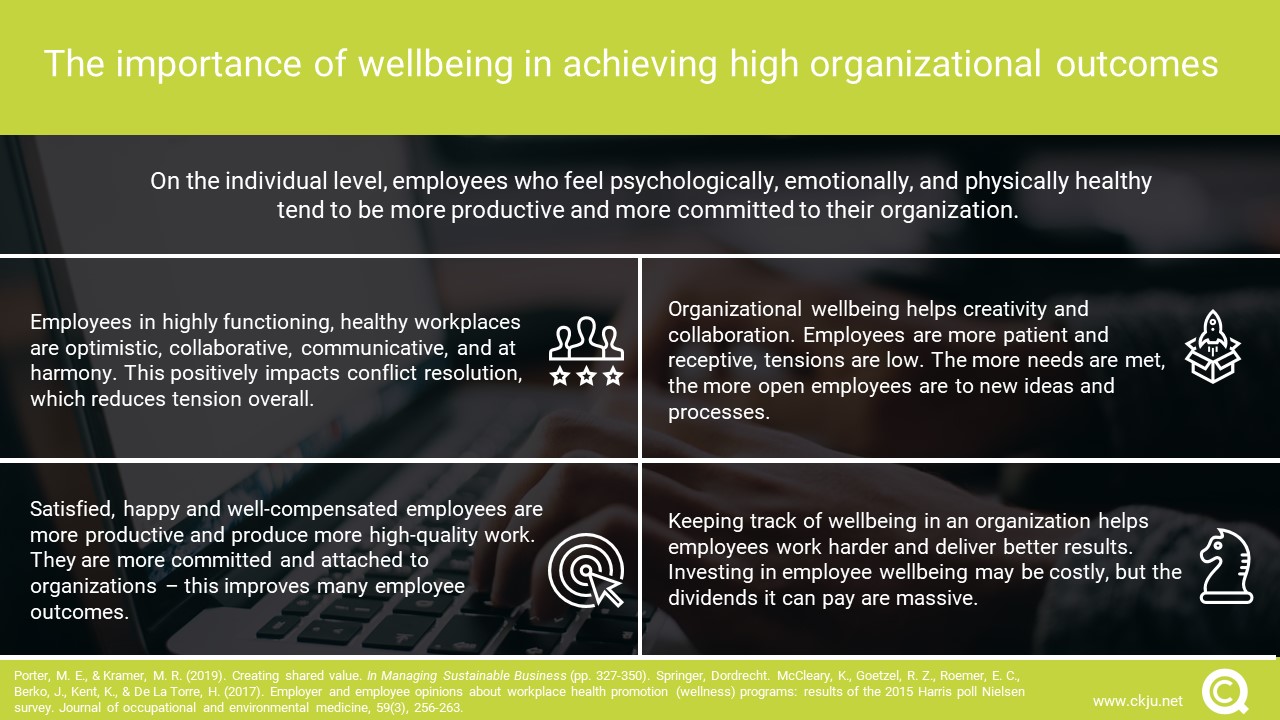
While many organizations truly cannot afford to give their employees free organic food or yoga rooms, there is a plethora of evidence that supports caring for employee wellbeing (Gubler et al, 2017). On the individual level, employees who feel psychologically, emotionally, and physically healthy tend to be more productive and more committed to their organization (Porter & Kramer, 2019). The risk of burnout is also diminished among employees whose wellbeing is attended to. But what about the macro level? A great deal of research also highlights the organizational benefits of caring about employee wellbeing. This dossier will review some of the latest findings on the subject, and provide advice to managers seeking to improve wellbeing across their workplace.
Contents
A high level of wellbeing has positive effects on the ability to resolve conflicts.
A highly functioning, healthy workplace is one in which employees are motivated and optimistic, teams are collaborative and communicative, and virtually no one views their job requirements as presenting a threat to their mental, emotional, or physical health. In such an environment, the organization begins to blossom and thrive in harmony with its employees. Health, optimism, and positivity motivate individuals to reach new performance levels and avoid conflicts that would have arisen in the past (Despres et al, 2014).
One sizeable benefit of promoting organizational wellbeing is an improvement in how conflicts are resolved (Goh et al, 2015). Some degree of disagreement and struggle is necessary within an organization; new ideas and accurate criticisms can be emotionally challenging, but can provide massive benefits. However, workplace conflict must be relatively low-intensity, and must be responsibly managed, in order to bear organizational fruit.
When individuals within an organization are high in wellbeing, they are more controlled and thoughtful in introducing conflicts. Happy, healthy employees are better positioned to phrase critiques in considerate, diplomatic ways; they are also more likely to feel safe airing concerns and bringing problems to the attention of management (Despres et al, 2014). When two or more employees are in conflict with one another, a healthy outlook can help that conflict de-escalate. Conversely, when two employees are exhausted, or poorly nourished (psychologically or physically), disagreements can “blow up” into resentments, arguments, and lost productivity (Huang et al, 2016). As a manager, you can avoid these outcomes by making sure to provide resources and institute policies that keep your team well-rested, comfortable, and healthy.
Wellbeing has a nurturing effect on creativity and collaboration.
Just as organizational wellbeing can influence how conflicts arise and are resolved, wellbeing can impact creativity and collaboration, too. When employees feel calm, yet stimulated, and physically capable, they are more patient and receptive with one another. Tensions are low, and openness to new ideas is increased (Goh et al, 2015). A great deal of psychological research attests to this fact – the more a person’s physical and mental needs are being met, the less threatened they feel, and the more they can “open up” to new ideas, new work processes, and creative endeavors (McCleary et al, 2017).
Managers can improve organizational wellbeing and foster healthy collaboration by making the workplace a pleasant, comfortable place to have conversations, work, and relax (Samad, 2015). Set aside space in the office where employees can reflect, and enjoy solitude; provide opportunities, too, for co-workers to chat and generate ideas over a beer, lunch, or just a cup of tea. Provide employees with opportunities to express their creativity and expand their minds – this can be achieved by helping people develop their skills, but also by providing the office with puzzles, games, or weekly trivia nights that take people’s minds off work. This process not only shows care for employees’ social and emotional lives, it can jumpstart creativity as well.
Employees who are satisfied and happy remain employed longer and are more committed.
An under-studied predictor of workplace outcomes is attachment to the workplace. Just as job satisfaction and compensation predict things like productivity and quality of work, how attached an employee feels to their employer has an influence on how long they remain employed, and how committed they feel to the organizations’ goals (Gubler et al, 2017). A highly attached employee views their job as a commitment, even a duty, and experiences feelings of devotion, and even affection, toward their employer and their managers. Attachment to the workplace is a difficult feeling to develop, but once it has been fostered, it endures and improves many employee outcomes.
What does attachment have to do with wellbeing? To understand the connection, consider humans’ earliest relationships: those to caregivers and parents. All humans have a number of central needs – the need for food and shelter, the need for love and social connection, even the need for purpose and stimulation chief among them. When a person or entity provides us with our needs, we often feel gratitude and attachment toward them. Over time, we come to love the parents, mentors, and romantic partners who help nourish our lives; in a similar fashion, we can feel deep and abiding attachment to the employers and managers who care for us in a holistic, compassionate way (Rahimina & Sharifirad, 2015).
A manager, of course, is not a parent or a romantic partner, but they can provide employees with crucial psychological and emotional needs. Ensure that your organization provides health benefits that give employees access to preventative medicine, exercise, and therapy (Huang et al, 2016). Run your organization with a firm sense of respect for employees’ time and their needs outside of the office. If someone is struggling with a personal difficulty or illness, make accommodations that allow them to heal. Focus, in general, on the “big picture” wellbeing of employees and of the organization as a whole (Laschinger, 2017). When your focus becomes holistic and wellbeing-oriented, you may begin to notice that employees are working harder, delivering better results, and showing less interest in pursuing other positions. Employee wellbeing can be a costly investment, but the dividends it can pay are massive.
Key Take-Aways
- Organizational wellbeing is present with the physical, psychological, and emotional health of all employees is respected and prioritized
- Organizations high in wellbeing experience more productive conflicts that are manageable in scale
- Collaboration and creativity increases when organizational wellbeing is boosted
- When an organization cares for the wellbeing of its employees, employee retention, commitment, and attachment is higher
References and further reading
Dailey, S. L., & Zhu, Y. (2017). Communicating health at work: Organizational wellness programs as identity bridges. Health communication, 32(3), 261-268.
Després, J. P., Alméras, N., & Gauvin, L. (2014). Worksite health and wellness programs: Canadian achievements & prospects. Progress in cardiovascular diseases, 56(5), 484-492.
Goh, Z., Ilies, R., & Wilson, K. S. (2015). Supportive supervisors improve employees' daily lives: The role supervisors play in the impact of daily workload on life satisfaction via work–family conflict. Journal of Vocational Behavior, 89, 65-73.
Gubler, T., Larkin, I., & Pierce, L. (2017). Doing well by making well: The impact of corporate wellness programs on employee productivity. Management Science.
Huang, H., Mattke, S., Batorsky, B., Miles, J., Liu, H., & Taylor, E. (2016). Incentives, program configuration, and employee uptake of workplace wellness programs. Journal of occupational and environmental medicine, 58(1), 30-34.
Laschinger, H. S., & Read, E. (2017). Workplace empowerment and employee health and wellbeing. The Routledge Companion to Wellbeing at Work, 182.
McCleary, K., Goetzel, R. Z., Roemer, E. C., Berko, J., Kent, K., & De La Torre, H. (2017). Employer and employee opinions about workplace health promotion (wellness) programs: results of the 2015 Harris poll Nielsen survey. Journal of occupational and environmental medicine, 59(3), 256-263.
Porter, M. E., & Kramer, M. R. (2019). Creating shared value. In Managing Sustainable Business (pp. 327-350). Springer, Dordrecht.
Rahimnia, F., & Sharifirad, M. S. (2015). Authentic leadership and employee well-being: The mediating role of attachment insecurity. Journal of Business Ethics, 132(2), 363-377.
Samad, A. (2015). Towards an understanding of the effect of leadership on employee wellbeing and organizational outcomes in Australian universities. The Journal of Developing Areas, 49(6), 441-448.