
Limitations of management by exception in context to modern performance management.
Contents
- Management by exception was designed to reduce noise. Has it become a blind spot?
- The difference between a visible problem and an emerging risk
- The functional differentiation in the impact of reporting and early warning signs
- The hidden cost of waiting for thresholds to be breached
- What does a modern business performance management software help leaders see?
- Where exactly does a KPI dashboard software fit and where it may fall short?
- Corporate performance management software: from reporting results to improving control
- How does AgilityVisual support a more connected approach to business performance management?
- Building an early warning culture: what leaders can do now
- Better business performance management begins before the exception
A performance report can tell a leadership team what went wrong last month. It may show performance deviations. But by the time these patterns become visible in a monthly review, the opportunity to intervene early may already be gone.
This points to a key limitation of Management by exception. The approach directs leadership attention towards deviations from expected performance. It often depends on those deviations becoming significant enough to trigger attention. Without strong team cohesion and situational awareness, even emerging deviations can remain unnoticed until they begin to affect broader business outcomes.
Modern organisations therefore need more than retrospective reporting. They need a well built business performance management software that helps leaders recognise what is changing before it becomes a visible exception. When they are able to connect emerging signals with the wider business context, leaders can identify potential risks and opportunities earlier. They can understand where attention is needed, and act before small operational issues develop into strategic problems.

Management by exception was designed to reduce noise. Has it become a blind spot?
Management by exception is built on a straightforward principle: leaders should not need to monitor every operational detail. Instead, they should focus on activities that fall outside defined expectations.
A project exceeding its budget. A department missing its quarterly target. A delivery milestone slipping beyond its planned date. Rather than reviewing everything, management concentrates on what appears to require attention.
The logic remains useful, particularly in complex organisations where leadership attention is limited. Research into management-by-exception reporting has examined how managers respond to different types of deviations, including absolute and percentage-based variations. Findings suggest that managers do not necessarily respond to exceptions in a uniform way. The size and context of a deviation influence whether it prompts investigation (Judd, Paddock, & Wetherbe, 1981; Ricketts & Nelson, 1987).
The challenge is that not every important problem begins as a visible exception. A gradual decline in resource availability may not breach a threshold today. Repeated delays in internal approvals may not trigger a major escalation. A series of small cost increases across several initiatives may remain individually insignificant.
Yet together, these signals can indicate a deeper organisational issue. This is the exact point where traditional management methods start presenting their limitations. It is effective at directing attention towards known deviations. It is less effective when leadership needs to recognise relationships, patterns, and developing risks across the organisation.
The difference between a visible problem and an emerging risk
Consider a transformation programme involving several departments. The current report shows:
- Budget utilisation is within acceptable limits.
- Project milestones remain broadly on schedule.
- Departmental KPIs are meeting quarterly expectations.
At first glance, there is little reason for concern. However, beneath these figures:
- A critical team has lost two experienced employees.
- Procurement approvals are taking longer than expected.
- Workstream dependencies are becoming more complex.
- Several project managers have raised concerns about resource availability.
None of these signals may independently justify escalation. But collectively, they could indicate that the programme's future performance is becoming less predictable or even has already started to decline.
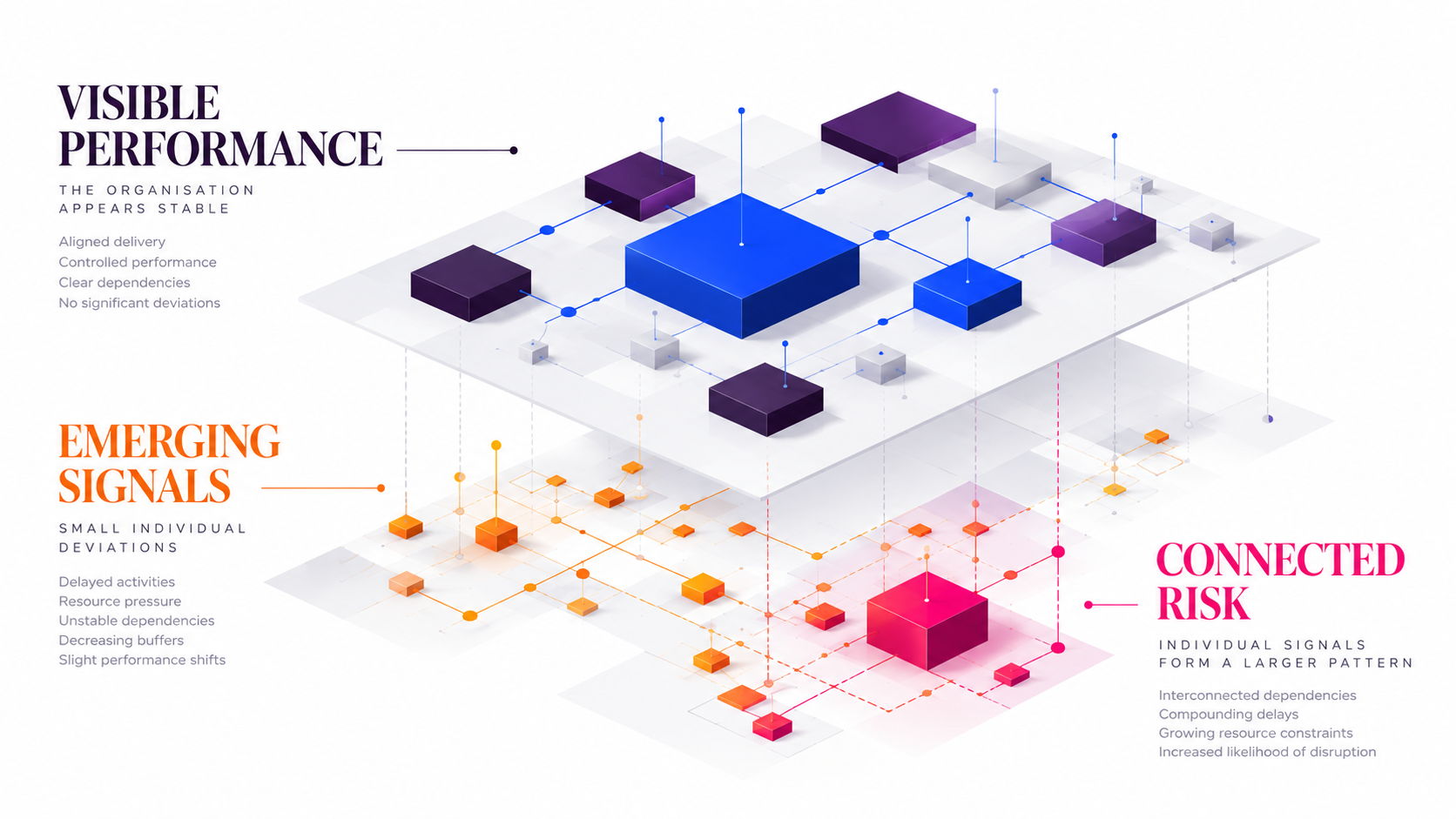
A leadership team relying exclusively on exception-based reporting may only react once the consequences become measurable. An organisation equipped to recognise early signals can investigate the underlying conditions sooner.
That distinction matters because organisational resilience is not built solely by responding well to problems. It is also built by recognising when problems are beginning to form.
The functional differentiation in the impact of reporting and early warning signs
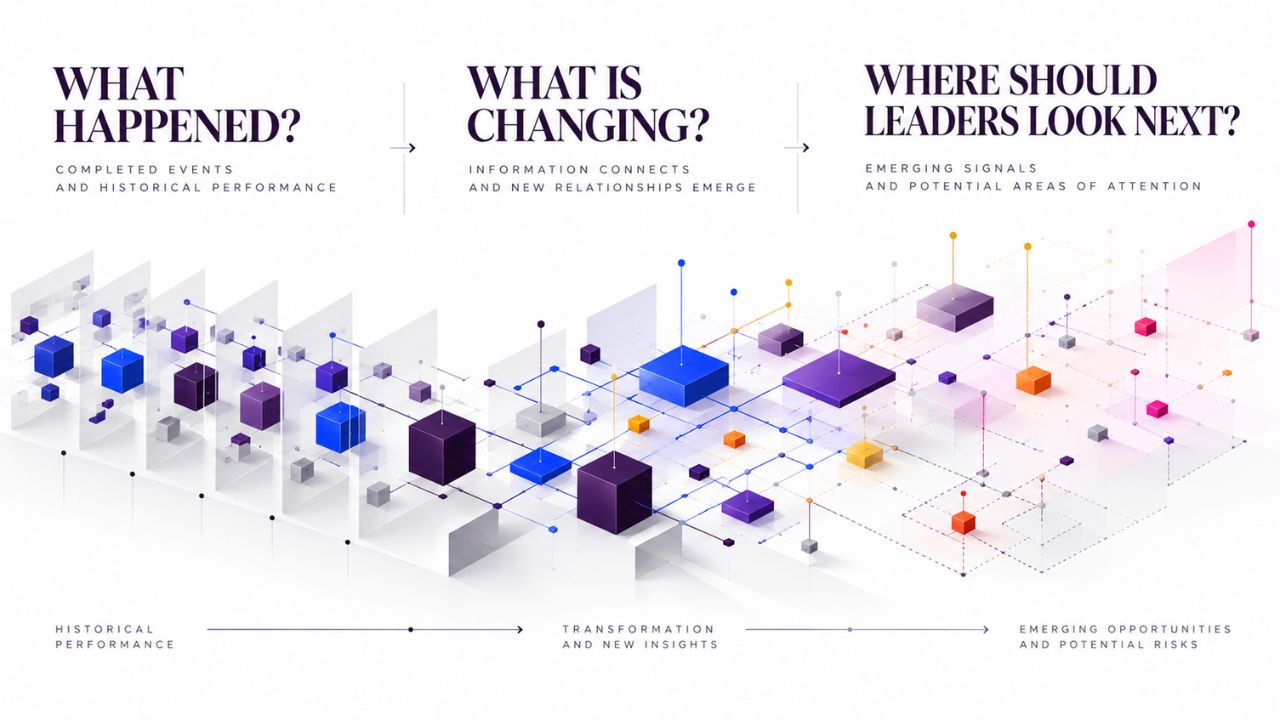
Performance reports and early warning systems serve related but different purposes. A performance report primarily answers:
What has happened, and how did we perform against expectations?
An early warning system asks:
What is changing, what could become a problem, and where should leadership pay attention next?
Both questions are necessary. The issue arises when organisations use historical performance reporting as a substitute for forward-looking management intelligence.
Research on corporate early warning systems has emphasised the importance of embedding early detection within ordinary management and control systems, rather than treating it as This has direct implications for how organisations approach performance management software.(science direct ; wiley online library)
The objective should not simply be to produce more reports. It should be to create a management environment where relevant changes become visible early enough to support meaningful action. This does not mean traditional reporting is obsolete. Historical data remains essential for understanding trends, evaluating outcomes, and maintaining accountability.
The difference lies in how that information is used. A report closes the loop on what happened. An early warning capability helps leadership decide what deserves attention before the next reporting cycle.
The hidden cost of waiting for thresholds to be breached
Thresholds are useful. They create consistency, clarify expectations, and help organisations determine when an issue requires escalation. But thresholds can also create a false sense of security.
If a KPI is green in the report, does that automatically mean the underlying business activity is healthy? Not necessarily. A performance indicator can remain within acceptable limits while the conditions supporting it deteriorate. A team may still deliver its targets by relying on overtime. A project may remain on schedule by consuming contingency resources. A department may maintain output while employee turnover quietly increases.This can create a performance picture that appears stable while the underlying conditions become increasingly fragile (Hubert, 1982)

The result is a performance picture that appears stable but may be becoming increasingly fragile.
Four costs of exception-only management
When leaders focus only on management by exception, they will face a set of downsides.
1. Delayed intervention
Leaders often become involved after an issue has already affected numerous factors. Corrective action then becomes more expensive and disruptive.
2. Fragmented accountability
When information is distributed across departments, each team may see only its own deviation. No one necessarily sees the relationship between multiple small signals.
3. Escalation fatigue
If reporting systems generate too many alerts without meaningful context, managers may struggle to distinguish urgent issues from routine fluctuations.
4. Reduced strategic capacity
Leadership time is consumed by investigating problems that could potentially have been identified earlier, leaving less attention for strategic priorities.
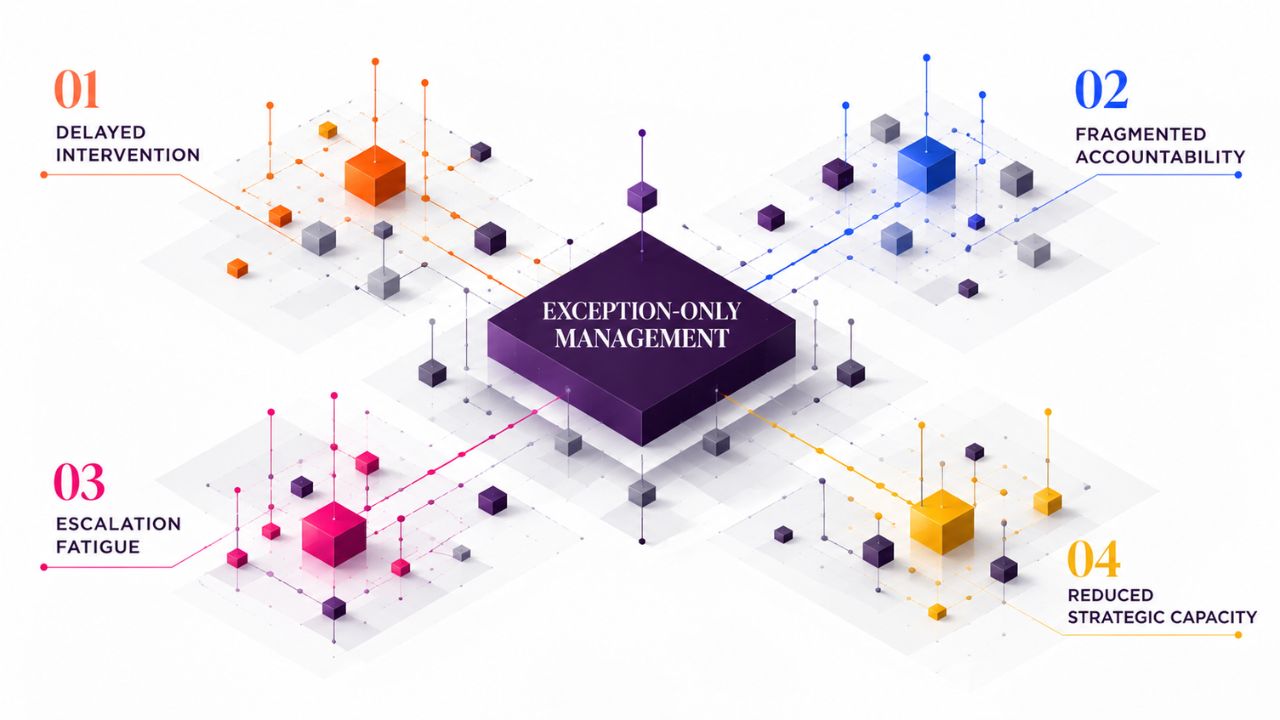
The underlying issue is not that management by exception is inherently flawed. It is that exception-based management becomes incomplete when it focuses only on outcomes and ignores the conditions producing them.
What does a modern business performance management software help leaders see?
The role of performance management software is evolving as organisations become more interconnected. For enterprise leaders, a platform's value should extend beyond displaying performance metrics. It should help connect operational information with management priorities, identify areas requiring attention, and support a more informed understanding of organisational performance.
This is particularly relevant for organisations operating across multiple business units, locations, and strategic initiatives which is a common reality for leadership teams across Germany, Austria, and Switzerland.
1. Trends, not just current status
A KPI's current value is only one part of its meaning. A metric showing 92% achievement could represent:
- Stable performance.
- A gradual decline from 98% over several months.
- Temporary improvement after a period of underperformance.
- The number is identical. The management implication is not.
Effective performance management should therefore allow leaders to examine movement over time rather than treating individual reporting periods as isolated events.
2. Relationships between operational signals
Business performance rarely depends on one metric. Project delays may be connected to resource constraints. Resource constraints may be linked to hiring delays. Hiring delays may affect strategic initiatives. Strategic delays may eventually influence revenue or customer commitments.
These relationships can be difficult to understand when information is separated across spreadsheets, departmental reports, and disconnected systems.
A more connected approach helps leaders examine performance in context.
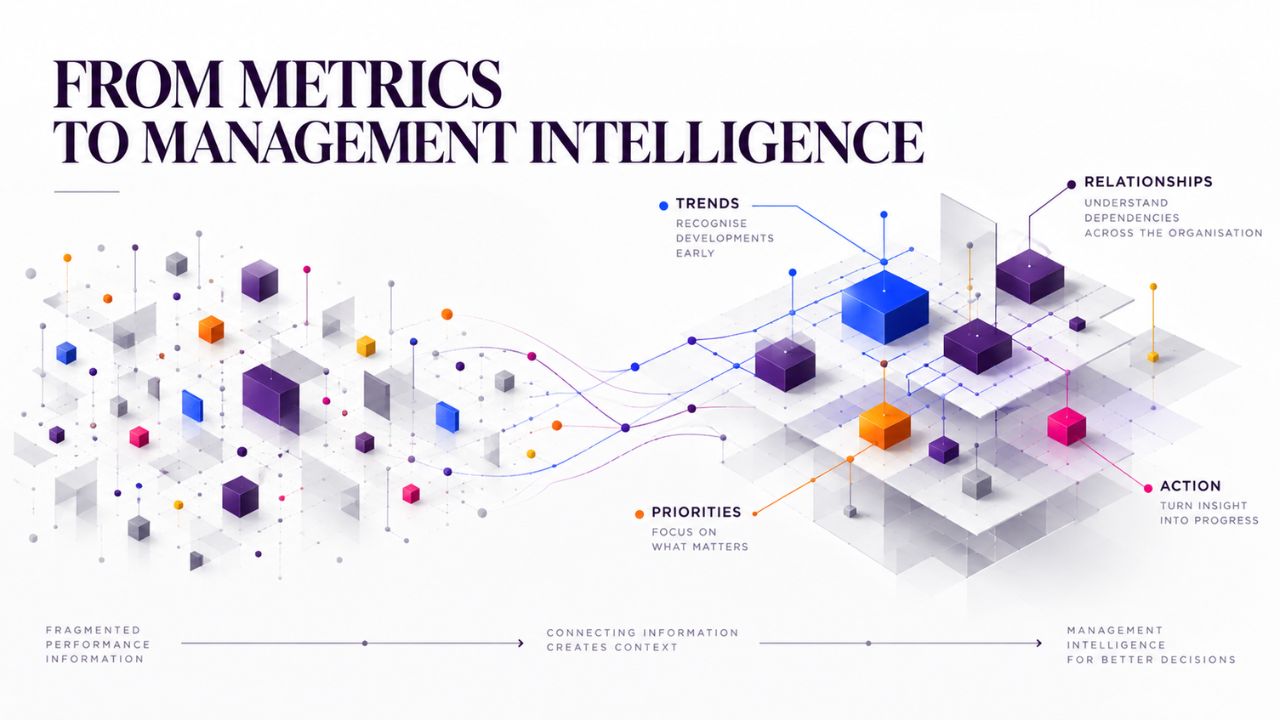
3. Prioritised attention
Not every deviation deserves executive intervention.
A small variance in a low-risk activity may require no action. A modest change affecting a critical strategic initiative may deserve immediate investigation.
The system should therefore support prioritisation based on business relevance and not simply numerical magnitude.
4. Actionable management context
Identifying a potential issue is only the beginning. Leaders also need to understand:
- What is affected?
- Why does it matter?
- Who owns the response?
- What decision is required?
- What could happen if no action is taken?
Without this context, even sophisticated analytics can leave management with more information but little clarity.
Where exactly does a KPI dashboard software fit and where it may fall short?
KPI dashboard software has become an essential part of modern business reporting. Well-designed dashboards provide a consolidated view of key performance indicators, making it easier for managers to monitor several aspects at different stages in a project. For organisations managing multiple performance dimensions, dashboards can reduce the effort involved in gathering information from different sources.
However, a dashboard is primarily a presentation layer. Its usefulness depends on the quality of the underlying data, the relevance of the selected KPIs, and the decisions leaders need to make. A dashboard showing that project costs have increased is useful. A management system that helps leaders understand which initiatives are affected. It also aids them to see what dependencies exist, and where intervention may be necessary is more valuable. This significantly becomes a tool for complex decision-making.
Dashboard visibility vs. management intelligence
|
|
|
|
|
|
|
|
|
|
|
|
|
|
|
|
|
|
|
|
|
|
|
|
The distinction is not about choosing dashboards or abandoning them. It is about recognising that visibility is most useful when it leads to understanding and action. For executive teams, the next generation of performance management requires more than attractive visualisations. It requires a connected view of organisational conditions.
Corporate performance management software: from reporting results to improving control
The broader category of corporate performance management software addresses organisational planning, performance monitoring, financial management, forecasting, and strategic alignment. Depending on the platform, these systems may support budgeting, planning, consolidation, financial analysis, and enterprise-level performance measurement.
They are particularly relevant when leadership needs to connect financial outcomes with corporate objectives. But early warning capabilities introduce another important consideration. It is that financial and strategic performance can be affected by operational developments that appear before they reach financial statements. This is why organisations should evaluate corporate performance management not only by its reporting capabilities, but also by how effectively it supports management awareness across operational and strategic dimensions.
A more complete corporate performance perspective
A mature performance management approach connects four layers:
1. Strategic Objectives
What the organisation is trying to achieve.
2. Performance Indicators
How progress and results are measured.
3. Operational Signals
What is changing under reported results?
4. Leadership Response
Where attention, decisions, or intervention are required.
This creates a more connected management cycle: objectives inform measurement, measurement reveals conditions, and conditions inform leadership action.
How does AgilityVisual support a more connected approach to business performance management?
For organisations seeking to move beyond fragmented reporting, AgilityVisual offers a relevant perspective on what performance management can become. Positioned as a Business Performance Management platform, AgilityVisual focuses on organisational control, operational visibility, and evidence-based leadership rather than treating software as an end in itself.
Its approach is particularly relevant to leaders who need a clearer understanding of how business activities connect across the organisation. Rather than asking leadership teams to manage every operational detail, the goal is to provide the context required to know where attention matters most. That distinction is important. The value of a connected performance platform is not simply that it produces more information. It is that it can help reduce the distance between an emerging operational concern and the leadership decision that addresses it.
For COOs, PMO leaders, and transformation executives, this means approaching performance management as an ongoing management capability not merely a monthly reporting exercise.
Building an early warning culture: what leaders can do now
Technology can improve visibility, but early warning systems also depend on how organisations manage information and respond to it. Leaders can begin by asking three practical questions.
1. What are we currently discovering too late?
Review recent operational problems and identify whether earlier signals existed.
Were there repeated delays? Increasing resource pressure? Unresolved dependencies? Declining engagement? Unexpected cost patterns?
The purpose is not to assign blame. It is to understand where the organisation's current reporting approach may be missing useful context.
2. Which signals deserve attention before they become exceptions?
Not every metric needs an alert.
Focus on indicators connected to strategic priorities, operational dependencies, critical resources, and material business risks.
The best early warning systems are selective. They help leaders concentrate on what matters rather than creating another stream of noise.
3. Can the right people act when a signal appears?
A warning without ownership is simply information.
Every meaningful signal should have a clear path towards interpretation, accountability, and action.
This is where management becomes as important as technology.
Research into early warning failures has repeatedly highlighted that recognising a signal does not automatically lead to effective action. Organisational structures, leadership awareness, and decision-making processes influence whether warnings result in timely intervention (Kletz & Mannan, 2021).
Better business performance management begins before the exception

Management by exception remains useful, but it should not be the only way leaders understand organisational performance. Waiting for targets to be missed or thresholds to be breached can leave organisations reacting to problems that were developing long before they became visible.
Modern business performance management software should help leadership teams connect results with context, recognise meaningful changes, and focus attention where it can make a difference.
If your organisation is ready to move beyond fragmented reports and build a more connected approach to operational control, AgilityVisual offers a platform designed around visibility, management capability, and evidence-based leadership.
Explore AgilityVisual and discover a clearer way to stay in control of organisational performance.
Visit AgilityVisual
References and further reading
Hubert, T. (1982). Developing effective corporate early warning systems. European Management Journal, 1(1), 49–56.
This article examines corporate early warning approaches and argues that their effectiveness depends on embedding them within normal management and control systems. ScienceDirect
Judd, P., Paddock, C., & Wetherbe, J. (1981). Decision impelling differences: An investigation of management by exception reporting. Information & Management, 4(5), 259–267.
The study examines how managers respond to different types of deviations and finds that absolute and percentage variations can influence exception-based decision-making differently. ScienceDirect
Kletz, T., & Mannan, S. (2021). Early warning signals noticed, but management doesn't act adequately or not at all: A brief analysis and direction of possible improvement. Journal of Loss Prevention in the Process Industries, 70, 104272.
The article examines situations where warning signals were available but did not result in timely management action, highlighting the importance of organisational structures, leadership awareness and decision-making. ScienceDirect
Ricketts, J. A., & Nelson, R. R. (1987). Management-by-exception reporting: An empirical investigation. Information & Management, 12(5), 235–246.
An empirical investigation into how decision-makers respond to exception reporting and different forms of performance deviation. ScienceDirect