
Structuration theory and its implications for management: Key take-aways for managers and working professionals
Contents
- Viewing strategy as a dynamic practice makes it possible to perceive and delve into dynamics that allow for better decision-making
- Strategy as Practice (SAP) is an organizational approach gaining popularity
- Structuration theory helps acknowledge the interplay between individual and structural factors underpinning choices
- Both individuals and the structure into which they are embedded matter in organizations
- Understanding this cycle is beneficial for conceptualizing and implementing successful managerial and strategic praxes
- It is not just (senior) management that shapes structures (and leads) but every single employee
- Strategy can only positively impact an organization when it is also reproduced from the bottom-up
- Too much structure can over-determine practice and thus make an organization rigid and inflexible
- Organizations can be shaped by shaping context, including norms, rituals and symbols
- Structuration theory is practice-based: in organizations, practice determines outcome
- Structuration Theory can be applied as a mental model in different areas including change management and leadership
- Structuration theory helps determine change momentum and speed
- References and further reading
Viewing strategy as a dynamic practice makes it possible to perceive and delve into dynamics that allow for better decision-making
“Management” and “strategy” are two broadly construed terms that have just as many definitions and understandings as they have manners of implementation. What unites much of how the two are understood is the conception - at least in traditional literature - that management and strategy are objects to be implemented. When looking at literature on organizational behaviour and change, the perception that management and strategy are processes, rather than objects, has long been established (see Barley’s seminal work from 1986).
Indeed, in any organization it makes sense to consider that all decisions are part of a broader framework and dynamic. In this sense, no action stands in isolation from another action and also not in isolation from its context. From a management perspective, this translates to the notion that strategy is a practice equipped with all sorts of implications and deeply embedded into context and processes within and outside organisations.
Strategy as Practice (SAP) is an organizational approach gaining popularity
What is termed “Strategy as Practice” has in recent years emerged as a distinctive research approach for studying management, decision-making and managerial work (Golsorkhi et al., 2010). Simply put, “It focuses on the micro-level social activities, processes and practices that characterize organizational strategy and strategizing. This provides not only an organisational perspective into strategy but also a strategic angle for examining the process of organizing”.
In other words, by viewing strategy and the act of strategizing as a dynamic process and practice, it becomes possible to uncover perspectives about management, behaviour and strategic decision-making that are often unaccounted for. This in turn brings the potential for a better understanding of these dynamics that can underpin more beneficial, all-encompassing choices within organisations.
Structuration theory helps acknowledge the interplay between individual and structural factors underpinning choices
There is a small body of literature that focuses on innovative approaches that investigate the relationships between actors, the contexts within which they operate, and the extent to which these dynamics facilitate or inhibit change. When considering the many processes and decisions that constitute an organization in the market realm, the question arises to what extent individuals within organisations can shape the sphere of activity of firms, and vice versa. In other words - does the agent determine structure, or does the structure determine agency? How do the two relate to each other and how does this help decision-making?
Gidden’s “Structuration Theory” seeks to provide a concrete theoretical framework to answer these questions and has long been invoked in organizational theory to explain and understand change (Whittington, 2015). In his seminal work, Giddens (1984) posits that structure and agency (so context and the actors within it) are interrelated and interdependent. Agents draw upon structures in the way they act and decide, and this very act constitutes, validates, and shapes the structure they engage with (Giddens, 1991).
Both individuals and the structure into which they are embedded matter in organizations
While this seems very abstract, the concept is very hands on: while in firms it is not only individuals who matter (managers, employees, etc) it is in equal amount the structure in which management is embedded (Elbasha & Wright, 2017). The choices made within firms are determined by organizational norms and rules, as well as by the context within which the firm operates. Norms, rules, and context are all constituted by the actors who engage in them and invoke them, meaning they gain validity and legitimacy - this in turn determines the choices made by individuals. The process of this dual relationship produces and reproduces itself on a continuous basis.
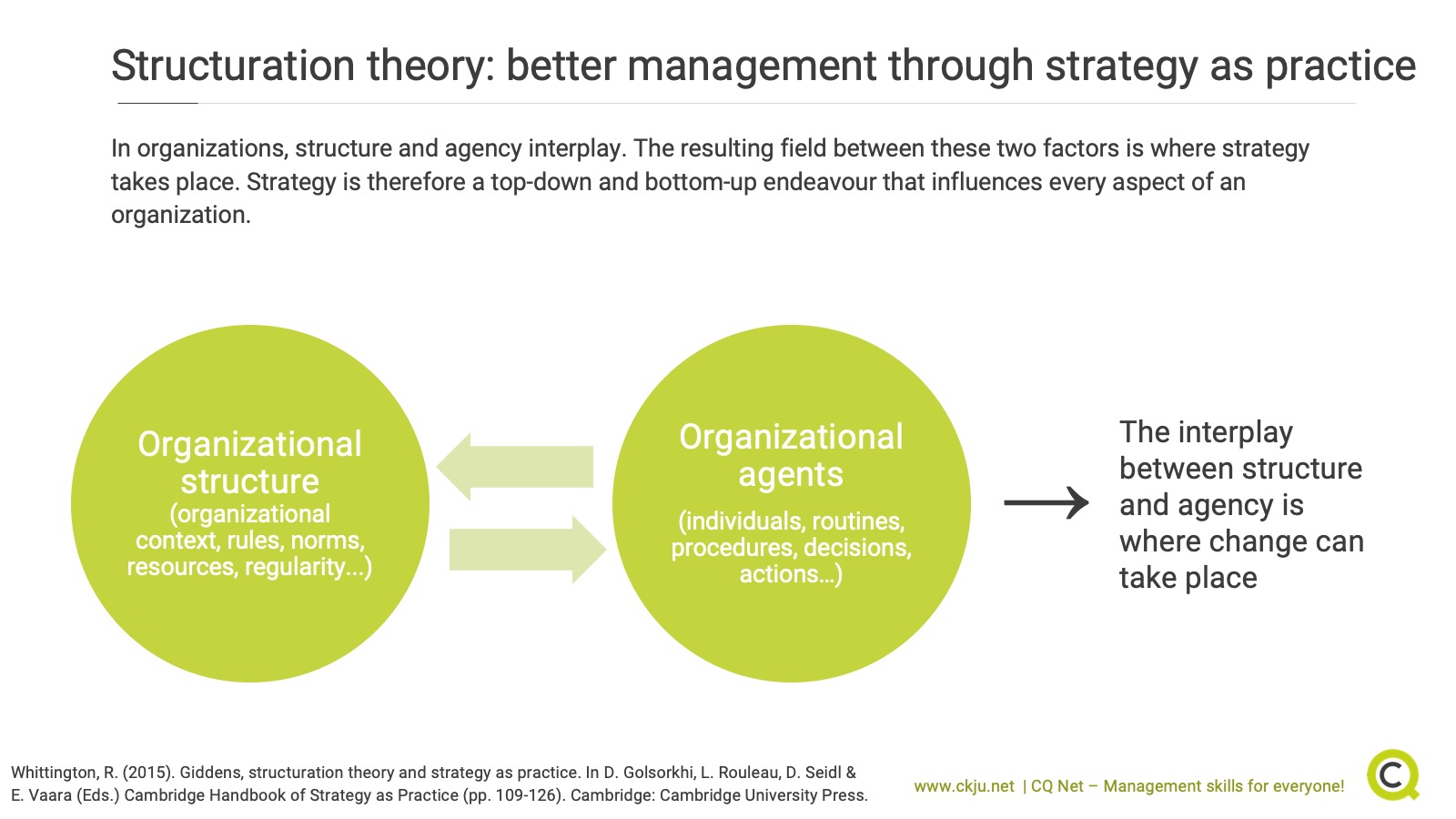
Understanding this cycle is beneficial for conceptualizing and implementing successful managerial and strategic praxes
How can the “Strategy as Practice” view infused with structuration theory help firms in their decision-making? Although the introduced concepts and use thereof remain largely in the theoretical realm, there are several scientific accounts of the benefits and insights associated with employing such an approach in management praxis.
Four major takeaways about social systems in firms and the practices within them are particularly beneficial:
It is not just (senior) management that shapes structures (and leads) but every single employee
By acknowledging that structure and agency are interwoven (what Giddens calls “the duality of structure”), one finds that structure does not determine conduct by itself, but that actors are vital in shaping and constituting it. Indeed, Heracleous (2013) points out that structuration theory is useful in organizational discourse and communication precisely because it accounts for the practical consciousness of agents which sustain organizations and give rise to institutional norms (Heracleous, 2013). Indeed, not only key decision-makers but everyone within an organization can make a difference that is crucial in shaping the organisation as a whole.
Strategy can only positively impact an organization when it is also reproduced from the bottom-up
Acknowledging "Strategy as Practice" makes it possible to construe strategic decisions in light of this interwovenness. Hence it becomes possible to permeate change and success through dynamic practices and processes laid out to target multiple levels, groups, and considerations. However, it also means acknowledging that strategy does not travel from the top-down solely from individuals in managerial positions to employees. Rather, it involves a considerable amount of maintenance and reproduction from the bottom-up and within organizational relations, which help stabilize firms and yield sustainable outcomes (Jarzabkowski, 2005).
Too much structure can over-determine practice and thus make an organization rigid and inflexible
Employing a structuration theory view of management helps enshrine the need for critical observation, improved communication, and also engrains organizational flexibility. By observing the dynamics that govern and alter organisations, it becomes possible to understand and make informed decisions about the effects of agency and structure, respectively (Jones, 2005). In this vein, organizational learning, intelligence and communication can be scrutinized, adapted, and help generate a form of foresight. Flexible organizational routines are persistent and highly effective and are often more sustainable than rigid routines (Howard-Grenville, 2005).
Organizations can be shaped by shaping context, including norms, rituals and symbols
Within this perspective, the door is opened for the consideration of a breadth of topics not often explicitly found in managerial considerations. These include questions of symbolism, rituals, power, intentionality, practical and discursive consciousness and the way in which rules and norms are legitimized (Marietto, Ribeiro & Serra, 2016). Investigating these dynamics can contribute to organisations staying true to their ideals also in practice, and to understanding and nurturing a healthy organizational culture.
Structuration theory is practice-based: in organizations, practice determines outcome
Taking an approach based on structuration theory touches on complex concepts and interactions that constitute the discourses within and around organisations. Adopting a “Strategy as Practice” approach that considers these discourses makes it possible to focus on the means that lead to beneficial outcomes, rather than only the beneficial end. Several discursive practices have been identified that help daily management, employer-employee relations, as well as stakeholder relations.
In our literature review on change interventions, we find that leadership taking account Giddens’ dynamics opens the path for new interventions to success: it is vital to use language and negotiations for shaping social reality and constructing a mutually beneficial partnership with stakeholders, motivating and emancipating employees through supportive environments, goals and autonomous motivating, and leading based on contextual, inspirational and intellectual considerations. These approaches can be summarized as broader attempts to integrate "Strategy as Practice" in organizational discourses, which in turn determine the outcome and relative success of and within a firm.
Structuration Theory can be applied as a mental model in different areas including change management and leadership
From a practical perspective, structuration theory and its application in the "Strategy as Practice" approach encourages us to always look behind routines, behaviors, and rituals to determine their structural foundation. Of course, we can also ask the questions the other way round: How do practices reproduce structures? Effective change interventions have to take both structure and practice into consideration.
More specifically, a vision, mission, and strategy can be a set of documents, graphics, slides or any other persistent structure. In order to shape the future of an organization, those structures have to be regularly applied in daily business. This could be in form of town hall meeting, strategy reviews, newsletters, lunch & learn sessions, or any other form of practice of reproduction.
Structuration theory helps determine change momentum and speed
Structuration theory also informs us about thresholds of change momentum and speed. Structures facilitate and enable practice. The higher the change momentum, the more pressure is put on established structures to change them instead of to simply reproduce them. In practice, effectively managing change requires reflection on how much change momentum is required to develop an organization into the desired direction. Of course, less change momentum - and thus less pressure to change structures - has a stabilizing effect on an organization. However, if an organization is truly in jeopardy for any reason, decisive actions are needed, established structures have to be questioned, and new structures must established and embedded in organizational practices.