
Why deviation management is an important leadership skill
Contents
What does deviation management mean?
Deviation management describes the structured handling of differences between target and actual status. This is not just about errors, but about any relevant deviation from defined targets, standards or expectations.
Typical examples are
- Sales below plan
- Delayed deadlines in projects
- Quality defects
- increasing complaint rates
- Budget overruns
- declining employee satisfaction
- inefficient processes
The task of managers is not only to document these deviations, but also to understand the causes and initiate effective countermeasures, track their implementation and validate their effectiveness;
First and foremost, this requires that the target and actual status be visualized so that deviations become visible. This goes hand in hand with the need to explicitly address, agree on and ultimately visualize implicit expectations that are not anchored in the company as the desired target state. An important role here is played by the Management of expectations.
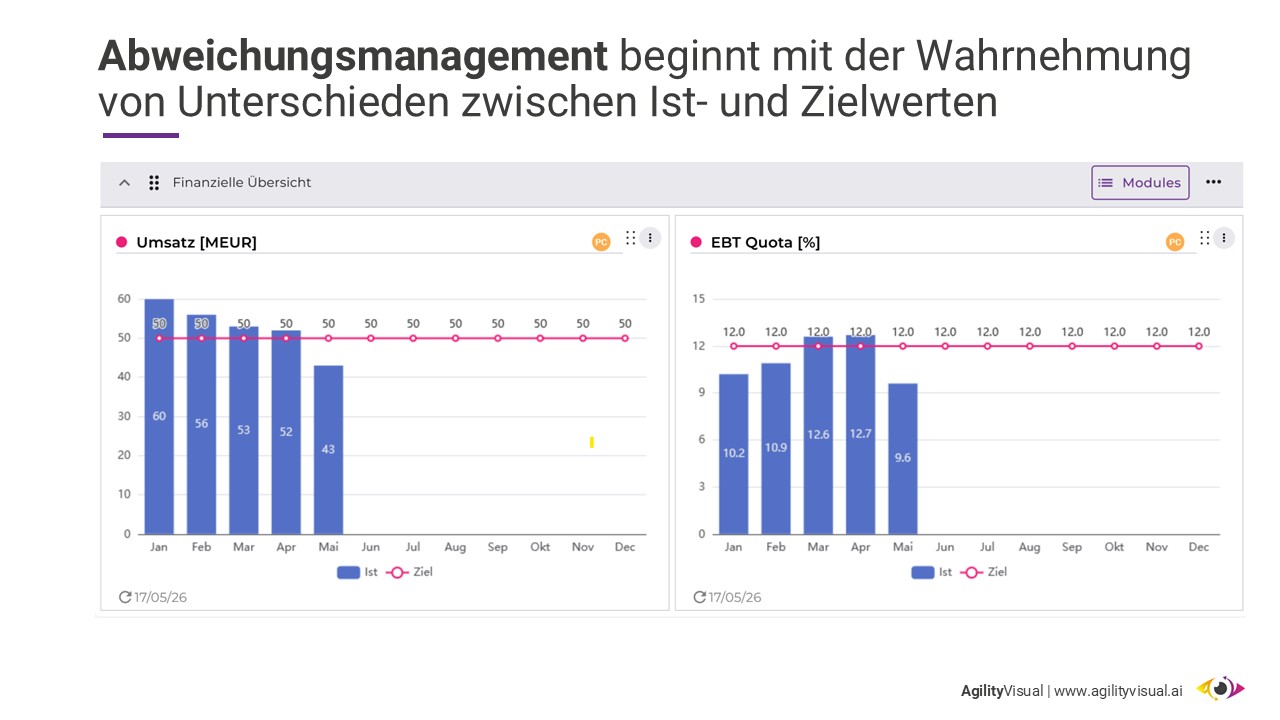
Why deviation management is crucial for managers
Management work is primarily aimed at making the right interventions in order to achieve corporate goals in the sense of target-oriented influence. Consistent deviation management is an important part of this management work. Managers who take this task seriously make an important contribution to improving company performance. What are the other benefits of consistent deviation management?
Early detection instead of crisis mode
Many problems do not arise suddenly. They develop gradually. Small deviations are ignored until they develop into operational or strategic crises. Professional deviation management creates transparency and enables early intervention. This gives managers room to maneuver before risks escalate. A high degree of situational awareness makes an important contribution to recognizing and understanding deviations at an early stage and assessing their development over time.
Faster decision-making
Leadership must not be based on gut feeling, but on hard, evaluated, reliable and validated facts. This requires the target and actual status to be made measurable accordingly and to be evaluated over the time axis in a short cycle with regard to deviations. It is also essential that the stakeholders in the organization share the same understanding of the actual and target values and their definition. This ensures that decisions are made quickly and on the basis of facts.
Higher process and result quality
Recurring errors cost companies time, money and trust. However, often only symptoms are treated, not the actual causes. In line with the motto "heroes are born in fire", many companies celebrate the short-term success of having solved the problem, but neglect to put a sustainable stop to the deviation. This is especially true when managers force and reinforce this behavior through appropriate interventions. Effective deviation management focuses on structured problem and root cause analysis, sustainable corrective measures and downstream process confirmation.
Strengthening responsibility and leadership culture
Companies with a weak error culture tend to conceal problems or pass on responsibility. Good deviation management, on the other hand, creates open communication, clear responsibilities, constructive problem-solving and a learning culture instead of apportioning blame. An important prerequisite for this is a high degree of psychological safety. This is linked to the willingness of your team members to take risks when deviations are addressed;
The most common errors in deviation management
At the beginning of every deviation management Definition of target and target values . Even if this may sound obvious at first, it is not always guaranteed. Furthermore, it is not enough to define target and target values. Only when these are accepted by the most important stakeholder groups can they be used as the basis for deviation management.
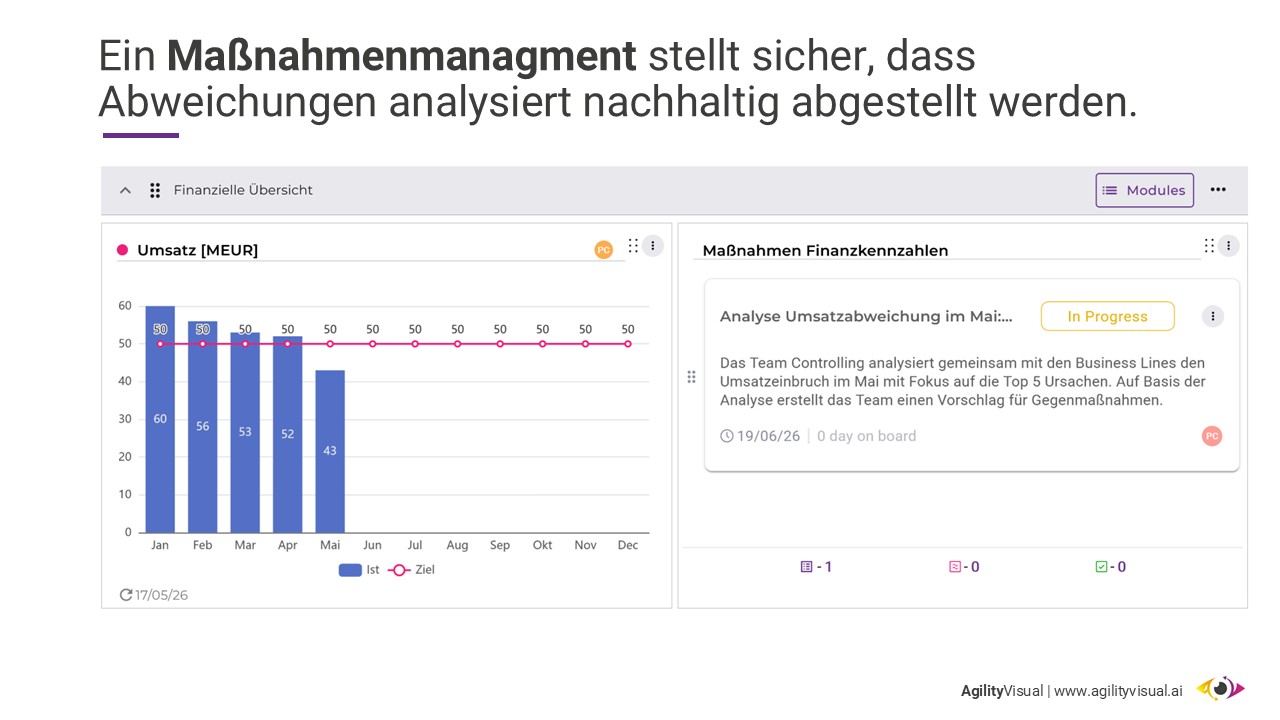
Many companies have a large number of reports and key figures. However, these are usually available in different systems and documents, meaning that there is no integrated and standardized business performance management. This is accompanied by a low level of situational awareness, which means that Deviations not noticed or noticed too late become.
As soon as a deviation has been identified, it must be analyzed as quickly as possible so that appropriate countermeasures can be implemented. This requires a consistent action management with clear responsibilities . In many companies, the management of measures is not directly linked to the deviation. As a result, the relevance and context of the measures are not clear and there is a risk of losing focus.
Companies that systematically analyze and consistently manage deviations create the basis for sustainable success. For managers, deviation management is therefore not a secondary task but a central component of modern corporate management.